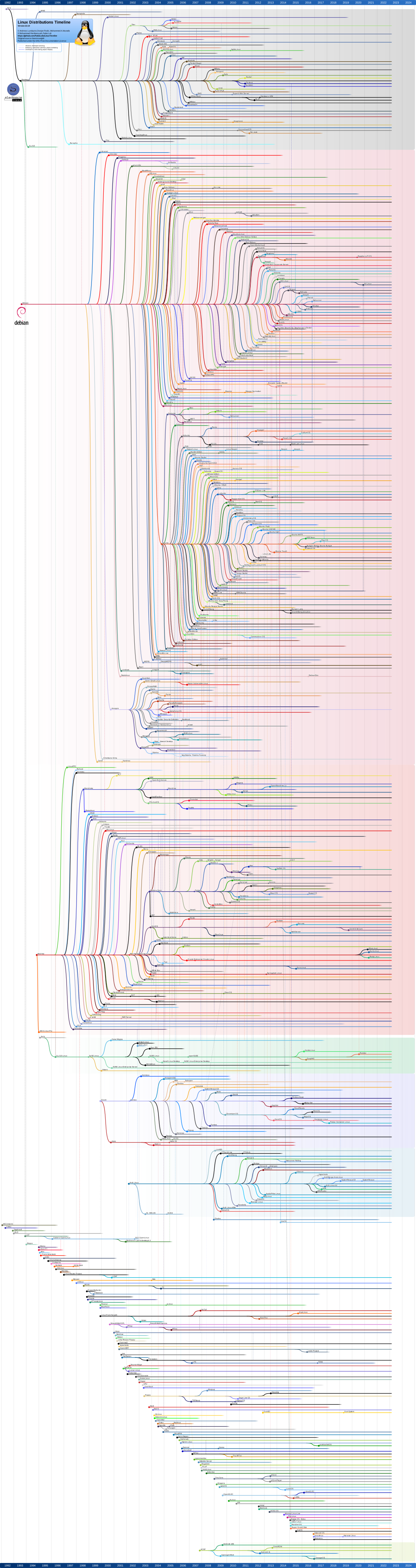
Yes, and the problem is compounded by the fact that there are many
distros, each of which have a cult following.
A businessman can't simply choose "linux". He must also subscribe to a particular distro.
There is NO LINUX operating system.
There are hundreds of linux "distros", much like feuding christian
churches with all the myriad of branches, cults etc.
I don't see any way for linux to ever become a mainstream computer
operating system the way it is now.
CrudeSausage <crude@sausa.ge> news:m2cPQ.1135083$k_17.986417@fx10.iad Fri,
07 Nov 2025 01:36:18 GMT in comp.os.linux.advocacy, wrote:
On 2025-11-06 6:01 p.m., Gremlin wrote:
CrudeSausage <crude@sausa.ge> news:kdUOQ.647349$6_hb.597960@fx46.iad
Thu, 06 Nov 2025 03:02:39 GMT in comp.os.linux.advocacy, wrote:
So, what is your general assessment of Apple products, at least on the >>>> repair side of things?
They go out of their way to make some repairs difficult if not
impossible. Serializing specific chips on the mainboard for example.
It's completely anti consumer. imo.
Completely agreed. I am not sure how true this is, but apparently you're
not going to be able to replace a MacBook's panel if it cracks for that
very reason. I can't imagine what kind of a zealot one would need to be
to defend a corporation's prohibition of you being able to replace the
panel. I needed to replace it on my old Sony Vaio, and I am glad that
the company didn't stand in my way of doing so.
It depends on the panel and specific model. They didn't serialize all of them, but, some are yea. I think they initially didn't serialize them,
but, enough of us were able to fix machines that Apple decided they should
go ahead and do that too. The last one I checked, the little board that's actually on the panel is responsible. So far, I haven't been able to get around it. Apple and their proprietary snarky shit. Yet, so many people
love the company and their devices.
If they knew what assholes the founders were, just like Bill Gates when he founded Microsoft - maybe? they wouldn't be so willing to open their
wallets. I sometimes think Apple people could be sold a polished turd.
On Fri, 7 Nov 2025 17:47:24 -0600, Hank Rogers wrote:
Yes, and the problem is compounded by the fact that there are many
distros, each of which have a cult following.
No such thing. It is easy to move between them, since they are all built
on common foundations anyway. The variations are mostly in things that are easy to adapt to, or differences in philosophy that have little or no
impact on interoperability.
A businessman can't simply choose "linux". He must also subscribe to a
particular distro.
Try your objection in a different context: ?the problem with buying a car
is compounded by the fact that there are many makes and models, each of
which has a cult following. A businessman can?t simply choose ?a car?, he must also subscribe to a particular make and model.?
On Fri, 7 Nov 2025 17:47:24 -0600, Hank Rogers wrote:
Yes, and the problem is compounded by the fact that there are many
distros, each of which have a cult following.
No such thing. It is easy to move between them, since they are all built
on common foundations anyway. The variations are mostly in things that are easy to adapt to, or differences in philosophy that have little or no
impact on interoperability.
A businessman can't simply choose "linux". He must also subscribe to a
particular distro.
Try your objection in a different context: ?the problem with buying a car
is compounded by the fact that there are many makes and models, each of
which has a cult following. A businessman can?t simply choose ?a car?, he must also subscribe to a particular make and model.?
Now try the conclusion you were trying to claim: ?I don?t see any way for cars to ever become a mainstream form of transport.?
See how nonsensical that is?
Open Source is all about choice.
There is NO LINUX operating system.
Yes there is <https://github.com/torvalds/linux>.
There are hundreds of linux "distros", much like feuding christian
churches with all the myriad of branches, cults etc.
Lots of people use or support multiple distros. ?Distro-hopping? is a
common thing. Imagine if your religions allowed adherents to freely move between different faiths ...
I don't see any way for linux to ever become a mainstream computer
operating system the way it is now.
I?ve got news for you: most of your Windows/Apple machines are essentially being used for passive consumption of content. And most of that content
comes from ... Linux machines!
Lawrence D?Oliveiro wrote on 11/7/2025 1:53 PM:
On Fri, 7 Nov 2025 13:21:00 +0100, Carlos E.R. wrote:
On 2025-11-07 01:42, Hank Rogers wrote:
Lawrence D?Oliveiro wrote on 11/6/2025 3:24 PM:
On Thu, 6 Nov 2025 12:15:58 +0100, Carlos E.R. wrote:
Linux greedy? It is free and gratis!
Some of us make a living from it.
Thanks.ÿ That explains a lot.ÿ Good luck and hope you succeed selling
linux.
It is not about selling Linux, although you can.
There is also ?selling? in the metaphorical sense, as in convincing
customers that Linux is the safest platform to bet their business on, not
just in terms of its capabilities to deal with the problems they are
handling today, as its potential to adapt to ones they are likely to
encounter in the future, both foreseeable and unforeseeable.
Yes, and the problem is compounded by the fact that there are many distros, each of which have a cult following.? A businessman can't simply choose "linux".? He must also subscribe to a particular distro.
There is NO LINUX operating system.? There are hundreds of linux "distros",? much like feuding christian churches with all the myriad of branches, cults etc.
I don't see any way for linux to ever become a mainstream computer operating system the way it is now.? You must pick a particular cult and worship it.? That's nutz!
On Nov 7, 2025 at 2:23:24?PM MST, "Gremlin" wrote <XnsB390A6BAD820AHT1@cF04o3ON7k2lx05.lLC.9r5>:
CrudeSausage <crude@sausa.ge> news:m2cPQ.1135083$k_17.986417@fx10.iad Fri, >> 07 Nov 2025 01:36:18 GMT in comp.os.linux.advocacy, wrote:
On 2025-11-06 6:01 p.m., Gremlin wrote:
CrudeSausage <crude@sausa.ge> news:kdUOQ.647349$6_hb.597960@fx46.iad
Thu, 06 Nov 2025 03:02:39 GMT in comp.os.linux.advocacy, wrote:
So, what is your general assessment of Apple products, at least on the >>>>> repair side of things?
They go out of their way to make some repairs difficult if not
impossible. Serializing specific chips on the mainboard for example.
It's completely anti consumer. imo.
Completely agreed. I am not sure how true this is, but apparently you're >>> not going to be able to replace a MacBook's panel if it cracks for that
very reason. I can't imagine what kind of a zealot one would need to be
to defend a corporation's prohibition of you being able to replace the
panel. I needed to replace it on my old Sony Vaio, and I am glad that
the company didn't stand in my way of doing so.
It depends on the panel and specific model. They didn't serialize all of
them, but, some are yea. I think they initially didn't serialize them,
but, enough of us were able to fix machines that Apple decided they should >> go ahead and do that too. The last one I checked, the little board that's
actually on the panel is responsible. So far, I haven't been able to get
around it. Apple and their proprietary snarky shit. Yet, so many people
love the company and their devices.
If something served me better for less money I would love it.
If they knew what assholes the founders were, just like Bill Gates when he >> founded Microsoft - maybe? they wouldn't be so willing to open their
wallets. I sometimes think Apple people could be sold a polished turd.
Stallman is a saint, eh? LOL!
Use what you like. Let others do so, too. No need to attack or belittle.
In your case you do it because you do not understand the value of the different choices. You are not very good with using tech. Even with Linux you get confused between distros and DEs:
----------------------------------------------------------------------
* Gremlin was so ignorant of Linux he thought I was saying a DE
and distro are the same.
<http://techrights.org/TechBytes/techbytes0056.mp3>
? At 9:54 I make it clear when I am speaking of a specific
issue with KDE I am speaking of how it is on one specific
distro by default. It is absolutely clear I know the DE and
the distro are not the same.
? At 12:15 I again speak of how I am referencing KDE on one
distro as it comes by default, and how I realize the
defaults can be changed, and how it is different on other
distros.
? At 30:50 or so I speak about how you are using not just a DE
(KDE, specifically) but a distro, and the distro is a lot
more than just the DE.
Yet you concluded:
<XnsACDA1EDB99E5CHT1@1k.r4QzV.C>:
-----
Snit is evidently unaware of the fact the distro itself and the DE
are not one in the same thing.
-----
----------------------------------------------------------------------
...
Lawrence D?Oliveiro wrote on 11/7/2025 6:08 PM:
On Fri, 7 Nov 2025 17:47:24 -0600, Hank Rogers wrote:
Yes, and the problem is compounded by the fact that there are many
distros, each of which have a cult following.
No such thing. It is easy to move between them, since they are all built
on common foundations anyway. The variations are mostly in things that
are
easy to adapt to, or differences in philosophy that have little or no
impact on interoperability.
A businessman can't simply choose "linux".ÿ He must also subscribe to a
particular distro.
Try your objection in a different context: ƒ??the problem with buying
a car
is compounded by the fact that there are many makes and models, each of
which has a cult following. A businessman canƒ??t simply choose ƒ??a
carƒ??, he
must also subscribe to a particular make and model.ƒ??
Now try the conclusion you were trying to claim: ƒ??I donƒ??t see any
way for
cars to ever become a mainstream form of transport.ƒ??
See how nonsensical that is?
Open Source is all about choice.
There is NO LINUX operating system.
Yes there is <https://github.com/torvalds/linux>.
There are hundreds of linux "distros", much like feuding christian
churches with all the myriad of branches, cults etc.
Lots of people use or support multiple distros. ƒ??Distro-hoppingƒ?? is a
common thing. Imagine if your religions allowed adherents to freely move
between different faiths ...
I don't see any way for linux to ever become a mainstream computer
operating system the way it is now.
Iƒ??ve got news for you: most of your Windows/Apple machines are
essentially
being used for passive consumption of content. And most of that content
comes from ... Linux machines!
We can all agree that linus torvalds is GOD.
Amen brother.
Brock McNuggets wrote on 11/7/2025 6:29 PM:
On Nov 7, 2025 at 2:23:24ƒ??PM MST, "Gremlin" wrote
<XnsB390A6BAD820AHT1@cF04o3ON7k2lx05.lLC.9r5>:
CrudeSausage <crude@sausa.ge> news:m2cPQ.1135083$k_17.986417@fx10.iad Fri, >>> 07 Nov 2025 01:36:18 GMT in comp.os.linux.advocacy, wrote:
On 2025-11-06 6:01 p.m., Gremlin wrote:
CrudeSausage <crude@sausa.ge> news:kdUOQ.647349$6_hb.597960@fx46.iad >>>>> Thu, 06 Nov 2025 03:02:39 GMT in comp.os.linux.advocacy, wrote:
So, what is your general assessment of Apple products, at least on the >>>>>> repair side of things?
They go out of their way to make some repairs difficult if not
impossible. Serializing specific chips on the mainboard for example. >>>>> It's completely anti consumer. imo.
Completely agreed. I am not sure how true this is, but apparently you're >>>> not going to be able to replace a MacBook's panel if it cracks for that >>>> very reason. I can't imagine what kind of a zealot one would need to be >>>> to defend a corporation's prohibition of you being able to replace the >>>> panel. I needed to replace it on my old Sony Vaio, and I am glad that
the company didn't stand in my way of doing so.
It depends on the panel and specific model. They didn't serialize all of >>> them, but, some are yea. I think they initially didn't serialize them,
but, enough of us were able to fix machines that Apple decided they should >>> go ahead and do that too. The last one I checked, the little board that's >>> actually on the panel is responsible. So far, I haven't been able to get >>> around it. Apple and their proprietary snarky shit. Yet, so many people
love the company and their devices.
If something served me better for less money I would love it.
If they knew what assholes the founders were, just like Bill Gates when he >>> founded Microsoft - maybe? they wouldn't be so willing to open their
wallets. I sometimes think Apple people could be sold a polished turd.
Stallman is a saint, eh? LOL!
Use what you like. Let others do so, too. No need to attack or belittle.
In your case you do it because you do not understand the value of the
different choices. You are not very good with using tech. Even with Linux you
get confused between distros and DEs:
----------------------------------------------------------------------
* Gremlin was so ignorant of Linux he thought I was saying a DE
and distro are the same.
<http://techrights.org/TechBytes/techbytes0056.mp3>
ƒ?› At 9:54 I make it clear when I am speaking of a specific
issue with KDE I am speaking of how it is on one specific
distro by default. It is absolutely clear I know the DE and
the distro are not the same.
ƒ?› At 12:15 I again speak of how I am referencing KDE on one
distro as it comes by default, and how I realize the
defaults can be changed, and how it is different on other
distros.
ƒ?› At 30:50 or so I speak about how you are using not just a DE
(KDE, specifically) but a distro, and the distro is a lot
more than just the DE.
Yet you concluded:
<XnsACDA1EDB99E5CHT1@1k.r4QzV.C>:
-----
Snit is evidently unaware of the fact the distro itself and the DE
are not one in the same thing.
-----
----------------------------------------------------------------------
...
Say, is red hat a "distro" or is it a "DE"?
I used it many many years ago. It was probably before distos and de's
were invented.
And exactly what the hell is a DE? People yammer on and on about
distros, but I haven't seen DEs mentioned much. Are they new?
Say, is red hat a "distro" or is it a "DE"?
But if you buy a Toyota the whole system is designed to work as a
system... at least for the most part. You do not have one door working
one way and another working in a different arbitrary way.
Desktop Linux does have that as a bit of a challenge.
A Lenovo web page has this to say:
"What?s the difference between Linux Kernel and Linux OS?
The Kernel is the core component of a computer's operating
system, responsible for directly managing hardware resources such
as the CPU, memory, and input/output devices. It acts as a bridge
between the hardware and software, ensuring that applications can
access hardware resources efficiently and safely.
On the other hand, the operating system (OS) encompasses the
Kernel along with additional features like applications, user
interfaces, and various tools.
We can all agree that linus torvalds is GOD.
On 08 Nov 2025 00:33:45 GMT, Brock McNuggets wrote:
But if you buy a Toyota the whole system is designed to work as a
system... at least for the most part. You do not have one door working
one way and another working in a different arbitrary way.
Funny you should mention that. The first Toyota that I owned, I got hold
of the user manual, which covered both the hatchback version that I had,
and a different model. And reading through the instructions, it happened
to mention that, to lock/unlock the door, you turned the key in the lock
one way on my model, and the opposite way in the other model.
Desktop Linux does have that as a bit of a challenge.
Choice is bad! Somebody should force the fans of Open Source to choose not to have a choice ...
On 2025-11-08, Hank Rogers <Hank@nospam.invalid> wrote:
Brock McNuggets wrote on 11/7/2025 6:29 PM:
On Nov 7, 2025 at 2:23:24ƒ??PM MST, "Gremlin" wrote
<XnsB390A6BAD820AHT1@cF04o3ON7k2lx05.lLC.9r5>:
CrudeSausage <crude@sausa.ge> news:m2cPQ.1135083$k_17.986417@fx10.iad Fri, >>>> 07 Nov 2025 01:36:18 GMT in comp.os.linux.advocacy, wrote:
On 2025-11-06 6:01 p.m., Gremlin wrote:
CrudeSausage <crude@sausa.ge> news:kdUOQ.647349$6_hb.597960@fx46.iad >>>>>> Thu, 06 Nov 2025 03:02:39 GMT in comp.os.linux.advocacy, wrote:
So, what is your general assessment of Apple products, at least on the >>>>>>> repair side of things?
They go out of their way to make some repairs difficult if not
impossible. Serializing specific chips on the mainboard for example. >>>>>> It's completely anti consumer. imo.
Completely agreed. I am not sure how true this is, but apparently you're >>>>> not going to be able to replace a MacBook's panel if it cracks for that >>>>> very reason. I can't imagine what kind of a zealot one would need to be >>>>> to defend a corporation's prohibition of you being able to replace the >>>>> panel. I needed to replace it on my old Sony Vaio, and I am glad that >>>>> the company didn't stand in my way of doing so.
It depends on the panel and specific model. They didn't serialize all of >>>> them, but, some are yea. I think they initially didn't serialize them, >>>> but, enough of us were able to fix machines that Apple decided they should >>>> go ahead and do that too. The last one I checked, the little board that's >>>> actually on the panel is responsible. So far, I haven't been able to get >>>> around it. Apple and their proprietary snarky shit. Yet, so many people >>>> love the company and their devices.
If something served me better for less money I would love it.
If they knew what assholes the founders were, just like Bill Gates when he >>>> founded Microsoft - maybe? they wouldn't be so willing to open their
wallets. I sometimes think Apple people could be sold a polished turd.
Stallman is a saint, eh? LOL!
Use what you like. Let others do so, too. No need to attack or belittle. >>>
In your case you do it because you do not understand the value of the
different choices. You are not very good with using tech. Even with Linux you
get confused between distros and DEs:
----------------------------------------------------------------------
* Gremlin was so ignorant of Linux he thought I was saying a DE
and distro are the same.
<http://techrights.org/TechBytes/techbytes0056.mp3>
ƒ?› At 9:54 I make it clear when I am speaking of a specific
issue with KDE I am speaking of how it is on one specific
distro by default. It is absolutely clear I know the DE and
the distro are not the same.
ƒ?› At 12:15 I again speak of how I am referencing KDE on one
distro as it comes by default, and how I realize the
defaults can be changed, and how it is different on other
distros.
ƒ?› At 30:50 or so I speak about how you are using not just a DE
(KDE, specifically) but a distro, and the distro is a lot
more than just the DE.
Yet you concluded:
<XnsACDA1EDB99E5CHT1@1k.r4QzV.C>:
-----
Snit is evidently unaware of the fact the distro itself and the DE >>> are not one in the same thing.
-----
----------------------------------------------------------------------
...
Say, is red hat a "distro" or is it a "DE"?
I used it many many years ago. It was probably before distos and de's
were invented.
And exactly what the hell is a DE? People yammer on and on about
distros, but I haven't seen DEs mentioned much. Are they new?
Redhat is indeed a Linux distribution like Ubuntu, LinuxMint and so forth.
A distribution is a complete packaging of Linux and it's applications and in relation to Windows or OSX it's kind of like an operating system in itself. That is technically incorrect but think of a distribution as the entire Linux software "experience" for lack of a better term.
So you install a distribution and move on to customization from that
point on.
A DE is a desktop environment.
Basically it is a GUI which provides the interface, widgets, a window manager and so forth for the user to interact with.
Think of it like changing the look and feel of a Windows desktop.
The DE differences are that some are eye candy loaded and others are lean
and mean which means they are good for lower powered computers.
There is literally something for everyone WRT Linux.
On 2025-11-07 19:44, Hank Rogers wrote:
Lawrence D?Oliveiro wrote on 11/7/2025 6:08 PM:
On Fri, 7 Nov 2025 17:47:24 -0600, Hank Rogers wrote:
Yes, and the problem is compounded by the fact that there are many
distros, each of which have a cult following.
No such thing. It is easy to move between them, since they are all built >>> on common foundations anyway. The variations are mostly in things that
are
easy to adapt to, or differences in philosophy that have little or no
impact on interoperability.
A businessman can't simply choose "linux". He must also subscribe to a >>>> particular distro.
Try your objection in a different context: ƒ??the problem with buying
a car
is compounded by the fact that there are many makes and models, each of
which has a cult following. A businessman canƒ??t simply choose ƒ??a
carƒ??, he
must also subscribe to a particular make and model.ƒ??
Now try the conclusion you were trying to claim: ƒ??I donƒ??t see any
way for
cars to ever become a mainstream form of transport.ƒ??
See how nonsensical that is?
Open Source is all about choice.
There is NO LINUX operating system.
Yes there is <https://github.com/torvalds/linux>.
There are hundreds of linux "distros", much like feuding christian
churches with all the myriad of branches, cults etc.
Lots of people use or support multiple distros. ƒ??Distro-hoppingƒ?? is a >>> common thing. Imagine if your religions allowed adherents to freely move >>> between different faiths ...
I don't see any way for linux to ever become a mainstream computer
operating system the way it is now.
Iƒ??ve got news for you: most of your Windows/Apple machines are
essentially
being used for passive consumption of content. And most of that content
comes from ... Linux machines!
We can all agree that linus torvalds is GOD.
Amen brother.
Please refrain from mocking God, for your own sake.
Brock McNuggets wrote on 11/7/2025 6:29 PM:
On Nov 7, 2025 at 2:23:24ƒ??PM MST, "Gremlin" wrote
<XnsB390A6BAD820AHT1@cF04o3ON7k2lx05.lLC.9r5>:
CrudeSausage <crude@sausa.ge> news:m2cPQ.1135083$k_17.986417@fx10.iad Fri, >>> 07 Nov 2025 01:36:18 GMT in comp.os.linux.advocacy, wrote:
On 2025-11-06 6:01 p.m., Gremlin wrote:
CrudeSausage <crude@sausa.ge> news:kdUOQ.647349$6_hb.597960@fx46.iad >>>>> Thu, 06 Nov 2025 03:02:39 GMT in comp.os.linux.advocacy, wrote:
So, what is your general assessment of Apple products, at least on the >>>>>> repair side of things?
They go out of their way to make some repairs difficult if not
impossible. Serializing specific chips on the mainboard for example. >>>>> It's completely anti consumer. imo.
Completely agreed. I am not sure how true this is, but apparently you're >>>> not going to be able to replace a MacBook's panel if it cracks for that >>>> very reason. I can't imagine what kind of a zealot one would need to be >>>> to defend a corporation's prohibition of you being able to replace the >>>> panel. I needed to replace it on my old Sony Vaio, and I am glad that
the company didn't stand in my way of doing so.
It depends on the panel and specific model. They didn't serialize all of >>> them, but, some are yea. I think they initially didn't serialize them,
but, enough of us were able to fix machines that Apple decided they should >>> go ahead and do that too. The last one I checked, the little board that's >>> actually on the panel is responsible. So far, I haven't been able to get >>> around it. Apple and their proprietary snarky shit. Yet, so many people
love the company and their devices.
If something served me better for less money I would love it.
If they knew what assholes the founders were, just like Bill Gates when he >>> founded Microsoft - maybe? they wouldn't be so willing to open their
wallets. I sometimes think Apple people could be sold a polished turd.
Stallman is a saint, eh? LOL!
Use what you like. Let others do so, too. No need to attack or belittle.
In your case you do it because you do not understand the value of the
different choices. You are not very good with using tech. Even with Linux you
get confused between distros and DEs:
----------------------------------------------------------------------
* Gremlin was so ignorant of Linux he thought I was saying a DE
and distro are the same.
<http://techrights.org/TechBytes/techbytes0056.mp3>
ƒ?› At 9:54 I make it clear when I am speaking of a specific
issue with KDE I am speaking of how it is on one specific
distro by default. It is absolutely clear I know the DE and
the distro are not the same.
ƒ?› At 12:15 I again speak of how I am referencing KDE on one
distro as it comes by default, and how I realize the
defaults can be changed, and how it is different on other
distros.
ƒ?› At 30:50 or so I speak about how you are using not just a DE
(KDE, specifically) but a distro, and the distro is a lot
more than just the DE.
Yet you concluded:
<XnsACDA1EDB99E5CHT1@1k.r4QzV.C>:
-----
Snit is evidently unaware of the fact the distro itself and the DE
are not one in the same thing.
-----
----------------------------------------------------------------------
...
Say, is red hat a "distro" or is it a "DE"?
I used it many many years ago. It was probably before distos and de's
were invented.
And exactly what the hell is a DE? People yammer on and on about
distros, but I haven't seen DEs mentioned much. Are they new?
On 08 Nov 2025 00:33:45 GMT, Brock McNuggets wrote:
But if you buy a Toyota the whole system is designed to work as a
system... at least for the most part. You do not have one door working
one way and another working in a different arbitrary way.
Funny you should mention that. The first Toyota that I owned, I got hold
of the user manual, which covered both the hatchback version that I had,
and a different model. And reading through the instructions, it happened
to mention that, to lock/unlock the door, you turned the key in the lock
one way on my model, and the opposite way in the other model.
Desktop Linux does have that as a bit of a challenge.
Choice is bad! Somebody should force the fans of Open Source to choose not
to have a choice ...
But if you buy a Toyota the whole system is designed to work as a
system... at least for the most part. You do not have one door working
one way and another working in a different arbitrary way. Desktop Linux
does have that as a bit of a challenge.
It goes some choices. Windows and macOS give other choices. I am happy
for all of them.
On Nov 7, 2025 at 6:23:56?PM MST, "Hank Rogers" wrote <10em63i$28vu6$1@dont-email.me>:
Brock McNuggets wrote on 11/7/2025 6:29 PM:
On Nov 7, 2025 at 2:23:24ƒ??PM MST, "Gremlin" wrote
<XnsB390A6BAD820AHT1@cF04o3ON7k2lx05.lLC.9r5>:
CrudeSausage <crude@sausa.ge> news:m2cPQ.1135083$k_17.986417@fx10.iad Fri, >>>> 07 Nov 2025 01:36:18 GMT in comp.os.linux.advocacy, wrote:
On 2025-11-06 6:01 p.m., Gremlin wrote:
CrudeSausage <crude@sausa.ge> news:kdUOQ.647349$6_hb.597960@fx46.iad >>>>>> Thu, 06 Nov 2025 03:02:39 GMT in comp.os.linux.advocacy, wrote:
So, what is your general assessment of Apple products, at least on the >>>>>>> repair side of things?
They go out of their way to make some repairs difficult if not
impossible. Serializing specific chips on the mainboard for example. >>>>>> It's completely anti consumer. imo.
Completely agreed. I am not sure how true this is, but apparently you're >>>>> not going to be able to replace a MacBook's panel if it cracks for that >>>>> very reason. I can't imagine what kind of a zealot one would need to be >>>>> to defend a corporation's prohibition of you being able to replace the >>>>> panel. I needed to replace it on my old Sony Vaio, and I am glad that >>>>> the company didn't stand in my way of doing so.
It depends on the panel and specific model. They didn't serialize all of >>>> them, but, some are yea. I think they initially didn't serialize them, >>>> but, enough of us were able to fix machines that Apple decided they should >>>> go ahead and do that too. The last one I checked, the little board that's >>>> actually on the panel is responsible. So far, I haven't been able to get >>>> around it. Apple and their proprietary snarky shit. Yet, so many people >>>> love the company and their devices.
If something served me better for less money I would love it.
If they knew what assholes the founders were, just like Bill Gates when he >>>> founded Microsoft - maybe? they wouldn't be so willing to open their
wallets. I sometimes think Apple people could be sold a polished turd.
Stallman is a saint, eh? LOL!
Use what you like. Let others do so, too. No need to attack or belittle. >>>
In your case you do it because you do not understand the value of the
different choices. You are not very good with using tech. Even with Linux you
get confused between distros and DEs:
----------------------------------------------------------------------
* Gremlin was so ignorant of Linux he thought I was saying a DE
and distro are the same.
<http://techrights.org/TechBytes/techbytes0056.mp3>
ƒ?› At 9:54 I make it clear when I am speaking of a specific
issue with KDE I am speaking of how it is on one specific
distro by default. It is absolutely clear I know the DE and
the distro are not the same.
ƒ?› At 12:15 I again speak of how I am referencing KDE on one
distro as it comes by default, and how I realize the
defaults can be changed, and how it is different on other
distros.
ƒ?› At 30:50 or so I speak about how you are using not just a DE
(KDE, specifically) but a distro, and the distro is a lot
more than just the DE.
Yet you concluded:
<XnsACDA1EDB99E5CHT1@1k.r4QzV.C>:
-----
Snit is evidently unaware of the fact the distro itself and the DE
are not one in the same thing.
-----
----------------------------------------------------------------------
...
Say, is red hat a "distro" or is it a "DE"?
Distro. By default it uses the GNOME DE.
I used it many many years ago. It was probably before distos and de's
were invented.
And exactly what the hell is a DE? People yammer on and on about
distros, but I haven't seen DEs mentioned much. Are they new?
No. A DE (Desktop Environment) isn't the full distro (or OS) -- it's the graphical layer that sits "on top". It provides things like windows, icons, menus, and system settings. In other words, it's essentially the GUI (Graphical User Interface) layer that makes Linux systems user-friendly and not require you to just use the CLI (Command Line Interface).
Underneath the DE is the Linux system itself -? the kernel (Linux), drivers, and command line tools that actually make everything work.
Some common DEs are GNOME, KDE Plasma, XFCE, Cinnamon, and MATE.
If I shut down the machine, come to work the next day, and booted, there would be a login screen as usual. I could click in the Username field,
and as I was about to type "bullwinkle" (my userid), I would look to the lower right and an icon there offers a small menu with the available DEs listed. I might see Cinnamon and Gnome. If I wanted to run Gnome for
this session I could.
While Windows has File Explorer as the file explorer, if I have
multiple DEs loaded, there would be a copy of Nemo, Thunar, Caja,
PCManFM, Nautilus and so on. Each might be a file explorer that is
slightly different, but you could be excused for visually confusing
one with another. Each one of these belongs with a DE, which you can
load at startup.
On Fri, 11/7/2025 11:09 PM, Brock McNuggets wrote:
On Nov 7, 2025 at 6:23:56?PM MST, "Hank Rogers" wrote
<10em63i$28vu6$1@dont-email.me>:
Brock McNuggets wrote on 11/7/2025 6:29 PM:
On Nov 7, 2025 at 2:23:24ƒ??PM MST, "Gremlin" wrote
<XnsB390A6BAD820AHT1@cF04o3ON7k2lx05.lLC.9r5>:
CrudeSausage <crude@sausa.ge> news:m2cPQ.1135083$k_17.986417@fx10.iad Fri,
07 Nov 2025 01:36:18 GMT in comp.os.linux.advocacy, wrote:
On 2025-11-06 6:01 p.m., Gremlin wrote:
CrudeSausage <crude@sausa.ge> news:kdUOQ.647349$6_hb.597960@fx46.iad >>>>>>> Thu, 06 Nov 2025 03:02:39 GMT in comp.os.linux.advocacy, wrote:
So, what is your general assessment of Apple products, at least on the >>>>>>>> repair side of things?
They go out of their way to make some repairs difficult if not
impossible. Serializing specific chips on the mainboard for example. >>>>>>> It's completely anti consumer. imo.
Completely agreed. I am not sure how true this is, but apparently you're >>>>>> not going to be able to replace a MacBook's panel if it cracks for that >>>>>> very reason. I can't imagine what kind of a zealot one would need to be >>>>>> to defend a corporation's prohibition of you being able to replace the >>>>>> panel. I needed to replace it on my old Sony Vaio, and I am glad that >>>>>> the company didn't stand in my way of doing so.
It depends on the panel and specific model. They didn't serialize all of >>>>> them, but, some are yea. I think they initially didn't serialize them, >>>>> but, enough of us were able to fix machines that Apple decided they should
go ahead and do that too. The last one I checked, the little board that's >>>>> actually on the panel is responsible. So far, I haven't been able to get >>>>> around it. Apple and their proprietary snarky shit. Yet, so many people >>>>> love the company and their devices.
If something served me better for less money I would love it.
Stallman is a saint, eh? LOL!
If they knew what assholes the founders were, just like Bill Gates when he
founded Microsoft - maybe? they wouldn't be so willing to open their >>>>> wallets. I sometimes think Apple people could be sold a polished turd. >>>>
Use what you like. Let others do so, too. No need to attack or belittle. >>>>
In your case you do it because you do not understand the value of the
different choices. You are not very good with using tech. Even with Linux you
get confused between distros and DEs:
---------------------------------------------------------------------- >>>>
* Gremlin was so ignorant of Linux he thought I was saying a DE
and distro are the same.
<http://techrights.org/TechBytes/techbytes0056.mp3>
ƒ?› At 9:54 I make it clear when I am speaking of a specific
issue with KDE I am speaking of how it is on one specific
distro by default. It is absolutely clear I know the DE and
the distro are not the same.
ƒ?› At 12:15 I again speak of how I am referencing KDE on one
distro as it comes by default, and how I realize the
defaults can be changed, and how it is different on other
distros.
ƒ?› At 30:50 or so I speak about how you are using not just a DE
(KDE, specifically) but a distro, and the distro is a lot
more than just the DE.
Yet you concluded:
<XnsACDA1EDB99E5CHT1@1k.r4QzV.C>:
-----
Snit is evidently unaware of the fact the distro itself and the DE >>>> are not one in the same thing.
-----
---------------------------------------------------------------------- >>>>
...
Say, is red hat a "distro" or is it a "DE"?
Distro. By default it uses the GNOME DE.
I used it many many years ago. It was probably before distos and de's
were invented.
And exactly what the hell is a DE? People yammer on and on about
distros, but I haven't seen DEs mentioned much. Are they new?
No. A DE (Desktop Environment) isn't the full distro (or OS) -- it's the
graphical layer that sits "on top". It provides things like windows, icons, >> menus, and system settings. In other words, it's essentially the GUI
(Graphical User Interface) layer that makes Linux systems user-friendly and >> not require you to just use the CLI (Command Line Interface).
Underneath the DE is the Linux system itself -? the kernel (Linux), drivers, >> and command line tools that actually make everything work.
Some common DEs are GNOME, KDE Plasma, XFCE, Cinnamon, and MATE.
When you download Linux Mint Cinnamon, that is an OS which includes
one (the named) desktop environment. But the other desktop environments
are still listed in the package manager. For convenience, there could be
a set of 100 packages, with all the "toys" that belong to a Desktop Environment
in a "MetaPackage". I could be sitting in Cinnamon, and install
"MetaPackage Gnome" and a second Desktop Environment would download
and install.
If I shut down the machine, come to work the next day, and booted, there would
be
a login screen as usual. I could click in the Username field, and as I was about to type "bullwinkle" (my userid), I would look to the lower right and an icon there offers a small menu with the available DEs listed. I might
see Cinnamon and Gnome. If I wanted to run Gnome for this session I could.
I select Gnome, then I enter my userid:password and the session begins.
While Windows has File Explorer as the file explorer, if I have multiple
DEs loaded, there would be a copy of Nemo, Thunar, Caja, PCManFM, Nautilus and so on. Each might be a file explorer that is slightly different, but
you could be excused for visually confusing one with another. Each one
of these belongs with a DE, which you can load at startup.
Some of the DEs have distinctive features. Let us say Gnome as a desktop environment, does not allow the user to place "icons" on the desktop.
The user may form an opinion about this, think back to that menu at login. And decide to go to the Package Manager and remove the metapackage or
purge it. You have the flexibility to whittle down the choices to the
one that works for you.
The application packages come with a .desktop file. It is a simple text thing, with a list of lines that tell the Desktop Environment about the program. And this allows the program to appear in a menu. Applications
are launched via menu. The menu could descend from the upper left corner, rise from the lower left corner, and so on. The menus may also open sideways, slide around, be searchable and so on. So any time you install a package,
you are "hopeful it comes with a .desktop file" like say firefox.desktop .
As that helps automate the install process and the .desktop says which "section" of the menu the item belongs in. If I installed GIMP photoeditor, maybe it is always sorted into the "Graphics" sub-menu.
For adjusting things, there are tools like "dconf" for editing all sorts
of properties of the desktop. This isn't Regedit, but it follows on some
very similar concepts. Usually it will take a Google, to form a plan about what you want to edit and why. Just as Windows programs can be
pretty opaque about how to achieve a decoration result.
Once you've settled on a Desktop Environment that is decently productive, your experimenting phase is over and you can stick with one solution, and then maybe you can remember your file sharing works as
nemo smb://wallace/shared
which is Windows file sharing with my WALLACE daily Windows machine. Nemo will pop up a login dialog so I can authenticate and get a file off the shared drive S: . On Windows it might be
explorer \\Wallace\shared
Both treat these things as a kind of URI. The file exploring application
then shows the contents of the remote server.
You're allowed to run multiple DEs, as a part of evaluating Desktop Environments. There is no particular reason to be fluttering back and
forth between them. One is quite frequently enough.
*******
You can find lists of these things. But they're not all of equal
size or maturity.
https://opensource.com/article/20/5/linux-desktops
The X11 server, it has been drawing polygons on the screen for decades.
And when it came out, the "twm" Window Manager was a thing. The reason it
is a Windows Manager, is it just handles moving windows around the screen
and the odd little right-click kind of menu. When you're poor and cannot afford the space for a Full Desktop Environment, it at least allows
you to open multiple instances of XTerm terminal window. If TWM is killed, whatever position the windows had on the screen, the windows stay at those coordinates and they cannot move. They can be dismissed if you like. If
you start more of them, they tend to lay on top of one another, obscuring
the ones underneath. But TWM is kind of a tradition, and if you just load
X11 and do a "ghetto" session, that can be enough for the job. You can
start Firefox from an XTerm window, and it comes up as you would expect
and you can move Firefox around the screen.
Some of the things in that list above, are a lot bigger than other things
in the list. But if you start a vanilla X11 (with no decorations to speak of),
then starting a copy of TWM would be a traditional way to decorate and
make it useful. For example, if you install the server version of a Linux,
it doesn't have the graphics desktop, and the users normally do a lot of command line. You would be installing X11 from the command line.
Installing TWM as a package. And so on. While you could install Gnome metapackage and the cascade of packages to install would include
installing X11 at the bottom layer, that is cheating. And it is good
to practice your skillz at bringing up X11 in the old-school way.
LightDM # LightDM is optional, and is the session manager
| \ # with the login box. It allows you to select Gnome or TWM.
| \
Gnome TWM # This layer adds a large or small amount of GUI stuff
\ /
X11 # This draws the screen, draws lines with BitBLT and so on.
| # If nothing else starts properly, the screen can remain kinda gray.
|
frame buffer # This is the hardware, somewhere at the bottom of the
diagram
There are terminal sessions "hiding behind the screen". If you press alt-F1 or
alt-F2, you will eventually find a text terminal with a login prompt. Let us say you started X11, the screen is gray, and your forgot to make a TWM. You're kinda screwed, right ? well, if you alt-F2 and login there as bullwinkle,
you can issue commands to kill the X11 session or do something else (you can start a TWM while in alt-f2). Thus, alt-Fn affords something you can do, which
is
"short of turning off the power".
That's a quick tour, from memory.
Paul
On 08 Nov 2025 04:17:16 GMT, Brock McNuggets wrote:
It goes some choices. Windows and macOS give other choices. I am happy
for all of them.
You weren?t so happy before, when you tried to claim that Linux choice was somehow ?a bit of a challenge?, were you?
Brock McNuggets <brock.mcnuggets@gmail.com> news:690e8fe9$6$25$882e4bbb@reader.netnews.com Sat, 08 Nov 2025 00:33:45
GMT in comp.os.linux.advocacy, wrote:
But if you buy a Toyota the whole system is designed to work as a
system... at least for the most part. You do not have one door working
one way and another working in a different arbitrary way. Desktop Linux
does have that as a bit of a challenge.
https://www.google.com/search?q=toyota+recall
LOLZ
Does this mean Linux is unusable? NO! Does it mean I am against it? NO!
Does it mean it does not have other advantages? NO!
All the battery life you need, is 16 hours for a regular day.
16 hours should be enough for anyone <snicker>.
You can wear a shirt with solar panels on it, if you wantI know you said that in jest (I assume), but given the reduction in
longer battery life.
Paul
On Fri, 7 Nov 2025 17:47:24 -0600, Hank Rogers wrote:t
Yes, and the problem is compounded by the fact that there are many
distros, each of which have a cult following.
No such thing. It is easy to move between them, since they are all buil
on common foundations anyway. The variations are mostly in things thatare
easy to adapt to, or differences in philosophy that have little or noa
impact on interoperability.
A businessman can't simply choose "linux". He must also subscribe to
ying a carparticular distro.
Try your objection in a different context: ?the problem with bu
is compounded by the fact that there are many makes and models, each of
which has a cult following. A businessman can?t simply choose ???a car?, he
must also subscribe to a particular make and model.?
There are hundreds of linux "distros", much like feuding christian
churches with all the myriad of branches, cults etc.
Lots of people use or support multiple distros. ?Distro-hopping? is a
common thing. Imagine if your religions allowed adherents to freely move
between different faiths ...
essentiallyI don't see any way for linux to ever become a mainstream computer
operating system the way it is now.
I?ve got news for you: most of your Windows/Apple machines are
being used for passive consumption of content. And most of that content
comes from ... Linux machines!Yes, I was going to say something to that effect. But equally, I'm with
All OSs / systems have challenges. One that desktop Linux distros haveis
getting as consistent of a UI as you see on Windows and macOS (not thateither
of those is perfect).Does
Does this mean Linux is unusable? NO! Does it mean I am against it? NO!
it mean it does not have other advantages? NO!ed to
Each have their pros and cons. For my day to day work I use macOS. I us
use Linux and Windows more. Hmmm, also use ChromeOS sometimes these days --
which of course also runs on Linux (but is not the GNU/Linux we usuallymean
when we speak of Desktop Linux).
I am happy all these choices exist.
On Fri, 7 Nov 2025 17:47:24 -0600, Hank Rogers wrote:[...]
I don't see any way for linux to ever become a mainstream computer operating system the way it is now.
I've got news for you: most of your Windows/Apple machines are essentially being used for passive consumption of content. And most of that content comes from ... Linux machines!
On 2025/11/8 7:7:54, Brock McNuggets wrote:
[]
All OSs / systems have challenges. One that desktop Linux distros have is
getting as consistent of a UI as you see on Windows and macOS (not that either
of those is perfect).
Does this mean Linux is unusable? NO! Does it mean I am against it? NO! Does >> it mean it does not have other advantages? NO!
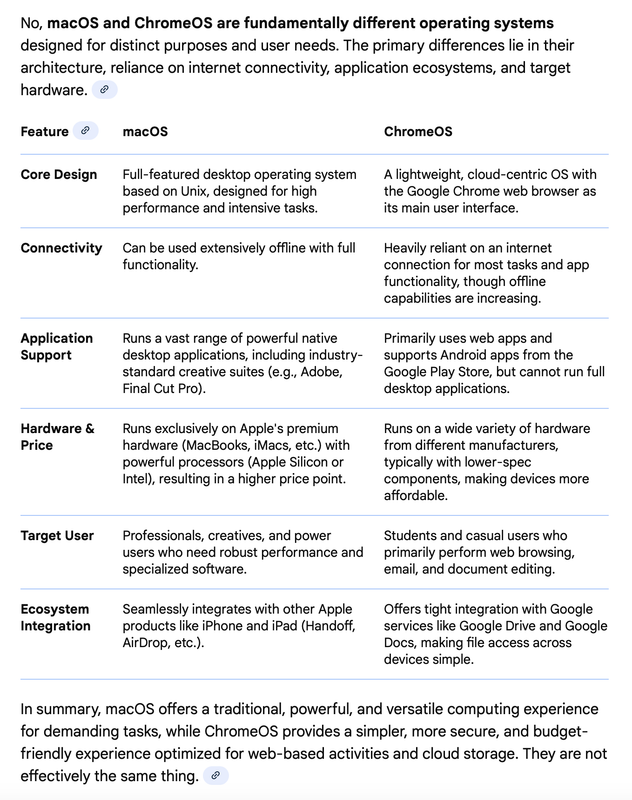
Each have their pros and cons. For my day to day work I use macOS. I used to >> use Linux and Windows more. Hmmm, also use ChromeOS sometimes these days -- >> which of course also runs on Linux (but is not the GNU/Linux we usually mean >> when we speak of Desktop Linux).
I am happy all these choices exist.
you are far too sensible and tolerant to take part in this discussion;
to do so, you have to join one camp, and pour scorn on all the others.
:-)
(Me: I started with 6800, then 6502, some time in bit-slice [2901 and
clones] and the DSP processors [TMS320, 56000, 96000] ...; for home, Tangerine, Oric, Atmos, BBC Master [all 6502], then at the choice of architecture between x86 and ARM went for the former - feeling like a
traitor - but on price; in the X86 world, DOS [Dr. then MS, but
initially they _were_ pretty interchangeable], then Windows, 3.1>95>98SElite>XP>7>10 - all the time being _tempted_ by the Linux _concept_, but never investing the effort - and now, too set in my ways [please don't bother]. Windows, always _trailing rather than leading
edge. But not _anti_ any of the others [Apple, Linux, Android, the
Windows ahead of the one I'm using], and grateful for the odd _idea_
that comes from them.)
On Nov 7, 2025 at 5:08:54?PM MST, "Lawrence D?Oliveiro" wrote <10em1mm$27mgj$2@dont-email.me>:
On Fri, 7 Nov 2025 17:47:24 -0600, Hank Rogers wrote:
Yes, and the problem is compounded by the fact that there are many
distros, each of which have a cult following.
No such thing. It is easy to move between them, since they are all built
on common foundations anyway. The variations are mostly in things that are >> easy to adapt to, or differences in philosophy that have little or no
impact on interoperability.
A businessman can't simply choose "linux". He must also subscribe to a
particular distro.
Try your objection in a different context: ?the problem with buying a car
is compounded by the fact that there are many makes and models, each of
which has a cult following. A businessman can?t simply choose ?a car?, he
must also subscribe to a particular make and model.?
But if you buy a Toyota the whole system is designed to work as a system... at
least for the most part. You do not have one door working one way and another working in a different arbitrary way. Desktop Linux does have that as a bit of
a challenge.
Say, is red hat a "distro" or is it a "DE"?
I used it many many years ago.ÿ It was probably before distos and de's
were invented.
And exactly what the hell is a DE?ÿ People yammer on and on about
distros, but I haven't seen DEs mentioned much.ÿ Are they new?
On 11/7/25 7:33 PM, Brock McNuggets wrote:
On Nov 7, 2025 at 5:08:54?PM MST, "Lawrence D?Oliveiro" wrote
<10em1mm$27mgj$2@dont-email.me>:
On Fri, 7 Nov 2025 17:47:24 -0600, Hank Rogers wrote:
Yes, and the problem is compounded by the fact that there are many
distros, each of which have a cult following.
No such thing. It is easy to move between them, since they are all built >>> on common foundations anyway. The variations are mostly in things that are >>> easy to adapt to, or differences in philosophy that have little or no
impact on interoperability.
A businessman can't simply choose "linux". He must also subscribe to a >>>> particular distro.
Try your objection in a different context: ?the problem with buying a car >>> is compounded by the fact that there are many makes and models, each of
which has a cult following. A businessman can?t simply choose ?a car?, he >>> must also subscribe to a particular make and model.?
But if you buy a Toyota the whole system is designed to work as a system... at
least for the most part. You do not have one door working one way and another
working in a different arbitrary way. Desktop Linux does have that as a bit of
a challenge.
That is an advantage of macOS, the consistency of UI.
But Windows and
Linux work just as well for people not concerned with it. Which for me
is true, I learn each piece of software individually.
You must pick a particular cult and worship it. That's nutz!
Hank Rogers wrote:
We can all agree that linus torvalds is GOD.
Lack of a rational response does tend to lead to passive-aggressive >substitutes like that ...
Lawrence D?Oliveiro wrote:
Hank Rogers wrote:
We can all agree that linus torvalds is GOD.
Lack of a rational response does tend to lead to passive-aggressive >>substitutes like that ...
He's a fscking idiot. You demonstrated that, so he ignores it and
spews more idiocy.
Hank Rogers wrote:
You must pick a particular cult and worship it. That's nutz!
What is "nutz" is a stupid bastard, like you, comparing the choosing a particular product to "worshipping" it and being part of a "cult".
Sheesh! You're just a shameless jackass, aren't you?
On 2025/11/8 7:7:54, Brock McNuggets wrote:
[]
All OSs / systems have challenges. One that desktop Linux distros have is getting as consistent of a UI as you see on Windows and macOS (not that either
of those is perfect).
Does this mean Linux is unusable? NO! Does it mean I am against it? NO! Does
it mean it does not have other advantages? NO!
Each have their pros and cons. For my day to day work I use macOS. I used to
use Linux and Windows more. Hmmm, also use ChromeOS sometimes these days -- which of course also runs on Linux (but is not the GNU/Linux we usually mean
when we speak of Desktop Linux).
I am happy all these choices exist.
you are far too sensible and tolerant to take part in this discussion;
to do so, you have to join one camp, and pour scorn on all the others.
:-)
(Me: I started with 6800, then 6502, some time in bit-slice [2901 and
clones] and the DSP processors [TMS320, 56000, 96000] ...; for home, Tangerine, Oric, Atmos, BBC Master [all 6502], then at the choice of architecture between x86 and ARM went for the former - feeling like a
traitor - but on price; in the X86 world, DOS [Dr. then MS, but
initially they _were_ pretty interchangeable], then Windows, 3.1>95>98SElite>XP>7>10 - all the time being _tempted_ by the Linux _concept_, but never investing the effort - and now, too set in my ways [please don't bother]. Windows, always _trailing rather than leading
edge. But not _anti_ any of the others [Apple, Linux, Android, the
Windows ahead of the one I'm using], and grateful for the odd _idea_
that comes from them.)
But there is a tiny minority, very vocal, who follow a Stallman like
view at a cult level.
On Nov 8, 2025 at 11:07:38?AM MST, "chrisv" wrote <mltugklkqk15lj08uk8kvvc21n92hm6hg1@4ax.com>:
Hank Rogers wrote:
You must pick a particular cult and worship it. That's nutz!
What is "nutz" is a stupid bastard, like you, comparing the choosing a
particular product to "worshipping" it and being part of a "cult".
Sheesh! You're just a shameless jackass, aren't you?
There are many who use Linux who use it as a tool and do so in a very reasonable way. The VAST majority of Linux users do so.
But there is a tiny minority, very vocal, who follow a Stallman like view at a
cult level.
On 08 Nov 2025 19:40:47 GMT, Brock McNuggets wrote:
But there is a tiny minority, very vocal, who follow a Stallman like
view at a cult level.
Without someone like Stallman, do you think Free software would have
achieved the ascendancy it enjoys today?
Lawrence D?Oliveiro wrote on 11/8/2025 4:03 PM:
On 08 Nov 2025 19:40:47 GMT, Brock McNuggets wrote:
But there is a tiny minority, very vocal, who follow a Stallman like
view at a cult level.
Without someone like Stallman, do you think Free software would have
achieved the ascendancy it enjoys today?
Stallman is a very sad case. But he tried hard, and did do some good.
I'm sad to see him so near death.
He was selling MUCH more than just Linux. Many benefited from his
efforts and don't even know who he was. Not just the elite linux cultists.
It's real easy to sell to them.
On 08 Nov 2025 19:40:47 GMT, Brock McNuggets wrote:
But there is a tiny minority, very vocal, who follow a Stallman like
view at a cult level.
Without someone like Stallman, do you think Free software would have
achieved the ascendancy it enjoys today?
Brock McNuggets wrote on 11/8/2025 1:40 PM:
On Nov 8, 2025 at 11:07:38ƒ??AM MST, "chrisv" wrote
<mltugklkqk15lj08uk8kvvc21n92hm6hg1@4ax.com>:
Hank Rogers wrote:
You must pick a particular cult and worship it. That's nutz!
What is "nutz" is a stupid bastard, like you, comparing the choosing a
particular product to "worshipping" it and being part of a "cult".
Sheesh! You're just a shameless jackass, aren't you?
There are many who use Linux who use it as a tool and do so in a very
reasonable way. The VAST majority of Linux users do so.
Yes. They are the silent majority. They are largely content, so they
don't tend to stir up shit.
But there is a tiny minority, very vocal, who follow a Stallman like view at a
cult level.
Let's not judge Chrissy just yet. She may have simply perceived
something as a personal attack.
On Nov 8, 2025 at 4:30:37?PM MST, "Hank Rogers" wrote <10eojr1$2u394$1@dont-email.me>:
Lawrence D?Oliveiro wrote on 11/8/2025 4:03 PM:
On 08 Nov 2025 19:40:47 GMT, Brock McNuggets wrote:
But there is a tiny minority, very vocal, who follow a Stallman like
view at a cult level.
Without someone like Stallman, do you think Free software would have
achieved the ascendancy it enjoys today?
Stallman is a very sad case. But he tried hard, and did do some good.
I'm sad to see him so near death.
Is he? Where do you see this?
When you download Linux Mint Cinnamon, that is an OS which includes
one (the named) desktop environment. But the other desktop environments
are still listed in the package manager. For convenience, there could be
a set of 100 packages, with all the "toys" that belong to a Desktop Environment in a "MetaPackage". I could be sitting in Cinnamon, and
install "MetaPackage Gnome" and a second Desktop Environment would
download and install.
Paul <nospam@needed.invalid> news:10emlm0$2cffv$1@dont-email.me Sat, 08
Nov 2025 05:49:49 GMT in comp.os.linux.advocacy, wrote:
When you download Linux Mint Cinnamon, that is an OS which includes
one (the named) desktop environment. But the other desktop environments
are still listed in the package manager. For convenience, there could be
a set of 100 packages, with all the "toys" that belong to a Desktop
Environment in a "MetaPackage". I could be sitting in Cinnamon, and
install "MetaPackage Gnome" and a second Desktop Environment would
download and install.
Nicely detailed post, Paul.
I would strongly advise fact checking whatever Snit brock mcnuggets
michael lee glasser of prescott arizona writes though. He has a serious problem with reading comprehension and likes to play games with the MIDs
he cherry picks to share.
For additional information if you aren't familiar with Snit, just check
this link. He gets off on trolling and has been doing it for decades now.
<https://tinyurl.com/Snitliesmethods>
He's been run out of this newsgroup before (COLA), but is attempting to re-establish himself since he's worn out his welcome on alt.computer.workshop.
Brock McNuggets wrote on 11/8/2025 5:53 PM:
On Nov 8, 2025 at 4:30:37ƒ??PM MST, "Hank Rogers" wrote
<10eojr1$2u394$1@dont-email.me>:
Lawrence Dƒ??Oliveiro wrote on 11/8/2025 4:03 PM:
On 08 Nov 2025 19:40:47 GMT, Brock McNuggets wrote:
But there is a tiny minority, very vocal, who follow a Stallman like >>>>> view at a cult level.
Without someone like Stallman, do you think Free software would have
achieved the ascendancy it enjoys today?
Stallman is a very sad case. But he tried hard, and did do some good.
I'm sad to see him so near death.
Is he? Where do you see this?
He got better:
In September 2023, while giving his keynote presentation at the GNU 40th anniversary event, Stallman revealed he had been diagnosed with
follicular lymphoma, a form of cancer, and said that his prognosis was
good and he hopes to be around for years to come.[153][154][155] He
later stated he was in remission and he was getting treatment.[156]
some thing wrote:
But if you buy a Toyota the whole system is designed to work as a
system... at least for the most part. You do not have one door working
one way and another working in a different arbitrary way. Desktop Linux
does have that as a bit of a challenge.
some thing wrote:
But if you buy a Toyota the whole system is designed to work as a
system... at least for the most part. You do not have one door working
one way and another working in a different arbitrary way. Desktop Linux
does have that as a bit of a challenge.
Yet people have no problem using other brands of cars that have
different controls and entertainment systems.
Idiot.
It is not as if ALL cars are one system.
On 09 Nov 2025 18:28:22 GMT, Brock McNuggets wrote:
It is not as if ALL cars are one system.
Imagine if cars were made by Microsoft and Apple.
If you wanted to change
cars, you would need to learn an entirely different way of driving, on an entirely separate set of roads. And you would need to fuel up and get servicing at an entirely separate network of stations.
In fact, you might even have to *untravel* some of the miles you had
already done in your old car, and travel them again in the new car.
Compare this to Linux distros: they may seem to offer a bewildering
variety of makes and models of cars, but they all drive pretty much the
same way, on the same roads, use the same fuel, and can get serviced at
the same depots.
And a journey you travel in any one of them carries over to the others: changing cars doesn?t suddenly put you back at your starting point.
On 09 Nov 2025 18:28:22 GMT, Brock McNuggets wrote:
It is not as if ALL cars are one system.
Imagine if cars were made by Microsoft and Apple. If you wanted to change cars, you would need to learn an entirely different way of driving, on an entirely separate set of roads. And you would need to fuel up and get servicing at an entirely separate network of stations.
In fact, you might even have to *untravel* some of the miles you had
already done in your old car, and travel them again in the new car.
Compare this to Linux distros: they may seem to offer a bewildering
variety of makes and models of cars, but they all drive pretty much the
same way, on the same roads, use the same fuel, and can get serviced at
the same depots.
And a journey you travel in any one of them carries over to the others: changing cars doesn?t suddenly put you back at your starting point.
Snit wrote:
But if you buy a Toyota the whole system is designed to work as a
system... at least for the most part. You do not have one door working
one way and another working in a different arbitrary way. Desktop Linux
does have that as a bit of a challenge.
Yet people have no problem using other brands of cars that have
different controls and entertainment systems. Idiot.
(snipped, unread)
some thing wrote:
But there is a tiny minority, very vocal, who follow a Stallman like
view at a cult level.
Without someone like Stallman, do you think Free software would have >achieved the ascendancy it enjoys today?
Lawrence D˜Oliveiro wrote:
some thing wrote:
But there is a tiny minority, very vocal, who follow a Stallman like
view at a cult level.
Even if true, nothing to do with what "Hank" was saying.
Without someone like Stallman, do you think Free software would have
achieved the ascendancy it enjoys today?
That thing won't admit how great the GPL is, man. Check out the
idiocy in my sig.
Hank Rogers wrote:
(snipped, unread)
Idiot.
Hank Rogers wrote:
(snipped, unread)
Idiot.
Not taking sides, here, just found this interesting. It's a
bit questionable given Microsoft's offer of free extended
updates to Win10 if one links their MS account. Nevertheless,
Win11's CPU/TPM requirements are a bit on the stringent side,
not to mention some people just don't like upgrading. Hard to
blame them for considering an alternative, though I find it
hard to recommend Apple which has limited-time support and
high prices. Ultimately, the big question to me is whether
this will further erode Windows' dominance.
Alan wrote on 10/31/2025 2:32 PM:
On 2025-10-31 12:18, Joel W. Crump wrote:
https://www.techradar.com/pro/windows-10-end-of-life-is-pushing-
users- towards-apple-mac-devices-is-it-time-for-you-to-make-the-big-jump >>>
Not taking sides, here, just found this interesting.?ÿ It's a bit
questionable given Microsoft's offer of free extended updates to
Win10 if one links their MS account.?ÿ Nevertheless, Win11's CPU/TPM
requirements are a bit on the stringent side, not to mention some
people just don't like upgrading.?ÿ Hard to blame them for
considering an alternative, though I find it hard to recommend Apple
which has limited- time support and high prices.?ÿ Ultimately, the
big question to me is whether this will further erode Windows'
dominance.
Every company has "limited-time support", dimwit.
Not apple.ÿ They support everything they ever sold.ÿÿ Forever.ÿ And it
is the finest of all support programs. Some people say "It just works".
They aren't greedy like microsoft and linux. Apple products are
reasonably priced, often much cheaper than linux or microsoft stuff.
The best thing is they don't lock you into their software like linux and microsoft.ÿ You're free to download and install anything, not just the
shit in some goddamn "store" like microsoft does.
And there is no need for an "account" like microsoft.ÿ Apple doesn't
even have an "account", nor do they push you to get one, nor require one
to access any service or use of their product which you bought and paid
for.
It is the most wonderful computer company in the modern world.
On 2025-10-31 17:31, Hank Rogers wrote:
Alan wrote on 10/31/2025 2:32 PM:
On 2025-10-31 12:18, Joel W. Crump wrote:
https://www.techradar.com/pro/windows-10-end-of-life-is-pushing-
users-
towards-apple-mac-devices-is-it-time-for-you-to-make-the-big-jump
Not taking sides, here, just found this interesting.?ÿ It's a bit
questionable given Microsoft's offer of free extended updates to
Win10 if one links their MS account.?ÿ Nevertheless, Win11's
CPU/TPM requirements are a bit on the stringent side, not to mention
some people just don't like upgrading.?ÿ Hard to blame them for
considering an alternative, though I find it hard to recommend Apple
which has limited- time support and high prices.?ÿ Ultimately, the
big question to me is whether this will further erode Windows'
dominance.
Every company has "limited-time support", dimwit.
Not apple.ÿ They support everything they ever sold.ÿÿ Forever.?
And it is the finest of all support programs. Some people say "It just
works".
They aren't greedy like microsoft and linux. Apple products are
reasonably priced, often much cheaper than linux or microsoft stuff.
The best thing is they don't lock you into their software like linux
and microsoft.ÿ You're free to download and install anything, not
just the shit in some goddamn "store" like microsoft does.
And there is no need for an "account" like microsoft.ÿ Apple doesn't
even have an "account", nor do they push you to get one, nor require
one to access any service or use of their product which you bought and
paid for.
It is the most wonderful computer company in the modern world.
Why do you choose to be SUCH an asshole?
I was going to address some of your specific bullshit, but I think that question really sums it up.
Alan wrote on 11/11/2025 12:08 PM:
On 2025-10-31 17:31, Hank Rogers wrote:
Alan wrote on 10/31/2025 2:32 PM:
On 2025-10-31 12:18, Joel W. Crump wrote:
https://www.techradar.com/pro/windows-10-end-of-life-is-pushing-
users- towards-apple-mac-devices-is-it-time-for-you-to-make-the-
big-jump
Not taking sides, here, just found this interesting.???ÿ It's a bit >>>>> questionable given Microsoft's offer of free extended updates to
Win10 if one links their MS account.???ÿ Nevertheless, Win11's CPU/ >>>>> TPM requirements are a bit on the stringent side, not to mention
some people just don't like upgrading.???ÿ Hard to blame them for
considering an alternative, though I find it hard to recommend
Apple which has limited- time support and high prices.???
Ultimately, the big question to me is whether this will further
erode Windows' dominance.
Every company has "limited-time support", dimwit.
Not apple.?ÿ They support everything they ever sold.?ÿ?ÿ Forever.?
And it is the finest of all support programs. Some people say "It
just works".
They aren't greedy like microsoft and linux. Apple products are
reasonably priced, often much cheaper than linux or microsoft stuff.
The best thing is they don't lock you into their software like linux
and microsoft.?ÿ You're free to download and install anything, not
just the shit in some goddamn "store" like microsoft does.
And there is no need for an "account" like microsoft.?ÿ Apple doesn't
even have an "account", nor do they push you to get one, nor require
one to access any service or use of their product which you bought
and paid for.
It is the most wonderful computer company in the modern world.
Why do you choose to be SUCH an asshole?
I was going to address some of your specific bullshit, but I think
that question really sums it up.
Sometimes, the truth hurts, nuh-uh.
On 11/11/25 2:34 PM, Hank Rogers wrote:
Alan wrote on 11/11/2025 12:08 PM:
On 2025-10-31 17:31, Hank Rogers wrote:
Alan wrote on 10/31/2025 2:32 PM:
On 2025-10-31 12:18, Joel W. Crump wrote:
https://www.techradar.com/pro/windows-10-end-of-life-is-pushing-
users- towards-apple-mac-devices-is-it-time-for-you-to-make-the-
big-jump
Not taking sides, here, just found this interesting.??? It's a bit >>>>>> questionable given Microsoft's offer of free extended updates to
Win10 if one links their MS account.??? Nevertheless, Win11's CPU/ >>>>>> TPM requirements are a bit on the stringent side, not to mention
some people just don't like upgrading.??? Hard to blame them for
considering an alternative, though I find it hard to recommend
Apple which has limited- time support and high prices.???
Ultimately, the big question to me is whether this will further
erode Windows' dominance.
Every company has "limited-time support", dimwit.
Not apple.? They support everything they ever sold.? ? Forever.?
And it is the finest of all support programs. Some people say "It
just works".
They aren't greedy like microsoft and linux. Apple products are
reasonably priced, often much cheaper than linux or microsoft stuff.
The best thing is they don't lock you into their software like linux
and microsoft.? You're free to download and install anything, not
just the shit in some goddamn "store" like microsoft does.
And there is no need for an "account" like microsoft.? Apple doesn't
even have an "account", nor do they push you to get one, nor require
one to access any service or use of their product which you bought
and paid for.
It is the most wonderful computer company in the modern world.
Why do you choose to be SUCH an asshole?
I was going to address some of your specific bullshit, but I think
that question really sums it up.
Sometimes, the truth hurts, nuh-uh.
Apple thrives on people who are willing to pay for and defend their
products.
On Nov 11, 2025 at 12:59:38?PM MST, ""Joel W. Crump"" wrote <RAMQQ.1806169$Jgh9.742896@fx15.iad>:
On 11/11/25 2:34 PM, Hank Rogers wrote:
Alan wrote on 11/11/2025 12:08 PM:
On 2025-10-31 17:31, Hank Rogers wrote:
Alan wrote on 10/31/2025 2:32 PM:
On 2025-10-31 12:18, Joel W. Crump wrote:
https://www.techradar.com/pro/windows-10-end-of-life-is-pushing- >>>>>>> users- towards-apple-mac-devices-is-it-time-for-you-to-make-the- >>>>>>> big-jump
Not taking sides, here, just found this interesting.??? It's a bit >>>>>>> questionable given Microsoft's offer of free extended updates to >>>>>>> Win10 if one links their MS account.??? Nevertheless, Win11's CPU/ >>>>>>> TPM requirements are a bit on the stringent side, not to mention >>>>>>> some people just don't like upgrading.??? Hard to blame them for >>>>>>> considering an alternative, though I find it hard to recommend
Apple which has limited- time support and high prices.???
Ultimately, the big question to me is whether this will further
erode Windows' dominance.
Every company has "limited-time support", dimwit.
Not apple.? They support everything they ever sold.? ? Forever.?
And it is the finest of all support programs. Some people say "It
just works".
They aren't greedy like microsoft and linux. Apple products are
reasonably priced, often much cheaper than linux or microsoft stuff. >>>>>
The best thing is they don't lock you into their software like linux >>>>> and microsoft.? You're free to download and install anything, not
just the shit in some goddamn "store" like microsoft does.
And there is no need for an "account" like microsoft.? Apple doesn't >>>>> even have an "account", nor do they push you to get one, nor require >>>>> one to access any service or use of their product which you bought
and paid for.
It is the most wonderful computer company in the modern world.
Why do you choose to be SUCH an asshole?
I was going to address some of your specific bullshit, but I think
that question really sums it up.
Sometimes, the truth hurts, nuh-uh.
Apple thrives on people who are willing to pay for and defend their
products.
What company doesn't?
Brock McNuggets wrote on 11/11/2025 4:21 PM:
On Nov 11, 2025 at 12:59:38ƒ??PM MST, ""Joel W. Crump"" wroteThey all do, but some rely on cultish behavior more than others. Just different business models. All the same deep down. Money.
<RAMQQ.1806169$Jgh9.742896@fx15.iad>:
On 11/11/25 2:34 PM, Hank Rogers wrote:
Alan wrote on 11/11/2025 12:08 PM:
On 2025-10-31 17:31, Hank Rogers wrote:
Alan wrote on 10/31/2025 2:32 PM:
On 2025-10-31 12:18, Joel W. Crump wrote:
https://www.techradar.com/pro/windows-10-end-of-life-is-pushing- >>>>>>>> users- towards-apple-mac-devices-is-it-time-for-you-to-make-the- >>>>>>>> big-jump
Not taking sides, here, just found this interesting.?Ÿƒ???? It's a bit
questionable given Microsoft's offer of free extended updates to >>>>>>>> Win10 if one links their MS account.?Ÿƒ???? Nevertheless, Win11's CPU/
TPM requirements are a bit on the stringent side, not to mention >>>>>>>> some people just don't like upgrading.?Ÿƒ???? Hard to blame them for >>>>>>>> considering an alternative, though I find it hard to recommend >>>>>>>> Apple which has limited- time support and high prices.?Ÿƒ????
Ultimately, the big question to me is whether this will further >>>>>>>> erode Windows' dominance.
Every company has "limited-time support", dimwit.
Not apple.?? They support everything they ever sold.?? ?? Forever.?? >>>>>> And it is the finest of all support programs. Some people say "It
just works".
They aren't greedy like microsoft and linux. Apple products are
reasonably priced, often much cheaper than linux or microsoft stuff. >>>>>>
The best thing is they don't lock you into their software like linux >>>>>> and microsoft.?? You're free to download and install anything, not >>>>>> just the shit in some goddamn "store" like microsoft does.
And there is no need for an "account" like microsoft.?? Apple doesn't >>>>>> even have an "account", nor do they push you to get one, nor require >>>>>> one to access any service or use of their product which you bought >>>>>> and paid for.
It is the most wonderful computer company in the modern world.
Why do you choose to be SUCH an asshole?
I was going to address some of your specific bullshit, but I think
that question really sums it up.
Sometimes, the truth hurts, nuh-uh.
Apple thrives on people who are willing to pay for and defend their
products.
What company doesn't?
Don't try so "save" anyone from any of them. Leave people alone. If a particular cult isn't their cup of tea, the person will eventually learn
that and get rid of it. If they love the warm cult environment, they'll stay.
Butting in is just as disgusting as the evangelists and proselytizers.
Apple thrives on people who are willing to pay for and defend their
products.
What company doesn't?
Don't try so "save" anyone from any of them. Leave people alone.
What specifically in there does he call out for lack of quality?
I'm not spending 15 minutes looking for what you implicitly claim to
already know.
On 11/11/25 5:21 PM, Brock McNuggets wrote:
Apple thrives on people who are willing to pay for and defend their
products.
What company doesn't?
Fair question!
If someone wants to call it a "cult" so be it. Not hurting anything. MAGA*is* a cult, and it is hurting pretty much everyone. Even the cult members.
On Tue, 11 Nov 2025 17:01:08 -0600, Hank Rogers wrote:
Don't try so "save" anyone from any of them. Leave people alone.
That?s not what these advocacy newsgroups are for. ;)
Brock McNuggets wrote on 11/11/2025 5:11 PM:
If someone wants to call it a "cult" so be it. Not hurting anything. MAGA*is*
a cult, and it is hurting pretty much everyone. Even the cult members.
Yes, MAGA certainly is a cult. What will you do about it?
I have no solution.
Members of cults are always their first victims. As long as the cultist remains loyal and happy with his cult, there is nothing heaven or earth
can do to pry him away from his gods.
Lawrence D?Oliveiro wrote on 11/11/2025 5:31 PM:
On Tue, 11 Nov 2025 17:01:08 -0600, Hank Rogers wrote:
Don't try so "save" anyone from any of them. Leave people alone.
Thatƒ??s not what these advocacy newsgroups are for. ;)
Yes I know. This windows newgroup you post in is designated as a forum
for preaching the gospel of linux and selling it.
On Fri, 7 Nov 2025 15:04:09 -0500, -hh wrote:
On 11/7/25 14:49, Lawrence D?Oliveiro wrote:
Meanwhile, power-efficiency has become something that?s important
across the entire range of computing hardware. Yet others have been
able to achieve it without sacrificing versatility and expandability.
As much as I'd like to agree with this from a home enthusiast
perspective to facilitate incremental improvements, I've seen how on the
Enterprise side, they don't care ...
Oh, they do indeed. The single largest expense in running a large-scale compute facility is the electricity bill.
That?s why you don?t just have the ?Top500? list any more, you also have
the ?Green500?.
<https://top500.org/statistics/efficiency-power-cores/>
On 11/7/25 15:57, Lawrence D?Oliveiro wrote:
On Fri, 7 Nov 2025 15:04:09 -0500, -hh wrote:
On 11/7/25 14:49, Lawrence D?Oliveiro wrote:
Meanwhile, power-efficiency has become something that?s important
across the entire range of computing hardware. Yet others have been
able to achieve it without sacrificing versatility and expandability.
As much as I'd like to agree with this from a home enthusiast
perspective to facilitate incremental improvements, I've seen how on the >>> Enterprise side, they don't care ...
Oh, they do indeed. The single largest expense in running a large-scale
compute facility is the electricity bill.
That?s why you don?t just have the ?Top500? list any more, you also have
the ?Green500?.
<https://top500.org/statistics/efficiency-power-cores/>
Way to miss the point.
On Thu, 13 Nov 2025 15:00:24 -0500, -hh wrote:ortant
On 11/7/25 15:57, Lawrence D?Oliveiro wrote:
On Fri, 7 Nov 2025 15:04:09 -0500, -hh wrote:
On 11/7/25 14:49, Lawrence D?Oliveiro wrote:
Meanwhile, power-efficiency has become something that?s imp
y.across the entire range of computing hardware. Yet others have been
able to achieve it without sacrificing versatility and expandabilit
the
As much as I'd like to agree with this from a home enthusiast
perspective to facilitate incremental improvements, I've seen how on
leEnterprise side, they don't care ...
Oh, they do indeed. The single largest expense in running a large-sca
?? list any more, you also havecompute facility is the electricity bill.
That?s why you don?t just have the ?Top500?
the ?Green500?.
<https://top500.org/statistics/efficiency-power-cores/>
Way to miss the point.
Way to shift the goalposts.
On 2025/11/13 22:24:28, Lawrence D?Oliveiro wrote:
On Thu, 13 Nov 2025 15:00:24 -0500, -hh wrote:
On 11/7/25 15:57, Lawrence D?Oliveiro wrote:
On Fri, 7 Nov 2025 15:04:09 -0500, -hh wrote:
On 11/7/25 14:49, Lawrence D?Oliveiro wrote:
As much as I'd like to agree with this from a home enthusiast
Meanwhile, power-efficiency has become something that?s important
across the entire range of computing hardware. Yet others have been >>>>>> able to achieve it without sacrificing versatility and expandability. >>>>>
perspective to facilitate incremental improvements, I've seen how on the >>>>> Enterprise side, they don't care ...
Oh, they do indeed. The single largest expense in running a large-scale >>>> compute facility is the electricity bill.
That?s why you don?t just have the ?Top500? list any more, you also have >>>> the ?Green500?.
<https://top500.org/statistics/efficiency-power-cores/>
Way to miss the point.
Way to shift the goalposts.
It was pretty clear to me that "-hh" (and L D'O) was/were talking about
the selection of general-use computers "on the Enterprise side", i. e.
the purchase of desktops/laptops for general enterprise use - not the ganging-together of many computers for things like data centres, AI, and
so on.
I don't think that was "shifting the goalposts" - or that LD'O _intentionally_ did so either, just got the wrong end of the stick there.Larry tried to take an aside on how Apple leading the transition to
On 9/11/2025 10:55 am, Brock McNuggets wrote:
<Snip>
"necrophilia, bestiality, possession of child pornography, and even"Various kinds of animals, including cats, dogs, gorillas, and dolphins, sometimes enjoy and even ask for sexual activities with humans."??
incest and pedophilia... should be legal as long as no one is coerced."
https://stallman.org/archives/2003-may-aug.html
"This "extreme pornography" law needs to be repealed, not just reformed.
Various kinds of animals, including cats, dogs, gorillas, and dolphins,
sometimes enjoy and even ask for sexual activities with humans. To
prohibit the act, or images of it, is sheer authoritarian prudery.
Necrophilia can't hurt the person who died (nothing can), so there is no
reason to prohibit the act, let alone images of it."
https://stallman.org/archives/2014-jul-oct.html
Really?? Talk about 'multi-lingual'!!
Any way, I went to his Melbourne Lecture and, of course, he took some questions after giving his Lecture. One of them was along the lines of
"What existed before the Big Bang?".
I'm guessing the Questioner was hoping for an answer along the lines of "Well, God, created the Universe with a Big Bang ...." but, seemingly
without batting an eyelid, Prof Cox answered that one of the (then)
current theories was that two Universes on two other planes of the
Cosmos bumped into each other and some of the matter from each of those
two Universes bleed through into what became Our Universe. Big Bang!!
Job Done!
Of course, he didn't explain how those two Universes came into being
.... or the four before that .... or the eight before that .... ad infinitum!!
[Stallman] is a repulsive human being, even if the GPL is amazing.
On 14 Nov 2025 18:22:53 GMT, Brock McNuggets wrote:
[Stallman] is a repulsive human being, even if the GPL is amazing.
A lot of companies don?t seem to like the GPL. Including Apple.
Lawrence D?Oliveiro wrote on 11/14/2025 1:17 PM:
On 14 Nov 2025 18:22:53 GMT, Brock McNuggets wrote:
[Stallman] is a repulsive human being, even if the GPL is amazing.
A lot of companies donƒ??t seem to like the GPL. Including Apple.
Is it true that underneath, apple's MacOS is really just linux?
I read that somewhere, but it could have been pure BS.
On 11/14/25 3:30 PM, Hank Rogers wrote:
Lawrence D?Oliveiro wrote on 11/14/2025 1:17 PM:
On 14 Nov 2025 18:22:53 GMT, Brock McNuggets wrote:
[Stallman] is a repulsive human being, even if the GPL is amazing.
A lot of companies donƒ??t seem to like the GPL. Including Apple.
Is it true that underneath, apple's MacOS is really just linux?
I read that somewhere, but it could have been pure BS.
It's not Linux, no, but a comparable underlying kernel.
On 2025-11-14 12:41, Joel W. Crump wrote:
On 11/14/25 3:30 PM, Hank Rogers wrote:
Lawrence D?Oliveiro wrote on 11/14/2025 1:17 PM:
On 14 Nov 2025 18:22:53 GMT, Brock McNuggets wrote:
[Stallman] is a repulsive human being, even if the GPL is amazing.
A lot of companies donƒ??t seem to like the GPL. Including Apple.
Is it true that underneath, apple's MacOS is really just linux?
I read that somewhere, but it could have been pure BS.
It's not Linux, no, but a comparable underlying kernel.
You put far too much emphasis on the kernel.
While a good kernel (monolithic, micro, or other) is an important base
on which to build the rest of an OS...
...it is just that: a BASE.
Like how a building needs a good foundation, it will still make no difference if you build a piece of crap on top of it.
On 2025-11-14 12:41, Joel W. Crump wrote:
On 11/14/25 3:30 PM, Hank Rogers wrote:
Lawrence D?Oliveiro wrote on 11/14/2025 1:17 PM:
On 14 Nov 2025 18:22:53 GMT, Brock McNuggets wrote:
[Stallman] is a repulsive human being, even if the GPL is amazing.
A lot of companies donƒ??t seem to like the GPL. Including Apple.
Is it true that underneath, apple's MacOS is really just linux?
I read that somewhere, but it could have been pure BS.
It's not Linux, no, but a comparable underlying kernel.
You put far too much emphasis on the kernel.
While a good kernel (monolithic, micro, or other) is an important base
on which to build the rest of an OS...
...it is just that: a BASE.
Like how a building needs a good foundation, it will still make no difference if you build a piece of crap on top of it.
Lawrence D?Oliveiro wrote on 11/14/2025 1:17 PM:
On 14 Nov 2025 18:22:53 GMT, Brock McNuggets wrote:
[Stallman] is a repulsive human being, even if the GPL is amazing.
A lot of companies don?t seem to like the GPL. Including Apple.
Is it true that underneath, apple's MacOS is really just linux?
I read that somewhere, but it could have been pure BS.
Alan wrote on 11/14/2025 3:00 PM:
On 2025-11-14 12:41, Joel W. Crump wrote:
On 11/14/25 3:30 PM, Hank Rogers wrote:
Lawrence Dƒ??Oliveiro wrote on 11/14/2025 1:17 PM:
On 14 Nov 2025 18:22:53 GMT, Brock McNuggets wrote:Is it true that underneath, apple's MacOS is really just linux?
[Stallman] is a repulsive human being, even if the GPL is amazing.
A lot of companies don?›ƒ?ªƒ?›t seem to like the GPL. Including Apple. >>>>
I read that somewhere, but it could have been pure BS.
It's not Linux, no, but a comparable underlying kernel.
You put far too much emphasis on the kernel.
While a good kernel (monolithic, micro, or other) is an important base
on which to build the rest of an OS...
...it is just that: a BASE.
Like how a building needs a good foundation, it will still make no
difference if you build a piece of crap on top of it.
Like the new liquid glass stuff?
On 2025-11-14 13:58, Hank Rogers wrote:
Alan wrote on 11/14/2025 3:00 PM:
On 2025-11-14 12:41, Joel W. Crump wrote:
On 11/14/25 3:30 PM, Hank Rogers wrote:
Lawrence Dƒ??Oliveiro wrote on 11/14/2025 1:17 PM:
On 14 Nov 2025 18:22:53 GMT, Brock McNuggets wrote:
[Stallman] is a repulsive human being, even if the GPL is amazing. >>>>>>A lot of companies don?›ƒ?ªƒ?›t seem to like the GPL.
Including Apple.
Is it true that underneath, apple's MacOS is really just linux?
I read that somewhere, but it could have been pure BS.
It's not Linux, no, but a comparable underlying kernel.
You put far too much emphasis on the kernel.
While a good kernel (monolithic, micro, or other) is an important
base on which to build the rest of an OS...
...it is just that: a BASE.
Like how a building needs a good foundation, it will still make no
difference if you build a piece of crap on top of it.
Like the new liquid glass stuff?
From what I've heard, it's not very good, so no.
On Fri, 14 Nov 2025 23:06:01 +1100, Daniel70 wrote:
Any way, I went to his Melbourne Lecture and, of course, he took some
questions after giving his Lecture. One of them was along the lines of
"What existed before the Big Bang?".
I'm guessing the Questioner was hoping for an answer along the lines of
"Well, God, created the Universe with a Big Bang ...." but, seemingly
without batting an eyelid, Prof Cox answered that one of the (then)
current theories was that two Universes on two other planes of the
Cosmos bumped into each other and some of the matter from each of those
two Universes bleed through into what became Our Universe. Big Bang!!
Job Done!
Of course, he didn't explain how those two Universes came into being
.... or the four before that .... or the eight before that .... ad
infinitum!!
There are certainly aspects of the structure of the Universe (e.g. the smoothness of the cosmic microwave background) that are difficult to
explain if there was only a single Big Bang.
On Fri, 11/14/2025 3:30 PM, Hank Rogers wrote:
Lawrence D?Oliveiro wrote on 11/14/2025 1:17 PM:
On 14 Nov 2025 18:22:53 GMT, Brock McNuggets wrote:
[Stallman] is a repulsive human being, even if the GPL is amazing.
A lot of companies don?t seem to like the GPL. Including Apple.
Is it true that underneath, apple's MacOS is really just linux?
I read that somewhere, but it could have been pure BS.
https://en.wikipedia.org/wiki/MacOS
"The kernel of NeXTSTEP is based upon the Mach kernel, which was originally developed
at Carnegie Mellon University, with additional kernel layers and low-level user space
code derived from parts of FreeBSD[19] and other BSD operating systems.
"
"This led Apple to acquire NeXT in 1997...
to serve as the basis for Apple's next-generation operating system.
"
https://en.wikipedia.org/wiki/Mach_%28kernel%29
"Mach is often considered one of the earliest examples of a microkernel.
However, not all versions of Mach are microkernels.
Mach's derivatives are the basis of the operating system kernel in
GNU Hurd
Apple's XNU kernel used in macOS, iOS, iPadOS, tvOS, and watchOS.
"
So its flavoring is Mach kernel with a side of BSD (UNIX) on it.
Paul
On 11/5/25 10:21 PM, Lawrence D?Oliveiro wrote:
On Wed, 5 Nov 2025 23:28:17 +0000, David B. wrote:
The inbuilt CD/DVD player would only play one or the other; I can't
recall which.
At the genius bar the Apple employee told me that that was
impossible. Having anticipated this, I demonstrated with the two
discs I had taken with me. He was somewhat flummoxed and retreated
to the safety of the workshop and came back somewhat sheepishly to
report that the player had two separate infra-red disc readers -
something he had not known before.
Infrared laser for CDs, red laser for DVDs. Presumably all dual-media
optical drives work this way, so not surprising one laser can fail
while the other works.
I'm just shocked that the Apple store employee thought it was impossible that one would work and not the other. Every optical drive type has a different type of laser, so it entirely possible that one would burn out
and not the other.
On 06/11/2025 13:54, CrudeSausage wrote:
On 11/5/25 10:21 PM, Lawrence D?Oliveiro wrote:
On Wed, 5 Nov 2025 23:28:17 +0000, David B. wrote:
The inbuilt CD/DVD player would only play one or the other; I can't
recall which.
At the genius bar the Apple employee told me that that was
impossible. Having anticipated this, I demonstrated with the two
discs I had taken with me. He was somewhat flummoxed and retreated
to the safety of the workshop and came back somewhat sheepishly to
report that the player had two separate infra-red disc readers -
something he had not known before.
Infrared laser for CDs, red laser for DVDs. Presumably all dual-media
optical drives work this way, so not surprising one laser can fail
while the other works.
I'm just shocked that the Apple store employee thought it was
impossible that one would work and not the other. Every optical drive
type has a different type of laser, so it entirely possible that one
would burn out and not the other.
Maybe he was simply an inexperienced member of the team.
Can you explain WHY there is a need for different lasers?
Can you explain WHY there is a need for different lasers?
Is it true that underneath, apple's MacOS is really just linux?
https://en.wikipedia.org/wiki/Mach_%28kernel%29
GNU Hurd
Apple's XNU kernel used in macOS, iOS, iPadOS, tvOS,
and watchOS.
Alan wrote on 11/14/2025 4:23 PM:
On 2025-11-14 13:58, Hank Rogers wrote:
From what I've heard, it's not very good, so no.
Alan wrote on 11/14/2025 3:00 PM:
Like how a building needs a good foundation, it will still make no
difference if you build a piece of crap on top of it.
Like the new liquid glass stuff?
Well, I guess even apple can't bat 1000. Maybe they'll get the message
and get rid of it. I hope so.
On 06/11/2025 13:54, CrudeSausage wrote:
On 11/5/25 10:21 PM, Lawrence D?Oliveiro wrote:
On Wed, 5 Nov 2025 23:28:17 +0000, David B. wrote:
The inbuilt CD/DVD player would only play one or the other; I can't
recall which.
At the genius bar the Apple employee told me that that was
impossible. Having anticipated this, I demonstrated with the two
discs I had taken with me. He was somewhat flummoxed and retreated
to the safety of the workshop and came back somewhat sheepishly to
report that the player had two separate infra-red disc readers -
something he had not known before.
Infrared laser for CDs, red laser for DVDs. Presumably all dual-media
optical drives work this way, so not surprising one laser can fail
while the other works.
I'm just shocked that the Apple store employee thought it was
impossible that one would work and not the other. Every optical drive
type has a different type of laser, so it entirely possible that one
would burn out and not the other.
Maybe he was simply an inexperienced member of the team.
Can you explain WHY there is a need for different lasers?
On Fri, 14 Nov 2025 16:32:18 -0600, Hank Rogers wrote:
Alan wrote on 11/14/2025 4:23 PM:
On 2025-11-14 13:58, Hank Rogers wrote:
Alan wrote on 11/14/2025 3:00 PM:From what I've heard, it's not very good, so no.
Like how a building needs a good foundation, it will still make no
difference if you build a piece of crap on top of it.
Like the new liquid glass stuff?
Well, I guess even apple can't bat 1000. Maybe they'll get the message
and get rid of it. I hope so.
?Liquid Glass? is just a GUI. You would think that the GUI would be an entirely separate layer from the OS kernel, modular and replaceable/ removable, like it traditionally is in OSes that claim to derive from the ?Unix? tradition.
But not in Apple?s case ...
On 11/14/25 6:17 PM, David B. wrote:
On 06/11/2025 13:54, CrudeSausage wrote:
On 11/5/25 10:21 PM, Lawrence D?Oliveiro wrote:
On Wed, 5 Nov 2025 23:28:17 +0000, David B. wrote:
The inbuilt CD/DVD player would only play one or the other; I can't
recall which.
At the genius bar the Apple employee told me that that was
impossible. Having anticipated this, I demonstrated with the two
discs I had taken with me. He was somewhat flummoxed and retreated
to the safety of the workshop and came back somewhat sheepishly to
report that the player had two separate infra-red disc readers -
something he had not known before.
Infrared laser for CDs, red laser for DVDs. Presumably all dual-media
optical drives work this way, so not surprising one laser can fail
while the other works.
I'm just shocked that the Apple store employee thought it was
impossible that one would work and not the other. Every optical drive
type has a different type of laser, so it entirely possible that one
would burn out and not the other.
Maybe he was simply an inexperienced member of the team.
Can you explain WHY there is a need for different lasers?
The formats of the discs are different, they have to be read
specifically to what they are.? I had a DVD player that could handle
about anything, I sold it at about 20 years old for a good sum because
they don't even make them like that anymore.? It handled DVD-Audio and
Super Audio CD discs, as well as normal DVD-Video and CDDA discs, and
MP3 data disks.
On 06/11/2025 03:21, Lawrence D?Oliveiro wrote:
On Wed, 5 Nov 2025 23:28:17 +0000, David B. wrote:
The inbuilt CD/DVD player would only play one or the other; I can't
recall which.
At the genius bar the Apple employee told me that that was
impossible. Having anticipated this, I demonstrated with the two
discs I had taken with me. He was somewhat flummoxed and retreated
to the safety of the workshop and came back somewhat sheepishly to
report that the player had two separate infra-red disc readers -
something he had not known before.
Infrared laser for CDs, red laser for DVDs. Presumably all dual-media
optical drives work this way, so not surprising one laser can fail
while the other works.
Thank you. ?
I had no idea about that at the time.
I suspect that many folk reading these posts didn't know it either!
On 2025-11-06 02:44, David B. wrote:
On 06/11/2025 03:21, Lawrence D?Oliveiro wrote:
On Wed, 5 Nov 2025 23:28:17 +0000, David B. wrote:
The inbuilt CD/DVD player would only play one or the other; I can't
recall which.
At the genius bar the Apple employee told me that that was
impossible. Having anticipated this, I demonstrated with the two
discs I had taken with me. He was somewhat flummoxed and retreated
to the safety of the workshop and came back somewhat sheepishly to
report that the player had two separate infra-red disc readers -
something he had not known before.
Infrared laser for CDs, red laser for DVDs. Presumably all dual-media
optical drives work this way, so not surprising one laser can fail
while the other works.
Thank you. ?
I had no idea about that at the time.
I suspect that many folk reading these posts didn't know it either!
As usual, you assume that everyone is as ignorant as you are.
I suspect many in a Usenet forum devoted to such discussions WOULD know about the different wavelengths for CDs, DVDs, and indeed, Bluray (the
name there is a dead giveaway that it uses a blue laser diode)
On 2025/11/6 10:44:48, David B. wrote:The CD format managed to store as much as 700MiB (binary megabytes of 1,048,576 bytes each) whereas the DVD stored 4.38 GiB on a
On 06/11/2025 03:21, Lawrence D?Oliveiro wrote:
On Wed, 5 Nov 2025 23:28:17 +0000, David B. wrote:
The inbuilt CD/DVD player would only play one or the other; I can't
recall which.
At the genius bar the Apple employee told me that that was
impossible. Having anticipated this, I demonstrated with the two
discs I had taken with me. He was somewhat flummoxed and retreated
to the safety of the workshop and came back somewhat sheepishly to
report that the player had two separate infra-red disc readers -
something he had not known before.
Infrared laser for CDs, red laser for DVDs. Presumably all dual-media
optical drives work this way, so not surprising one laser can fail
while the other works.
Thank you. ?
I had no idea about that at the time.
I suspect that many folk reading these posts didn't know it either!
I wonder why? First thought is something to do with wavelength - IR is
longer than red, so maybe can't see the fine enough detail needed. But
that wouldn't stop the red one reading the coarser details. I then
thought maybe it's penetration - maybe the red one can't see through the materials; but, CDs (certainly mass-pressed ones) use clear
polycarbonate and an aluminium (US: aluminum) layer, which ought to work
well enough with either.
Joel W. Crump wrote on 11/14/2025 5:25 PM:
On 11/14/25 6:17 PM, David B. wrote:
dleMaybe he was simply an inexperienced member of the team.
Can you explain WHY there is a need for different lasers?
The formats of the discs are different, they have to be read
specifically to what they are.ÿ I had a DVD player that could han
about anything, I sold it at about 20 years old for a good sum because
o andthey don't even make them like that anymore.ÿ It handled DVD-Audi
Super Audio CD discs, as well as normal DVD-Video and CDDA discs, and
MP3 data disks.
.
Yep. If you use a program like HwInfo or glow.sys to look at the
details, you'll likely see a long list of what the drive can read and
write. Everything from old fashion CDs to blu-ray. How many layers etc
and this that and the other. It can be confusing.Blu-ray has the finest detail, so will need the shortest wavelength
Really old units might be missing things, but devices manufactured near
the epoch and demise of cd/dvd/Blu drives can read and write MANY
different types of disks. I'm sure they have more than a crude single
laser transducer.
On Fri, 14 Nov 2025 16:32:18 -0600, Hank Rogers wrote:
Alan wrote on 11/14/2025 4:23 PM:
On 2025-11-14 13:58, Hank Rogers wrote:
From what I've heard, it's not very good, so no.
Alan wrote on 11/14/2025 3:00 PM:
Like how a building needs a good foundation, it will still make no
difference if you build a piece of crap on top of it.
Like the new liquid glass stuff?
Well, I guess even apple can't bat 1000. Maybe they'll get the message
and get rid of it. I hope so.
?Liquid Glass? is just a GUI. You would think that the GUI would be an entirely separate layer from the OS kernel, modular and replaceable/ removable, like it traditionally is in OSes that claim to derive from the ?Unix? tradition.
But not in Apple?s case ...
On 2025/11/14 23:50:29, Hank Rogers wrote:
Joel W. Crump wrote on 11/14/2025 5:25 PM:
On 11/14/25 6:17 PM, David B. wrote:
[]
Maybe he was simply an inexperienced member of the team.
Can you explain WHY there is a need for different lasers?
The formats of the discs are different, they have to be read
specifically to what they are.ÿ I had a DVD player that could handle
about anything, I sold it at about 20 years old for a good sum because
they don't even make them like that anymore.ÿ It handled DVD-Audio and
Super Audio CD discs, as well as normal DVD-Video and CDDA discs, and
MP3 data disks.
I think those are all CD _density_ discs (not sure about DVD-audio - is
that the format that had digital audio and analogue video, and thus had
one track on a standard-size disc?). If I'm right, then handling those
is a matter of the _firmware_, not the reader _hardware_ (apart from
maybe that special one). If it played normal DVDs, then it obviously had reader _hardware_ capable of reading the finer structures that DVD uses.
Blu-ray has the finest detail, so will need the shortest wavelength
Yep. If you use a program like HwInfo or glow.sys to look at the
details, you'll likely see a long list of what the drive can read and
write. Everything from old fashion CDs to blu-ray. How many layers etc.
and this that and the other. It can be confusing.
light (hence the name - blue is shorter than red which is shorter than infra-red). I'm still not sure why a player would need more than one
laser - the shortest-wavelength one should surely be able to read larger structures. (But I'm willing to believe some _do_ have two [or more?] lasers.)
On 2025/11/14 23:50:29, Hank Rogers wrote:
Joel W. Crump wrote on 11/14/2025 5:25 PM:
On 11/14/25 6:17 PM, David B. wrote:
Maybe he was simply an inexperienced member of the team.
Can you explain WHY there is a need for different lasers?
The formats of the discs are different, they have to be read
specifically to what they are.ÿ I had a DVD player that could handle
about anything, I sold it at about 20 years old for a good sum because
they don't even make them like that anymore.ÿ It handled DVD-Audio and
Super Audio CD discs, as well as normal DVD-Video and CDDA discs, and
MP3 data disks.
I think those are all CD _density_ discs (not sure about DVD-audio - is
that the format that had digital audio and analogue video, and thus had
one track on a standard-size disc?). If I'm right, then handling those
is a matter of the _firmware_, not the reader _hardware_ (apart from
maybe that special one). If it played normal DVDs, then it obviously had reader _hardware_ capable of reading the finer structures that DVD uses.
On 11/14/25 6:33 PM, Lawrence D?Oliveiro wrote:
On Fri, 14 Nov 2025 16:32:18 -0600, Hank Rogers wrote:
Alan wrote on 11/14/2025 4:23 PM:
On 2025-11-14 13:58, Hank Rogers wrote:
Alan wrote on 11/14/2025 3:00 PM:? From what I've heard, it's not very good, so no.
Like how a building needs a good foundation, it will still make no >>>>>> difference if you build a piece of crap on top of it.
Like the new liquid glass stuff?
Well, I guess even apple can't bat 1000.? Maybe they'll get the message
and get rid of it.? I hope so.
?Liquid Glass? is just a GUI. You would think that the GUI would
be an
entirely separate layer from the OS kernel, modular and replaceable/
removable, like it traditionally is in OSes that claim to derive from the
?Unix? tradition.
But not in Apple?s case ...
Apple hasn't done anything from scratch in a long time.? Woz did
remarkable things in the early days, and they kind of came up with the original Mac and IIGS on their own, but when it came time to make the
Mac a real computer, they had to buy out NeXT, hack that kernel and glue
it onto their crapware.? Just a laughable company, by now, they've
produced terrible computers value-wise with lackluster software, failing
to innovate on their own like MS does, not having anywhere near the technical skill of the open-source community.? And yet they're raking in
the cash, because of idiots buying the Pocket for $200+.? Heh.
Joel W. Crump wrote on 11/14/2025 5:41 PM:
On 11/14/25 6:33 PM, Lawrence Dƒ??Oliveiro wrote:
On Fri, 14 Nov 2025 16:32:18 -0600, Hank Rogers wrote:
Alan wrote on 11/14/2025 4:23 PM:
On 2025-11-14 13:58, Hank Rogers wrote:
Alan wrote on 11/14/2025 3:00 PM:ÿ From what I've heard, it's not very good, so no.
Like how a building needs a good foundation, it will still make no >>>>>>> difference if you build a piece of crap on top of it.
Like the new liquid glass stuff?
Well, I guess even apple can't bat 1000.ÿ Maybe they'll get the message >>>> and get rid of it.ÿ I hope so.
ƒ??Liquid Glassƒ?? is just a GUI. You would think that the GUI would
be an
entirely separate layer from the OS kernel, modular and replaceable/
removable, like it traditionally is in OSes that claim to derive from
the
ƒ??Unixƒ?? tradition.
But not in Appleƒ??s case ...
Apple hasn't done anything from scratch in a long time.ÿ Woz did
remarkable things in the early days, and they kind of came up with the
original Mac and IIGS on their own, but when it came time to make the
Mac a real computer, they had to buy out NeXT, hack that kernel and
glue it onto their crapware.ÿ Just a laughable company, by now,
they've produced terrible computers value-wise with lackluster
software, failing to innovate on their own like MS does, not having
anywhere near the technical skill of the open-source community.ÿ And
yet they're raking in the cash, because of idiots buying the Pocket
for $200+.ÿ Heh.
Wozniak was a fireball.ÿ Steve BlowJobs, not so much.
On 11/14/25 6:57 PM, Alan wrote:
On 2025-11-06 02:44, David B. wrote:
On 06/11/2025 03:21, Lawrence D?Oliveiro wrote:
On Wed, 5 Nov 2025 23:28:17 +0000, David B. wrote:
The inbuilt CD/DVD player would only play one or the other; I can't
recall which.
At the genius bar the Apple employee told me that that was
impossible. Having anticipated this, I demonstrated with the two
discs I had taken with me. He was somewhat flummoxed and retreated
to the safety of the workshop and came back somewhat sheepishly to
report that the player had two separate infra-red disc readers -
something he had not known before.
Infrared laser for CDs, red laser for DVDs. Presumably all dual-media
optical drives work this way, so not surprising one laser can fail
while the other works.
Thank you. ?
I had no idea about that at the time.
I suspect that many folk reading these posts didn't know it either!
As usual, you assume that everyone is as ignorant as you are.
I suspect many in a Usenet forum devoted to such discussions WOULD know
about the different wavelengths for CDs, DVDs, and indeed, Bluray (the
name there is a dead giveaway that it uses a blue laser diode)
David may be uninformed about this topic, I'm not sure he's entirely
wrong though that someone with good information could educate others.
On 14 Nov 2025 18:22:53 GMT, Brock McNuggets wrote:
[Stallman] is a repulsive human being, even if the GPL is amazing.
A lot of companies don?t seem to like the GPL. Including Apple.
On 11/14/25 6:57 PM, Alan wrote:
On 2025-11-06 02:44, David B. wrote:
On 06/11/2025 03:21, Lawrence D?Oliveiro wrote:
On Wed, 5 Nov 2025 23:28:17 +0000, David B. wrote:
The inbuilt CD/DVD player would only play one or the other; I can't
recall which.
At the genius bar the Apple employee told me that that was
impossible. Having anticipated this, I demonstrated with the two
discs I had taken with me. He was somewhat flummoxed and retreated
to the safety of the workshop and came back somewhat sheepishly to
report that the player had two separate infra-red disc readers -
something he had not known before.
Infrared laser for CDs, red laser for DVDs. Presumably all dual-media
optical drives work this way, so not surprising one laser can fail
while the other works.
Thank you. ?
I had no idea about that at the time.
I suspect that many folk reading these posts didn't know it either!
As usual, you assume that everyone is as ignorant as you are.
I suspect many in a Usenet forum devoted to such discussions WOULD
know about the different wavelengths for CDs, DVDs, and indeed, Bluray
(the name there is a dead giveaway that it uses a blue laser diode)
David may be uninformed about this topic, I'm not sure he's entirely
wrong though that someone with good information could educate others.
On 11/14/25 3:30 PM, Hank Rogers wrote:
Lawrence D?Oliveiro wrote on 11/14/2025 1:17 PM:
On 14 Nov 2025 18:22:53 GMT, Brock McNuggets wrote:
[Stallman] is a repulsive human being, even if the GPL is amazing.
A lot of companies donƒ??t seem to like the GPL. Including Apple.
Is it true that underneath, apple's MacOS is really just linux?
I read that somewhere, but it could have been pure BS.
It's not Linux, no, but a comparable underlying kernel.
Alan wrote on 11/14/2025 3:00 PM:
On 2025-11-14 12:41, Joel W. Crump wrote:
On 11/14/25 3:30 PM, Hank Rogers wrote:
Lawrence Dƒ??Oliveiro wrote on 11/14/2025 1:17 PM:
On 14 Nov 2025 18:22:53 GMT, Brock McNuggets wrote:Is it true that underneath, apple's MacOS is really just linux?
[Stallman] is a repulsive human being, even if the GPL is amazing.
A lot of companies don?›ƒ?ªƒ?›t seem to like the GPL. Including Apple. >>>>
I read that somewhere, but it could have been pure BS.
It's not Linux, no, but a comparable underlying kernel.
You put far too much emphasis on the kernel.
While a good kernel (monolithic, micro, or other) is an important base
on which to build the rest of an OS...
...it is just that: a BASE.
Like how a building needs a good foundation, it will still make no
difference if you build a piece of crap on top of it.
Like the new liquid glass stuff?
I'm still not sure why a player would need more than one laser - the shortest-wavelength one should surely be able to read larger
structures.
... you'll likely see a long list of what the drive can read and
write. Everything from old fashion CDs to blu-ray. How many layers
etc. and this that and the other. It can be confusing.
Liquid Glass is new ...
macOS is certified Unix (for what that's worth), built on Darwin ...
Wozniak was a fireball.
Alan wrote on 11/14/2025 4:23 PM:
On 2025-11-14 13:58, Hank Rogers wrote:
Alan wrote on 11/14/2025 3:00 PM:
On 2025-11-14 12:41, Joel W. Crump wrote:
On 11/14/25 3:30 PM, Hank Rogers wrote:
Lawrence D?›ƒ?ªƒ?›Oliveiro wrote on 11/14/2025 1:17 PM:
On 14 Nov 2025 18:22:53 GMT, Brock McNuggets wrote:
[Stallman] is a repulsive human being, even if the GPL is amazing. >>>>>>>A lot of companies don?Ÿ?›?›ƒ???ª?›ƒ???›t seem to like the GPL. >>>>>>> Including Apple.
Is it true that underneath, apple's MacOS is really just linux?
I read that somewhere, but it could have been pure BS.
It's not Linux, no, but a comparable underlying kernel.
You put far too much emphasis on the kernel.
While a good kernel (monolithic, micro, or other) is an important
base on which to build the rest of an OS...
...it is just that: a BASE.
Like how a building needs a good foundation, it will still make no
difference if you build a piece of crap on top of it.
Like the new liquid glass stuff?
ÿFrom what I've heard, it's not very good, so no.
Well, I guess even apple can't bat 1000.ÿ Maybe they'll get the message
and get rid of it.ÿ I hope so.
On Fri, 14 Nov 2025 16:32:18 -0600, Hank Rogers wrote:
Alan wrote on 11/14/2025 4:23 PM:
On 2025-11-14 13:58, Hank Rogers wrote:
From what I've heard, it's not very good, so no.
Alan wrote on 11/14/2025 3:00 PM:
Like how a building needs a good foundation, it will still make no
difference if you build a piece of crap on top of it.
Like the new liquid glass stuff?
Well, I guess even apple can't bat 1000. Maybe they'll get the message
and get rid of it. I hope so.
?Liquid Glass? is just a GUI. You would think that the GUI would be an entirely separate layer from the OS kernel, modular and replaceable/ removable, like it traditionally is in OSes that claim to derive from the ?Unix? tradition.
But not in Apple?s case ...
On 11/14/25 6:33 PM, Lawrence D?Oliveiro wrote:
On Fri, 14 Nov 2025 16:32:18 -0600, Hank Rogers wrote:
Alan wrote on 11/14/2025 4:23 PM:
On 2025-11-14 13:58, Hank Rogers wrote:
Alan wrote on 11/14/2025 3:00 PM:ÿ From what I've heard, it's not very good, so no.
Like how a building needs a good foundation, it will still make no >>>>>> difference if you build a piece of crap on top of it.
Like the new liquid glass stuff?
Well, I guess even apple can't bat 1000.ÿ Maybe they'll get the message
and get rid of it.ÿ I hope so.
?Liquid Glass? is just a GUI. You would think that the GUI would be an
entirely separate layer from the OS kernel, modular and replaceable/
removable, like it traditionally is in OSes that claim to derive from the
?Unix? tradition.
But not in Apple?s case ...
Apple hasn't done anything from scratch in a long time.
Woz did
remarkable things in the early days, and they kind of came up with the original Mac and IIGS on their own, but when it came time to make the
Mac a real computer, they had to buy out NeXT,
hack that kernel and glue
it onto their crapware.
Just a laughable company, by now, they've
produced terrible computers value-wise with lackluster software, failing
to innovate on their own like MS does,
not having anywhere near the
technical skill of the open-source community.
ÿ And yet they're raking in
the cash, because of idiots buying the Pocket for $200+.ÿ Heh.
Joel W. Crump wrote on 11/14/2025 5:41 PM:
On 11/14/25 6:33 PM, Lawrence Dƒ??Oliveiro wrote:
On Fri, 14 Nov 2025 16:32:18 -0600, Hank Rogers wrote:
Alan wrote on 11/14/2025 4:23 PM:
On 2025-11-14 13:58, Hank Rogers wrote:
Alan wrote on 11/14/2025 3:00 PM:ÿ From what I've heard, it's not very good, so no.
Like how a building needs a good foundation, it will still make no >>>>>>> difference if you build a piece of crap on top of it.
Like the new liquid glass stuff?
Well, I guess even apple can't bat 1000.ÿ Maybe they'll get the message >>>> and get rid of it.ÿ I hope so.
ƒ??Liquid Glassƒ?? is just a GUI. You would think that the GUI would
be an
entirely separate layer from the OS kernel, modular and replaceable/
removable, like it traditionally is in OSes that claim to derive from
the
ƒ??Unixƒ?? tradition.
But not in Appleƒ??s case ...
Apple hasn't done anything from scratch in a long time.ÿ Woz did
remarkable things in the early days, and they kind of came up with the
original Mac and IIGS on their own, but when it came time to make the
Mac a real computer, they had to buy out NeXT, hack that kernel and
glue it onto their crapware.ÿ Just a laughable company, by now,
they've produced terrible computers value-wise with lackluster
software, failing to innovate on their own like MS does, not having
anywhere near the technical skill of the open-source community.ÿ And
yet they're raking in the cash, because of idiots buying the Pocket
for $200+.ÿ Heh.
Wozniak was a fireball.ÿ Steve BlowJobs, not so much.
On Fri, 14 Nov 2025 17:15:22 -0500, Paul wrote:
https://en.wikipedia.org/wiki/Mach_%28kernel%29
GNU Hurd
Apple's XNU kernel used in macOS, iOS, iPadOS, tvOS,
and watchOS.
And what does ?XNU? stand for? It stands for ?XNU?s Not Unix?.
What was that about Apple?s OS being ?Unix?, again?
On 15 Nov 2025 01:38:57 GMT, Brock McNuggets wrote:
macOS is certified Unix (for what that's worth), built on Darwin ...
Fun fact, it?s not called ?Darwin? any more. It?s now called ?XNU?, which stands for ?XNU?s Not Unix?.
Now, why would an OS that is supposedly ?certified Unix? have to be built
on a kernel that admits that it is ?not Unix? ... ?
Paul wrote on 11/14/2025 4:15 PM:
On Fri, 11/14/2025 3:30 PM, Hank Rogers wrote:
Lawrence D?Oliveiro wrote on 11/14/2025 1:17 PM:
On 14 Nov 2025 18:22:53 GMT, Brock McNuggets wrote:
[Stallman] is a repulsive human being, even if the GPL is amazing.
A lot of companies donƒ??t seem to like the GPL. Including Apple.
Is it true that underneath, apple's MacOS is really just linux?
I read that somewhere, but it could have been pure BS.
ÿ https://en.wikipedia.org/wiki/MacOS
ÿÿÿÿ "The kernel of NeXTSTEP is based upon the Mach kernel, which was
originally developed
ÿÿÿÿÿ at Carnegie Mellon University, with additional kernel layers and
low-level user space
ÿÿÿÿÿ code derived from parts of FreeBSD[19] and other BSD operating
systems.
ÿÿÿÿ "
ÿÿÿÿ "This led Apple to acquire NeXT in 1997...
ÿÿÿÿÿ to serve as the basis for Apple's next-generation operating system.
ÿÿÿÿ "
ÿ https://en.wikipedia.org/wiki/Mach_%28kernel%29
ÿÿÿÿ "Mach is often considered one of the earliest examples of a
microkernel.
ÿÿÿÿÿ However, not all versions of Mach are microkernels.
ÿÿÿÿÿ Mach's derivatives are the basis of the operating system kernel in
ÿÿÿÿÿÿÿÿ GNU Hurd
ÿÿÿÿÿÿÿÿ Apple's XNU kernel used in macOS, iOS, iPadOS, tvOS, and
watchOS.
ÿÿÿÿ "
So its flavoring is Mach kernel with a side of BSD (UNIX) on it.
ÿÿÿ Paul
Thanks.ÿ So it really is partly true, though not pure unadulterated linux.
I guess it was cobbled up from lots of bits and pieces of code.ÿ Doesn't matter as long as it works OK.Exactly.
On Fri, 14 Nov 2025 17:15:22 -0500, Paul wrote:
https://en.wikipedia.org/wiki/Mach_%28kernel%29
GNU Hurd
Apple's XNU kernel used in macOS, iOS, iPadOS, tvOS,
and watchOS.
And what does ?XNU? stand for? It stands for ?XNU?s Not Unix?.
What was that about Apple?s OS being ?Unix?, again?
On Fri, 14 Nov 2025 14:30:33 -0600, Hank Rogers wrote:
Is it true that underneath, apple's MacOS is really just linux?
It?s built on a BSD basis, as others have mentioned.
The irony in its licensing the ?Unix? name is that it has no code from original AT&T ?Unix? in it at all.
David B. wrote on 11/14/2025 5:17 PM:
On 06/11/2025 13:54, CrudeSausage wrote:
On 11/5/25 10:21 PM, Lawrence Dƒ??Oliveiro wrote:
On Wed, 5 Nov 2025 23:28:17 +0000, David B. wrote:
The inbuilt CD/DVD player would only play one or the other; I can't
recall which.
At the genius bar the Apple employee told me that that was
impossible. Having anticipated this, I demonstrated with the two
discs I had taken with me. He was somewhat flummoxed and retreated
to the safety of the workshop and came back somewhat sheepishly to
report that the player had two separate infra-red disc readers -
something he had not known before.
Infrared laser for CDs, red laser for DVDs. Presumably all dual-media
optical drives work this way, so not surprising one laser can fail
while the other works.
I'm just shocked that the Apple store employee thought it was
impossible that one would work and not the other. Every optical drive
type has a different type of laser, so it entirely possible that one
would burn out and not the other.
Maybe he was simply an inexperienced member of the team.
Can you explain WHY there is a need for different lasers?
It could be the apple genius was stalling, but maybe he was actually
that ignorant.ÿ Who knows?
On 15 Nov 2025 01:38:57 GMT, Brock McNuggets wrote:Fun fact: you're thinking that Darwin was the kernel. It never was. And
macOS is certified Unix (for what that's worth), built on Darwin ...
Fun fact, it?s not called ?Darwin? any more. It?s now called ?XNU?, which stands for ?XNU?s Not Unix?.
On 2025-11-14 15:41, Joel W. Crump wrote:
On 11/14/25 6:33 PM, Lawrence D?Oliveiro wrote:
On Fri, 14 Nov 2025 16:32:18 -0600, Hank Rogers wrote:
Alan wrote on 11/14/2025 4:23 PM:
On 2025-11-14 13:58, Hank Rogers wrote:
Alan wrote on 11/14/2025 3:00 PM:ÿ From what I've heard, it's not very good, so no.
Like how a building needs a good foundation, it will still make no >>>>>>> difference if you build a piece of crap on top of it.
Like the new liquid glass stuff?
Well, I guess even apple can't bat 1000.ÿ Maybe they'll get the message >>>> and get rid of it.ÿ I hope so.
?Liquid Glass? is just a GUI. You would think that the GUI would be an
entirely separate layer from the OS kernel, modular and replaceable/
removable, like it traditionally is in OSes that claim to derive from
the
?Unix? tradition.
But not in Apple?s case ...
Apple hasn't done anything from scratch in a long time.
You mean other than:
Start designing world-class silicon?
Woz did remarkable things in the early days, and they kind of came up
with the original Mac and IIGS on their own, but when it came time to
make the Mac a real computer, they had to buy out NeXT,
Ignoring the 16 years before where the Mac was a very real and very
popular computer...
hack that kernel and glue it onto their crapware.
Again: making far too much of the kernel...
...and far too little of all the work done to it since they acquired NeXT.
Just a laughable company, by now, they've produced terrible computers
value-wise with lackluster software, failing to innovate on their own
like MS does,
Like purchasing QDOS to fulfill a contract with IBM; an OS that was
mostly a copy of CP/M?
Like licensing the GUI from Apple when Apple was rolling out the Macintosh?
Like hiring the entire braintrust of DEC to build Windows NT?
Collaborating with IBM before double-crossing them for the second time?
not having anywhere near the technical skill of the open-source
community.
LOLOLOLOLOLOLOLOLOL
On 11/14/25 10:43 PM, Alan wrote:
On 2025-11-14 15:41, Joel W. Crump wrote:
On 11/14/25 6:33 PM, Lawrence D?Oliveiro wrote:
On Fri, 14 Nov 2025 16:32:18 -0600, Hank Rogers wrote:
Alan wrote on 11/14/2025 4:23 PM:
On 2025-11-14 13:58, Hank Rogers wrote:
Alan wrote on 11/14/2025 3:00 PM:From what I've heard, it's not very good, so no.
Like how a building needs a good foundation, it will
still make no difference if you build a piece of crap
on top of it.
Like the new liquid glass stuff?
Well, I guess even apple can't bat 1000. Maybe they'll get
the message and get rid of it. I hope so.
?Liquid Glass? is just a GUI. You would think that the GUI
would be an entirely separate layer from the OS kernel,
modular and replaceable/ removable, like it traditionally is
in OSes that claim to derive from the ?Unix? tradition.
But not in Apple?s case ...
Apple hasn't done anything from scratch in a long time.
You mean other than:
Start designing world-class silicon?
They didn't design anything, they turned ARM into supposedly their
own product, not unlike how they turned others' code into supposedly
their own OS.
Woz did remarkable things in the early days, and they kind of
came up with the original Mac and IIGS on their own, but when it
came time to make the Mac a real computer, they had to buy out
NeXT,
Ignoring the 16 years before where the Mac was a very real and
very popular computer...
Nah, the Mac wasn't shit until OS X was developed.
hack that kernel and glue it onto their crapware.
Again: making far too much of the kernel...
???
...and far too little of all the work done to it since they
acquired NeXT.
They never wrote it from scratch, is the point.
Just a laughable company, by now, they've produced terrible
computers value-wise with lackluster software, failing to
innovate on their own like MS does,
Like purchasing QDOS to fulfill a contract with IBM; an OS that
was mostly a copy of CP/M?
Like licensing the GUI from Apple when Apple was rolling out the
Macintosh?
Like hiring the entire braintrust of DEC to build Windows NT?
Collaborating with IBM before double-crossing them for the second
time?
It's actually fair to say that Microsoft appropriated DOS, but to
deny that they invented NT from scratch is ludicrous, hiring Cutler
was essential I realize, but it worked for them. Apple is just
lame, by comparison.
not having anywhere near the technical skill of the open-source
community.
LOLOLOLOLOLOLOLOLOL
I am serious.More's the pity.
Apple hasn't done anything from scratch in a long time.
You mean other than:
Start designing world-class silicon?
They didn't design anything, they turned ARM into supposedly their
own product, not unlike how they turned others' code into supposedly
their own OS.
You really are clueless.
The build CPUs that implement the ARM ISA. That's "Instruction Set Architecture" for you who are obviously ignorant.
The CPUs that run that ISA are designed completely in-house.
Do you even understand the difference between an ISA and the CPU that implements it?
Woz did remarkable things in the early days, and they kind of
came up with the original Mac and IIGS on their own, but when it
came time to make the Mac a real computer, they had to buy out
NeXT,
Ignoring the 16 years before where the Mac was a very real and
very popular computer...
Nah, the Mac wasn't shit until OS X was developed.
Lots of folks disagreed.
And you can't deal with the concept that anyone who doesn't agree with
you can be right.
hack that kernel and glue it onto their crapware.
Again: making far too much of the kernel...
???
...and far too little of all the work done to it since they
acquired NeXT.
They never wrote it from scratch, is the point.
Microsoft didn't write MS-DOS from scratch.
The didn't write Windows NT from scratch.
Just a laughable company, by now, they've produced terrible
computers value-wise with lackluster software, failing to
innovate on their own like MS does,
Like purchasing QDOS to fulfill a contract with IBM; an OS that
was mostly a copy of CP/M?
Like licensing the GUI from Apple when Apple was rolling out the
Macintosh?
Like hiring the entire braintrust of DEC to build Windows NT?
Collaborating with IBM before double-crossing them for the second
time?
It's actually fair to say that Microsoft appropriated DOS, but to
deny that they invented NT from scratch is ludicrous, hiring Cutler
was essential I realize, but it worked for them.ÿ Apple is just
lame, by comparison.
They re-used the same designs (right down to duplicating the names of
many of the functions).
More's the pity.not having anywhere near the technical skill of the open-source
community.
LOLOLOLOLOLOLOLOLOL
I am serious.
On 11/14/25 11:20 PM, Alan wrote:
Apple hasn't done anything from scratch in a long time.
You mean other than:
Start designing world-class silicon?
They didn't design anything, they turned ARM into supposedly
their own product, not unlike how they turned others' code into
supposedly their own OS.
You really are clueless.
The build CPUs that implement the ARM ISA. That's "Instruction
Set Architecture" for you who are obviously ignorant.
The CPUs that run that ISA are designed completely in-house.
Do you even understand the difference between an ISA and the CPU
that implements it?
If they're so great at fashioning CPUs, why did they use ARM's
instruction set? Is it maybe because they aren't bright enough to
create their own? Implementing ARM on their own metal is like AMD implementing x86 on their chips in the past, not original.
Woz did remarkable things in the early days, and they kind
of came up with the original Mac and IIGS on their own, but
when it came time to make the Mac a real computer, they had
to buy out NeXT,
Ignoring the 16 years before where the Mac was a very real and
very popular computer...
Nah, the Mac wasn't shit until OS X was developed.
Lots of folks disagreed.
And you can't deal with the concept that anyone who doesn't agree
with you can be right.
It's scientific fact that the Mac only became a real OS because of
the Unix melding. What came before that was just Apple's
proprietary crapware.
hack that kernel and glue it onto their crapware.
Again: making far too much of the kernel...
???
...and far too little of all the work done to it since they
acquired NeXT.
They never wrote it from scratch, is the point.
Microsoft didn't write MS-DOS from scratch.
The didn't write Windows NT from scratch.
NT was from scratch, dude, you can't weasel out of that.
Just a laughable company, by now, they've produced terrible
computers value-wise with lackluster software, failing to
innovate on their own like MS does,
Like purchasing QDOS to fulfill a contract with IBM; an OS
that was mostly a copy of CP/M?
Like licensing the GUI from Apple when Apple was rolling out
the Macintosh?
Like hiring the entire braintrust of DEC to build Windows NT?
Collaborating with IBM before double-crossing them for the
second time?
It's actually fair to say that Microsoft appropriated DOS, but
to deny that they invented NT from scratch is ludicrous, hiring
Cutler was essential I realize, but it worked for them. Apple
is just lame, by comparison.
They re-used the same designs (right down to duplicating the names
of many of the functions).
They wrote the code from scratch.
Cutler's experience made the
product a lot alike to what he did before.
MS was even nice enough
to settle the frivolous lawsuit, but they would've prevailed in
court, had they battled it out.
More's the pity.not having anywhere near the technical skill of the open-
source community.
LOLOLOLOLOLOLOLOLOL
I am serious.
I pity you, bowing down to Apple.
On 2025-11-14 20:10, Joel W. Crump wrote:
On 11/14/25 10:43 PM, Alan wrote:
On 2025-11-14 15:41, Joel W. Crump wrote:
On 11/14/25 6:33 PM, Lawrence D?Oliveiro wrote:
On Fri, 14 Nov 2025 16:32:18 -0600, Hank Rogers wrote:
Alan wrote on 11/14/2025 4:23 PM:
On 2025-11-14 13:58, Hank Rogers wrote:
Alan wrote on 11/14/2025 3:00 PM:From what I've heard, it's not very good, so no.
Like how a building needs a good foundation, it will
still make no difference if you build a piece of crap
on top of it.
Like the new liquid glass stuff?
Well, I guess even apple can't bat 1000. Maybe they'll get
the message and get rid of it. I hope so.
?Liquid Glass? is just a GUI. You would think that the GUI
would be an entirely separate layer from the OS kernel,
modular and replaceable/ removable, like it traditionally is
in OSes that claim to derive from the ?Unix? tradition.
But not in Apple?s case ...
Apple hasn't done anything from scratch in a long time.
You mean other than:
Start designing world-class silicon?
They didn't design anything, they turned ARM into supposedly their
own product, not unlike how they turned others' code into supposedly
their own OS.
You really are clueless.
The build CPUs that implement the ARM ISA. That's "Instruction Set Architecture" for you who are obviously ignorant.
The CPUs that run that ISA are designed completely in-house.
Do you even understand the difference between an ISA and the CPU that implements it?
On Nov 14, 2025 at 9:20:54?PM MST, "Alan" wrote <10f8v36$39d3s$1@dont-email.me>:
On 2025-11-14 20:10, Joel W. Crump wrote:
On 11/14/25 10:43 PM, Alan wrote:
On 2025-11-14 15:41, Joel W. Crump wrote:
On 11/14/25 6:33 PM, Lawrence D?Oliveiro wrote:
On Fri, 14 Nov 2025 16:32:18 -0600, Hank Rogers wrote:
Alan wrote on 11/14/2025 4:23 PM:
On 2025-11-14 13:58, Hank Rogers wrote:
Alan wrote on 11/14/2025 3:00 PM:From what I've heard, it's not very good, so no.
Like how a building needs a good foundation, it will
still make no difference if you build a piece of crap
on top of it.
Like the new liquid glass stuff?
Well, I guess even apple can't bat 1000. Maybe they'll get
the message and get rid of it. I hope so.
?Liquid Glass? is just a GUI. You would think that the GUI
would be an entirely separate layer from the OS kernel,
modular and replaceable/ removable, like it traditionally is
in OSes that claim to derive from the ?Unix? tradition.
But not in Apple?s case ...
Apple hasn't done anything from scratch in a long time.
You mean other than:
Start designing world-class silicon?
They didn't design anything, they turned ARM into supposedly their
own product, not unlike how they turned others' code into supposedly
their own OS.
You really are clueless.
The build CPUs that implement the ARM ISA. That's "Instruction Set
Architecture" for you who are obviously ignorant.
The CPUs that run that ISA are designed completely in-house.
Do you even understand the difference between an ISA and the CPU that
implements it?
ARM is the instruction set (the blueprint),
Apple hasn't done anything from scratch in a long time.
You mean other than:
Start designing world-class silicon?
They didn't design anything, they turned ARM into supposedly
their own product, not unlike how they turned others' code into
supposedly their own OS.
You really are clueless.
The build CPUs that implement the ARM ISA. That's "Instruction
Set Architecture" for you who are obviously ignorant.
The CPUs that run that ISA are designed completely in-house.
Do you even understand the difference between an ISA and the CPU
that implements it?
If they're so great at fashioning CPUs, why did they use ARM's
instruction set?ÿ Is it maybe because they aren't bright enough to
create their own?ÿ Implementing ARM on their own metal is like AMD
implementing x86 on their chips in the past, not original.
Because it was a good choice?
Read carefully:
APPLE DESIGNS THEIR OWN SILICON.
Woz did remarkable things in the early days, and they kind
of came up with the original Mac and IIGS on their own, but
when it came time to make the Mac a real computer, they had
to buy out NeXT,
Ignoring the 16 years before where the Mac was a very real and very >>>>> popular computer...
Nah, the Mac wasn't shit until OS X was developed.
Lots of folks disagreed.
And you can't deal with the concept that anyone who doesn't agree
with you can be right.
It's scientific fact that the Mac only became a real OS because of
the Unix melding.ÿ What came before that was just Apple's
proprietary crapware.
You have a weird idea of what is actually a "fact".
hack that kernel and glue it onto their crapware.
Again: making far too much of the kernel...
???
...and far too little of all the work done to it since they
acquired NeXT.
They never wrote it from scratch, is the point.
Microsoft didn't write MS-DOS from scratch.
The didn't write Windows NT from scratch.
NT was from scratch, dude, you can't weasel out of that.
Nope. If it were "from scratch", it wouldn't have resembled VMS so
exactly in so many particulars.
Just a laughable company, by now, they've produced terrible
computers value-wise with lackluster software, failing to innovate >>>>>> on their own like MS does,
Like purchasing QDOS to fulfill a contract with IBM; an OS
that was mostly a copy of CP/M?
Like licensing the GUI from Apple when Apple was rolling out
the Macintosh?
Like hiring the entire braintrust of DEC to build Windows NT?
Collaborating with IBM before double-crossing them for the
second time?
It's actually fair to say that Microsoft appropriated DOS, but
to deny that they invented NT from scratch is ludicrous, hiring
Cutler was essential I realize, but it worked for them.ÿ Apple
is just lame, by comparison.
They re-used the same designs (right down to duplicating the names
of many of the functions).
They wrote the code from scratch.
So you admit not all. And I suspect you're trying to equate re-writing
code in a different language as writing from scratch.
Cutler's experience made the
product a lot alike to what he did before.
It was a copy in large part.
ÿMS was even nice enough
to settle the frivolous lawsuit, but they would've prevailed in
court, had they battled it out.
Now you're an expert on intellectual property law!
LOLOLOLOL
More's the pity.not having anywhere near the technical skill of the open-
source community.
LOLOLOLOLOLOLOLOLOL
I am serious.
I pity you, bowing down to Apple.
LOL
On 11/14/25 11:51 PM, Alan wrote:
Apple hasn't done anything from scratch in a long time.
You mean other than:
Start designing world-class silicon?
They didn't design anything, they turned ARM into supposedly
their own product, not unlike how they turned others' code into
supposedly their own OS.
You really are clueless.
The build CPUs that implement the ARM ISA. That's "Instruction
Set Architecture" for you who are obviously ignorant.
The CPUs that run that ISA are designed completely in-house.
Do you even understand the difference between an ISA and the CPU
that implements it?
If they're so great at fashioning CPUs, why did they use ARM's
instruction set?ÿ Is it maybe because they aren't bright enough to
create their own?ÿ Implementing ARM on their own metal is like AMD
implementing x86 on their chips in the past, not original.
Because it was a good choice?
Read carefully:
APPLE DESIGNS THEIR OWN SILICON.
With someone else's instruction set.
Woz did remarkable things in the early days, and they kind
of came up with the original Mac and IIGS on their own, but
when it came time to make the Mac a real computer, they had
to buy out NeXT,
Ignoring the 16 years before where the Mac was a very real and
very popular computer...
Nah, the Mac wasn't shit until OS X was developed.
Lots of folks disagreed.
And you can't deal with the concept that anyone who doesn't agree
with you can be right.
It's scientific fact that the Mac only became a real OS because of
the Unix melding.ÿ What came before that was just Apple's
proprietary crapware.
You have a weird idea of what is actually a "fact".
They were incapable of producing something to compete with Microsoft and Unix without, well, incorporating existing Unix into their crapware.
hack that kernel and glue it onto their crapware.
Again: making far too much of the kernel...
???
...and far too little of all the work done to it since they
acquired NeXT.
They never wrote it from scratch, is the point.
Microsoft didn't write MS-DOS from scratch.
The didn't write Windows NT from scratch.
NT was from scratch, dude, you can't weasel out of that.
Nope. If it were "from scratch", it wouldn't have resembled VMS so
exactly in so many particulars.
"Resembled".ÿ A double cheeseburger at Burger King resembles one at McDonald's, too.ÿ They taste fairly different, though.
Just a laughable company, by now, they've produced terrible
computers value-wise with lackluster software, failing to
innovate on their own like MS does,
Like purchasing QDOS to fulfill a contract with IBM; an OS
that was mostly a copy of CP/M?
Like licensing the GUI from Apple when Apple was rolling out
the Macintosh?
Like hiring the entire braintrust of DEC to build Windows NT?
Collaborating with IBM before double-crossing them for the
second time?
It's actually fair to say that Microsoft appropriated DOS, but
to deny that they invented NT from scratch is ludicrous, hiring
Cutler was essential I realize, but it worked for them.ÿ Apple
is just lame, by comparison.
They re-used the same designs (right down to duplicating the names
of many of the functions).
They wrote the code from scratch.
So you admit not all. And I suspect you're trying to equate re-writing
code in a different language as writing from scratch.
They didn't translate code, though, they created brand-new code that did very similar things.
Cutler's experience made the
product a lot alike to what he did before.
It was a copy in large part.
It copied ideas, not code.
ÿMS was even nice enough
to settle the frivolous lawsuit, but they would've prevailed in
court, had they battled it out.
Now you're an expert on intellectual property law!
LOLOLOLOL
Correct, I have the kind of mind to accurately judge such a dispute.
It's one of the benefits of being who I am.
More's the pity.not having anywhere near the technical skill of the open-
source community.
LOLOLOLOLOLOLOLOLOL
I am serious.
I pity you, bowing down to Apple.
LOL
But you do, you won't even call them out about the Pocket BS.
"This led Apple to acquire NeXT in 1997... to serve as the basis for
Apple's next-generation operating system."
The practice of everyone copying from UNIX isn't exactly a new idea.
For example, the "toy OSes" frequently did not have their own TCP/IP
stack. It was purchased somewhere and bolted on. Later, when more
open source TCP/IP stacks appeared on the scene, there could be more
native versions for people to use.
We do not know how strongly UNIX has influenced everything,
If they're so great at fashioning CPUs, why did they use ARM's
instruction set?ÿ Is it maybe because they aren't bright enough to
create their own?ÿ Implementing ARM on their own metal is like AMD
implementing x86 on their chips in the past, not original.
Because it was a good choice?
Read carefully:
APPLE DESIGNS THEIR OWN SILICON.
With someone else's instruction set.
So what?
They started using ARM chips before they started making their own.
Why would they change instruction sets unnecessarily?
It's scientific fact that the Mac only became a real OS because of
the Unix melding.ÿ What came before that was just Apple's
proprietary crapware.
You have a weird idea of what is actually a "fact".
They were incapable of producing something to compete with Microsoft
and Unix without, well, incorporating existing Unix into their crapware.
The assertions of someone who claims he is obsessed with hating Apple
don't count for...
...anything, really.
The didn't write Windows NT from scratch.
NT was from scratch, dude, you can't weasel out of that.
Nope. If it were "from scratch", it wouldn't have resembled VMS so
exactly in so many particulars.
"Resembled".ÿ A double cheeseburger at Burger King resembles one at
McDonald's, too.ÿ They taste fairly different, though.
Cute. But not the same.
It's actually fair to say that Microsoft appropriated DOS, but
to deny that they invented NT from scratch is ludicrous, hiring
Cutler was essential I realize, but it worked for them.ÿ Apple
is just lame, by comparison.
They re-used the same designs (right down to duplicating the names
of many of the functions).
They wrote the code from scratch.
So you admit not all. And I suspect you're trying to equate re-
writing code in a different language as writing from scratch.
They didn't translate code, though, they created brand-new code that
did very similar things.
You were privy to their design meetings were you?
Cutler's experience made the
product a lot alike to what he did before.
It was a copy in large part.
It copied ideas, not code.
Copying ideas is still copying.
ÿMS was even nice enough
to settle the frivolous lawsuit, but they would've prevailed in
court, had they battled it out.
Now you're an expert on intellectual property law!
LOLOLOLOL
Correct, I have the kind of mind to accurately judge such a dispute.
It's one of the benefits of being who I am.
LOLOLOLOLOLOL!
More's the pity.not having anywhere near the technical skill of the open-
source community.
LOLOLOLOLOLOLOLOLOL
I am serious.
I pity you, bowing down to Apple.
LOL
But you do, you won't even call them out about the Pocket BS.
Because I don't care!
On 11/15/25 12:37 AM, Alan wrote:
If they're so great at fashioning CPUs, why did they use ARM's
instruction set?ÿ Is it maybe because they aren't bright enough to
create their own?ÿ Implementing ARM on their own metal is like AMD
implementing x86 on their chips in the past, not original.
Because it was a good choice?
Read carefully:
APPLE DESIGNS THEIR OWN SILICON.
With someone else's instruction set.
So what?
They started using ARM chips before they started making their own.
Why would they change instruction sets unnecessarily?
They wouldn't.ÿ But also *couldn't*.ÿ They're incapable.
It's scientific fact that the Mac only became a real OS because of
the Unix melding.ÿ What came before that was just Apple's
proprietary crapware.
You have a weird idea of what is actually a "fact".
They were incapable of producing something to compete with Microsoft
and Unix without, well, incorporating existing Unix into their crapware.
The assertions of someone who claims he is obsessed with hating Apple
don't count for...
...anything, really.
I'm self-evidently correct.
The didn't write Windows NT from scratch.
NT was from scratch, dude, you can't weasel out of that.
Nope. If it were "from scratch", it wouldn't have resembled VMS so
exactly in so many particulars.
"Resembled".ÿ A double cheeseburger at Burger King resembles one at
McDonald's, too.ÿ They taste fairly different, though.
Cute. But not the same.
Actually, it is a good metaphor, because the end result at BK or McD's
is so similar, as with the two OSes, but yet they're produced
independently of each other, in each case.
It's actually fair to say that Microsoft appropriated DOS, but
to deny that they invented NT from scratch is ludicrous, hiring
Cutler was essential I realize, but it worked for them.ÿ Apple
is just lame, by comparison.
They re-used the same designs (right down to duplicating the names >>>>>> of many of the functions).
They wrote the code from scratch.
So you admit not all. And I suspect you're trying to equate re-
writing code in a different language as writing from scratch.
They didn't translate code, though, they created brand-new code that
did very similar things.
You were privy to their design meetings were you?
This shouldn't be a matter of dispute.
Cutler's experience made the
product a lot alike to what he did before.
It was a copy in large part.
It copied ideas, not code.
Copying ideas is still copying.
And yet it isn't, because nothing is literally copied, call it
reinventing the wheel perhaps, but it's not a facsimile.
ÿMS was even nice enough
to settle the frivolous lawsuit, but they would've prevailed in
court, had they battled it out.
Now you're an expert on intellectual property law!
LOLOLOLOL
Correct, I have the kind of mind to accurately judge such a dispute.
It's one of the benefits of being who I am.
LOLOLOLOLOLOL!
You just don't know about it, you're on a lower level.
More's the pity.not having anywhere near the technical skill of the open-
source community.
LOLOLOLOLOLOLOLOLOL
I am serious.
I pity you, bowing down to Apple.
LOL
But you do, you won't even call them out about the Pocket BS.
Because I don't care!
But you should.Why?
The didn't write Windows NT from scratch.
NT was from scratch, dude, you can't weasel out of that.
Nope. If it were "from scratch", it wouldn't have resembled VMS so
exactly in so many particulars.
"Resembled".ÿ A double cheeseburger at Burger King resembles one at
McDonald's, too.ÿ They taste fairly different, though.
Cute. But not the same.
Actually, it is a good metaphor, because the end result at BK or McD's
is so similar, as with the two OSes, but yet they're produced
independently of each other, in each case.
But but NT wasn't produced independently.
Cutler's experience made the
product a lot alike to what he did before.
It was a copy in large part.
It copied ideas, not code.
Copying ideas is still copying.
And yet it isn't, because nothing is literally copied, call it
reinventing the wheel perhaps, but it's not a facsimile.
Ideas can be copied, and they copied far more than broad ideas.
They copied specifics.
Why?More's the pity.not having anywhere near the technical skill of the open-
source community.
LOLOLOLOLOLOLOLOLOL
I am serious.
I pity you, bowing down to Apple.
LOL
But you do, you won't even call them out about the Pocket BS.
Because I don't care!
But you should.
On Sat, 15 Nov 2025 00:40:34 +0000, J. P. Gilliver wrote:
I'm still not sure why a player would need more than one laser - the
shortest-wavelength one should surely be able to read larger
structures.
There is refraction through the disc material involved, and different wavelengths would refract differently.
If you look at the disc carefully, you might notice that the data is embossed on the *top* of the disc. And that is also where the labelhe
covering is. In the drive, the laser comes in through the *bottom* of t
disc, and travels through its entire thickness before bouncing off thetop
and coming back down and out again.
I don?t think the opacity of the label is important; the disc can still be
read if there is no label -- except that any process that removes theNo, the label is indeed mostly irrelevant to the reading process -
label is likely to damage the data as well. The bouncing off the top
surface happens through total internal reflection.
On Fri, 11/14/2025 3:30 PM, Hank Rogers wrote:
Lawrence D?Oliveiro wrote on 11/14/2025 1:17 PM:
On 14 Nov 2025 18:22:53 GMT, Brock McNuggets wrote:
[Stallman] is a repulsive human being, even if the GPL is amazing.
A lot of companies don???t seem to like the GPL. Including Apple.
Is it true that underneath, apple's MacOS is really just linux?
I read that somewhere, but it could have been pure BS.
https://en.wikipedia.org/wiki/MacOS
"The kernel of NeXTSTEP is based upon the Mach kernel, which was
originally developed at Carnegie Mellon University, with
additional kernel layers and low-level user space code derived
from parts of FreeBSD[19] and other BSD operating systems.
"
"This led Apple to acquire NeXT in 1997...
to serve as the basis for Apple's next-generation operating system.
"
https://en.wikipedia.org/wiki/Mach_%28kernel%29
"Mach is often considered one of the earliest examples of a microkernel.
However, not all versions of Mach are microkernels.
Mach's derivatives are the basis of the operating system kernel in
GNU Hurd
Apple's XNU kernel used in macOS, iOS, iPadOS, tvOS, and watchOS.
"
So its flavoring is Mach kernel with a side of BSD (UNIX) on it.
On Fri, 14 Nov 2025 17:15:22 -0500, Paul wrote:
https://en.wikipedia.org/wiki/Mach_%28kernel%29
GNU Hurd
Apple's XNU kernel used in macOS, iOS, iPadOS, tvOS,
and watchOS.
And what does ?XNU? stand for? It stands for ?XNU?s Not Unix?.
What was that about Apple?s OS being ?Unix?, again?
On Fri, 14 Nov 2025 14:30:33 -0600, Hank Rogers wrote:
Is it true that underneath, apple's MacOS is really just linux?
It's built on a BSD basis, as others have mentioned.
The irony in its licensing the 'Unix' name is that it has no code from original AT&T 'Unix' in it at all.
On 11/14/25 7:57 PM, Hank Rogers wrote:
Joel W. Crump wrote on 11/14/2025 5:41 PM:
On 11/14/25 6:33 PM, Lawrence Dƒ??Oliveiro wrote:
On Fri, 14 Nov 2025 16:32:18 -0600, Hank Rogers wrote:
Alan wrote on 11/14/2025 4:23 PM:
On 2025-11-14 13:58, Hank Rogers wrote:
Alan wrote on 11/14/2025 3:00 PM:From what I've heard, it's not very good, so no.
Like how a building needs a good foundation, it will still make no >>>>>>>> difference if you build a piece of crap on top of it.
Like the new liquid glass stuff?
Well, I guess even apple can't bat 1000. Maybe they'll get the message >>>>> and get rid of it. I hope so.
ƒ??Liquid Glassƒ?? is just a GUI. You would think that the GUI would
be an
entirely separate layer from the OS kernel, modular and replaceable/
removable, like it traditionally is in OSes that claim to derive from
the
ƒ??Unixƒ?? tradition.
But not in Appleƒ??s case ...
Apple hasn't done anything from scratch in a long time. Woz did
remarkable things in the early days, and they kind of came up with the
original Mac and IIGS on their own, but when it came time to make the
Mac a real computer, they had to buy out NeXT, hack that kernel and
glue it onto their crapware. Just a laughable company, by now,
they've produced terrible computers value-wise with lackluster
software, failing to innovate on their own like MS does, not having
anywhere near the technical skill of the open-source community. And
yet they're raking in the cash, because of idiots buying the Pocket
for $200+. Heh.
Wozniak was a fireball. Steve BlowJobs, not so much.
SNL's impression of Jobs when the original iPhone came out tells the
story of Apple. Just a bunch of brain damaged rich people.
On Nov 14, 2025 at 8:04:04?PM EST, ""Joel W. Crump"" <joelcrump@gmail.com> wrote:
SNL's impression of Jobs when the original iPhone came out tells the
story of Apple. Just a bunch of brain damaged rich people.
Says the severely brain damaged poor guy.
Pot. Kettle. Black.
On 15/11/2025 9:36 am, Paul wrote:
On Fri, 11/14/2025 2:16 PM, Lawrence D?Oliveiro wrote:Thanks, Paul, .... but too deep for me.
On Fri, 14 Nov 2025 23:06:01 +1100, Daniel70 wrote:
Any way, I went to his Melbourne Lecture and, of course, he took some
questions after giving his Lecture. One of them was along the lines of >>>> "What existed before the Big Bang?".
I'm guessing the Questioner was hoping for an answer along the lines of >>>> "Well, God, created the Universe with a Big Bang ...." but, seemingly
without batting an eyelid, Prof Cox answered that one of the (then)
current theories was that two Universes on two other planes of the
Cosmos bumped into each other and some of the matter from each of those >>>> two Universes bleed through into what became Our Universe. Big Bang!!
Job Done!
Of course, he didn't explain how those two Universes came into being
.... or the four before that .... or the eight before that .... ad
infinitum!!
There are certainly aspects of the structure of the Universe (e.g. the
smoothness of the cosmic microwave background) that are difficult to
explain if there was only a single Big Bang.
https://www.americanscientist.org/article/the-shape-of-the-universe-ten-possibilities
ÿÿÿ Paul
Maybe if I read it another dozen times. ;-P
SNL's impression of Jobs when the original iPhone came out tells the
story of Apple. Just a bunch of brain damaged rich people.
Says the severely brain damaged poor guy.
Pot. Kettle. Black.
On 11/15/25 11:17 PM, Tyrone wrote:
SNL's impression of Jobs when the original iPhone came out tells the
story of Apple. Just a bunch of brain damaged rich people.
Says the severely brain damaged poor guy.
Pot. Kettle. Black.
I'm not the one using Apple products.
https://www.techradar.com/pro/windows-10-end-of-life-is-pushing-users- towards-apple-mac-devices-is-it-time-for-you-to-make-the-big-jump
Not taking sides, here, just found this interesting.ÿ It's a bit questionable given Microsoft's offer of free extended updates to Win10
if one links their MS account.ÿ Nevertheless, Win11's CPU/TPM
requirements are a bit on the stringent side, not to mention some people just don't like upgrading.ÿ Hard to blame them for considering an alternative, though I find it hard to recommend Apple which has limited- time support and high prices.ÿ Ultimately, the big question to me is
whether this will further erode Windows' dominance.
Both of my 8+ year old HP laptops with "insufficient" Intel Core 7
CPUs are happily running 24H2 Windows 11.
On 15/11/2025 10:29 am, Lawrence D?Oliveiro wrote:
On Fri, 14 Nov 2025 23:17:19 +0000, David B. wrote:I can recall seeing DVD's that had 9.4GB capacity.
Can you explain WHY there is a need for different lasers?
The DVD pits are too small and too close together to be made out with the
CD laser.
Similarly, Blu-Ray (and its late competitor HD-DVD) required moving to a
blue laser (hence the name) to read its even finer pits.
I was told that, somehow, they had two Data levels, rather than using 'half size' bits all on the one level.
How did these High Density Disks work .... and how could a normal DVD Player read them??
On 15/11/2025 10:29 am, Lawrence D?Oliveiro wrote:
On Fri, 14 Nov 2025 23:17:19 +0000, David B. wrote:
Can you explain WHY there is a need for different lasers?
The DVD pits are too small and too close together to be made out with the
CD laser.
Two ways: one way, which I think was hardly ever used, was to use bothSimilarly, Blu-Ray (and its late competitor HD-DVD) required moving to aI can recall seeing DVD's that had 9.4GB capacity.
blue laser (hence the name) to read its even finer pits.
I was told that, somehow, they had two Data levels, rather than using
'half size' bits all on the one level.
How did these High Density Disks work .... and how could a normal DVD
Player read them??
On 2025/11/17 12:44:21, Daniel70 wrote:
On 15/11/2025 10:29 am, Lawrence D?Oliveiro wrote:
On Fri, 14 Nov 2025 23:17:19 +0000, David B. wrote:
Can you explain WHY there is a need for different lasers?
The DVD pits are too small and too close together to be made out with the >>> CD laser.
Yes, but the CD pits are obviously _not_ too small to be made out with
the DVD laser, so _that_ still doesn't explain the need for two. It
_may_ be something to do with refraction.>>
Two ways: one way, which I think was hardly ever used, was to use bothSimilarly, Blu-Ray (and its late competitor HD-DVD) required moving to a >>> blue laser (hence the name) to read its even finer pits.I can recall seeing DVD's that had 9.4GB capacity.
I was told that, somehow, they had two Data levels, rather than using
'half size' bits all on the one level.
How did these High Density Disks work .... and how could a normal DVD
Player read them??
sides, just like an audio record - basically two back-to-back. I think
two reasons against: 1. you can't have a label (or, it has to be
restricted to just the very centre); 2. the user has to turn it over (or
you have to make a player with two readers, which is more expensive and
makes it - the player - thicker). The main way was/is "dual layer",
where there are two layers of data: the innermost one is read _through_
the outermost, which is thus out-of-focus. For commercial movies, the changeover point is obviously chosen to be a point in the movie where
it's faded to black, or similar; one "half" (they don't have to be
equal) plays as normal from the middle outwards, but to minimise the changeover time, the second half is played from the outside in, like an LP/single.
On 2025/11/17 12:44:21, Daniel70 wrote:
On 15/11/2025 10:29 am, Lawrence D?Oliveiro wrote:
On Fri, 14 Nov 2025 23:17:19 +0000, David B. wrote:
Can you explain WHY there is a need for different lasers?
The DVD pits are too small and too close together to be made out with the >>> CD laser.
Yes, but the CD pits are obviously _not_ too small to be made out with
the DVD laser, so _that_ still doesn't explain the need for two. It
_may_ be something to do with refraction.>>
On 18/11/2025 12:57 am, J. P. Gilliver wrote:h the
On 2025/11/17 12:44:21, Daniel70 wrote:
On 15/11/2025 10:29 am, Lawrence D?Oliveiro wrote:
On Fri, 14 Nov 2025 23:17:19 +0000, David B. wrote:
Can you explain WHY there is a need for different lasers?
The DVD pits are too small and too close together to be made out wit
to aCD laser.
Yes, but the CD pits are obviously _not_ too small to be made out with
the DVD laser, so _that_ still doesn't explain the need for two. It
_may_ be something to do with refraction.>>
Similarly, Blu-Ray (and its late competitor HD-DVD) required moving
orblue laser (hence the name) to read its even finer pits.I can recall seeing DVD's that had 9.4GB capacity.
I was told that, somehow, they had two Data levels, rather than using
'half size' bits all on the one level.
How did these High Density Disks work .... and how could a normal DVD
Player read them??Two ways: one way, which I think was hardly ever used, was to use both
sides, just like an audio record - basically two back-to-back. I think
two reasons against: 1. you can't have a label (or, it has to be
restricted to just the very centre); 2. the user has to turn it over (
dyou have to make a player with two readers, which is more expensive an
makes it - the player - thicker).
So like 'they' did with 5.25 inch Floppies, 3.5 inch Floppies, CDs and,
I think, DVDs.
_The main way was/is "dual layer",
where there are two layers of data: the innermost one is read _through
nthe outermost, which is thus out-of-focus. For commercial movies, the
changeover point is obviously chosen to be a point in the movie where
it's faded to black, or similar; one "half" (they don't have to be
equal) plays as normal from the middle outwards, but to minimise the
changeover time, the second half is played from the outside in, like a
You're welcome.LP/single.O.K., thanks to you and Paul.
On 1/11/2025 3:40 pm, Brock McNuggets wrote:
On Oct 31, 2025 at 9:24:51?PM MST, "Tyrone" wrote
<XCGdnZwnzrIOFpj0nZ2dnZfqn_qdnZ2d@supernews.com>:
On Oct 31, 2025 at 11:20:25?PM EDT, "Brock McNuggets"
ainderGlobal desktop OS share (2025 approx.): * Windows ~71% * macOS
~10?15% * Linux ~4% * Chrome OS & others ~1?2% * Rem
(~8?15%) = older OSes, niche systems, measurement gaps
Of the ones KNOWN, Windows still has about 81% share. Hardly
suffering.
Source?
https://gs.statcounter.com/os-market-share/desktop/worldwide
What's the difference between MacOS and ChromeOS?? Aren't they,
effective, the same thing??
On 2025/11/18 11:32:6, Daniel70 wrote:
...
So like 'they' did with 5.25 inch Floppies, 3.5 inch Floppies, CDs and,
I think, DVDs.
Well, I never came across a floppy drive where you had to turn over the floppy - in fact most (certainly for the 3«") had mechanisms to prevent
you doing so. They _did_ have two heads....
On 1/11/2025 3:40 pm, Brock McNuggets wrote:
On Oct 31, 2025 at 9:24:51?PM MST, "Tyrone" wrote
<XCGdnZwnzrIOFpj0nZ2dnZfqn_qdnZ2d@supernews.com>:
On Oct 31, 2025 at 11:20:25?PM EDT, "Brock McNuggets"
<brock.mcnuggets@gmail.com> wrote:
On Oct 31, 2025 at 3:57:39?PM MST, "CrudeSausage" wrote
<D9bNQ.1455698$ctz9.1304737@fx16.iad>:
On 2025-10-31 5:46 p.m., Tyrone wrote:
<Snip>
Windows "dominance" is down from 95% twenty years ago to 64%
today. That's no longer dominance.ÿ That's 20 years of
erosing of your once-dominant position.
How shocking that Windows users would grow tired of being used
as lab rats for untested updates, be forced into storing their
private information online and get annoyed at having spam
delivered to their Start menu as a result of Microsoft spying
on their activities and learning what their interests are!
Global desktop OS share (2025 approx.): * Windows ~71% * macOS
~10?15% * Linux ~4% * Chrome OS & others ~1?2% * Remainder
(~8?15%) = older OSes, niche systems, measurement gaps
Of the ones KNOWN, Windows still has about 81% share. Hardly
suffering.
Source?
https://gs.statcounter.com/os-market-share/desktop/worldwide
What's the difference between MacOS and ChromeOS?? Aren't they,
effective, the same thing??
They are absolutely *NOT* the same at all!!!!
On 18/11/2025 14:54, David B. wrote:
[....]
They are absolutely *NOT* the same at all!!!!
On 2025/11/18 11:45:34, Daniel70 wrote:
On 1/11/2025 3:40 pm, Brock McNuggets wrote:
On Oct 31, 2025 at 9:24:51?PM MST, "Tyrone" wrote
<XCGdnZwnzrIOFpj0nZ2dnZfqn_qdnZ2d@supernews.com>:
On Oct 31, 2025 at 11:20:25?PM EDT, "Brock McNuggets"
[]
Global desktop OS share (2025 approx.): * Windows ~71% * macOS
~10?15% * Linux ~4% * Chrome OS & others ~1?2% * Remainder
(~8?15%) = older OSes, niche systems, measurement gaps
Of the ones KNOWN, Windows still has about 81% share. Hardly
suffering.
Source?
https://gs.statcounter.com/os-market-share/desktop/worldwide
What's the difference between MacOS and ChromeOS?? Aren't they,
effective, the same thing??
When I try to follow the above, I get an error 500 from cloudflare.
On 1/11/2025 3:40 pm, Brock McNuggets wrote:
On Oct 31, 2025 at 9:24:51?PM MST, "Tyrone" wrote
<XCGdnZwnzrIOFpj0nZ2dnZfqn_qdnZ2d@supernews.com>:
On Oct 31, 2025 at 11:20:25?PM EDT, "Brock McNuggets"
<brock.mcnuggets@gmail.com> wrote:
On Oct 31, 2025 at 3:57:39?PM MST, "CrudeSausage" wrote
<D9bNQ.1455698$ctz9.1304737@fx16.iad>:
On 2025-10-31 5:46 p.m., Tyrone wrote:
<Snip>
Windows "dominance" is down from 95% twenty years ago to 64%
today. That's no longer dominance.ÿ That's 20 years of
erosing of your once-dominant position.
How shocking that Windows users would grow tired of being used
as lab rats for untested updates, be forced into storing their
private information online and get annoyed at having spam
delivered to their Start menu as a result of Microsoft spying
on their activities and learning what their interests are!
Global desktop OS share (2025 approx.): * Windows ~71% * macOS
~10?15% * Linux ~4% * Chrome OS & others ~1?2% * Remainder
(~8?15%) = older OSes, niche systems, measurement gaps
Of the ones KNOWN, Windows still has about 81% share. Hardly
suffering.
Source?
https://gs.statcounter.com/os-market-share/desktop/worldwide
What's the difference between MacOS and ChromeOS?? Aren't they,
effective, the same thing??
On 1/11/2025 3:40 pm, Brock McNuggets wrote:
On Oct 31, 2025 at 9:24:51?PM MST, "Tyrone" wrote
<XCGdnZwnzrIOFpj0nZ2dnZfqn_qdnZ2d@supernews.com>:
On Oct 31, 2025 at 11:20:25?PM EDT, "Brock McNuggets"
<brock.mcnuggets@gmail.com> wrote:
On Oct 31, 2025 at 3:57:39?PM MST, "CrudeSausage" wrote
<D9bNQ.1455698$ctz9.1304737@fx16.iad>:
On 2025-10-31 5:46 p.m., Tyrone wrote:
<Snip>
Windows "dominance" is down from 95% twenty years ago to 64%
today. That's no longer dominance. That's 20 years of
erosing of your once-dominant position.
How shocking that Windows users would grow tired of being used
as lab rats for untested updates, be forced into storing their
private information online and get annoyed at having spam
delivered to their Start menu as a result of Microsoft spying
on their activities and learning what their interests are!
Global desktop OS share (2025 approx.): * Windows ~71% * macOS
~10?15% * Linux ~4% * Chrome OS & others ~1?2% * Remainder
(~8?15%) = older OSes, niche systems, measurement gaps
Of the ones KNOWN, Windows still has about 81% share. Hardly
suffering.
Source?
https://gs.statcounter.com/os-market-share/desktop/worldwide
What's the difference between MacOS and ChromeOS?? Aren't they,
effective, the same thing??
On 18/11/2025 14:54, David B. wrote:
[....]
They are absolutely *NOT* the same at all!!!!
No, macOS and ChromeOS are fundamentally different operating systems designed for distinct purposes and user needs. The primary differences lie in their architecture, reliance on internet connectivity, application ecosystems, and target hardware.
Feature macOS ChromeOS
Core Design Full-featured desktop operating system based on Unix, designed for high performance and intensive tasks. A lightweight, cloud-centric OS with the Google Chrome web browser as its main user interface.
Connectivity Can be used extensively offline with full functionality. Heavily reliant on an internet connection for most tasks and app functionality, though offline capabilities are increasing.
Application Support Runs a vast range of powerful native desktop applications, including industry-standard creative suites (e.g., Adobe, Final Cut Pro). Primarily uses web apps and supports Android apps from the Google Play Store, but cannot run full desktop applications.
Hardware & Price Runs exclusively on Apple's premium hardware (MacBooks, iMacs, etc.) with powerful processors (Apple Silicon or Intel), resulting in a higher price point. Runs on a wide variety of hardware from different manufacturers, typically with lower-spec components, making devices more affordable.
Target User Professionals, creatives, and power users who need robust performance and specialized software. Students and casual users who primarily perform web browsing, email, and document editing.
Ecosystem Integration Seamlessly integrates with other Apple products like iPhone and iPad (Handoff, AirDrop, etc.). Offers tight integration with Google services like Google Drive and Google Docs, making file access across devices simple.
In summary, macOS offers a traditional, powerful, and versatile computing experience for demanding tasks, while ChromeOS provides a simpler, more secure, and budget-friendly experience optimized for web-based activities and cloud storage. They are not effectively the same thing.
You're welcome.
I think virtually all movie DVDs were (are, for the small market that's
still making and buying them!) dual-layer, except for very short movies.
On 2025/11/18 11:45:34, Daniel70 wrote:
On 1/11/2025 3:40 pm, Brock McNuggets wrote:
On Oct 31, 2025 at 9:24:51?PM MST, "Tyrone" wrote
<XCGdnZwnzrIOFpj0nZ2dnZfqn_qdnZ2d@supernews.com>:
On Oct 31, 2025 at 11:20:25?PM EDT, "Brock McNuggets"
[]
Global desktop OS share (2025 approx.): * Windows ~71% * macOS
~10?15% * Linux ~4% * Chrome OS & others ~1?2% * Remainder
(~8?15%) = older OSes, niche systems, measurement gaps
Of the ones KNOWN, Windows still has about 81% share. Hardly
suffering.
Source?
https://gs.statcounter.com/os-market-share/desktop/worldwide
What's the difference between MacOS and ChromeOS?? Aren't they,
effective, the same thing??
When I try to follow the above, I get an error 500 from cloudflare.
In short: macOS is generally better for creative work, pro software ...
What's the difference between MacOS and ChromeOS?? Aren't they,
effective, the same thing??
On Tue, 18 Nov 2025 22:45:34 +1100, Daniel70 wrote:
What's the difference between MacOS and ChromeOS?? Aren't they,
effective, the same thing??
ChromeOS is actual Linux, MacOS is a Linux-wannabe.
On 18 Nov 2025 17:20:40 GMT, Brock McNuggets wrote:
In short: macOS is generally better for creative work, pro software ...
Reminds me of the Samsung ad where the guy says ?I could never buy
[non-Apple product]. I?m a creative.?
And his friend replies, ?Dude, you?re a barista!?
On Tue, 11/18/2025 10:02 AM, David B. wrote:
On 18/11/2025 14:54, David B. wrote:
[....]
They are absolutely *NOT* the same at all!!!!
LLM AI Slop Incoming
================
No, macOS and ChromeOS are fundamentally different operating systems designed for distinct purposes and user needs. The primary differences lie in their architecture, reliance on internet connectivity, application ecosystems, and target hardware.End - LLM AI Slop
Feature macOS ChromeOS
Core Design Full-featured desktop operating system based on Unix, designed for high performance and intensive tasks. A lightweight, cloud-centric OS with the Google Chrome web browser as its main user interface.
Connectivity Can be used extensively offline with full functionality. Heavily reliant on an internet connection for most tasks and app functionality, though offline capabilities are increasing.
Application Support Runs a vast range of powerful native desktop applications, including industry-standard creative suites (e.g., Adobe, Final Cut Pro). Primarily uses web apps and supports Android apps from the Google Play Store, but cannot run full desktop applications.
Hardware & Price Runs exclusively on Apple's premium hardware (MacBooks, iMacs, etc.) with powerful processors (Apple Silicon or Intel), resulting in a higher price point. Runs on a wide variety of hardware from different manufacturers, typically with lower-spec components, making devices more affordable.
Target User Professionals, creatives, and power users who need robust performance and specialized software. Students and casual users who primarily perform web browsing, email, and document editing.
Ecosystem Integration Seamlessly integrates with other Apple products like iPhone and iPad (Handoff, AirDrop, etc.). Offers tight integration with Google services like Google Drive and Google Docs, making file access across devices simple.
In summary, macOS offers a traditional, powerful, and versatile computing experience for demanding tasks, while ChromeOS provides a simpler, more secure, and budget-friendly experience optimized for web-based activities and cloud storage. They are not effectively the same thing.
================
Always label your AI generated material, as it is to be excluded
from future training materials.
Note that the above slop was meant to be formatted as a table.
feature | macOS | ChromeOS
--------+-----------+-----------
Core | A | A
Design |sentence | sentence
|goes here | goes here
--------+-----------+-----------
| |
Runtime - 0.02 seconds Slop Cleaner Pro (tm)
Paul
On 2025/11/16 19:11:7, Joel W. Crump wrote:
On 11/15/25 11:17 PM, Tyrone wrote:Mopping-up done.
SNL's impression of Jobs when the original iPhone came out tells the
story of Apple. Just a bunch of brain damaged rich people.
Says the severely brain damaged poor guy.
Pot. Kettle. Black.
I'm not the one using Apple products.
https://www.techradar.com/pro/windows-10-end-of-life-is-pushing-users-
towards-apple-mac-devices-is-it-time-for-you-to-make-the-big-jump
Not taking sides, here, just found this interesting.ÿ It's a bit
questionable given Microsoft's offer of free extended updates to Win10
if one links their MS account.ÿ Nevertheless, Win11's CPU/TPM
requirements are a bit on the stringent side, not to mention some
people just don't like upgrading.ÿ Hard to blame them for considering
an alternative, though I find it hard to recommend Apple which has
limited- time support and high prices.ÿ Ultimately, the big question
to me is whether this will further erode Windows' dominance.
Both of my 8+ year old HP laptops with "insufficient" Intel Core 7 CPUs
are happily running 24H2 Windows 11. Getting all the updates that my 3
year old Dell XPS is getting too.
Time will tell, but Windows will be around for a very long time.
On Nov 18, 2025 at 12:28:19?PM MST, "Lawrence D?Oliveiro" wrote <10fihcj$1p41c$4@dont-email.me>:
On Tue, 18 Nov 2025 22:45:34 +1100, Daniel70 wrote:
What's the difference between MacOS and ChromeOS?? Aren't they,
effective, the same thing??
ChromeOS is actual Linux, MacOS is a Linux-wannabe.
LOL!
https://itsfoss.com/macos-like-linux-distros/
But really, each has benefits and each has its place.
macOS
ChromeOS
Full-featured desktop operating system based on Unix, designed for
high performance and intensive tasks.
ChromeOS
A lightweight, cloud-centric OS with the Google Chrome web browser
as its main user interface.
On Tue, 18 Nov 2025 15:02:05 +0000, David B. wrote:
macOS
ChromeOS
Full-featured desktop operating system based on Unix, designed for
high performance and intensive tasks.
Nobody uses macOS in ?high-performance? applications. Back when Apple
sold servers (the ?XServe?, if you remember those), I remember a
review which ran the identical workload on the identical version of
MySQL, with one set of trials under OS X server, and the other under
Linux, on the same Apple hardware.
Linux handily beat Apple?s ?server? OS.
ChromeOS
A lightweight, cloud-centric OS with the Google Chrome web browser
as its main user interface.
Interesting that a full-function Linux kernel, with its advanced
network stack, containerization, resource management etc can be
considered ?lightweight? ...
Makes you wonder what a resource hog the less-functional macOS must be
...
On Tue, 18 Nov 2025 15:02:05 +0000, David B. wrote:
macOS
ChromeOS
Full-featured desktop operating system based on Unix, designed for
high performance and intensive tasks.
Nobody uses macOS in ?high-performance? applications. Back when Apple
sold servers (the ?XServe?, if you remember those), I remember a
review which ran the identical workload on the identical version of
MySQL, with one set of trials under OS X server, and the other under
Linux, on the same Apple hardware.
Linux handily beat Apple?s ?server? OS.
ChromeOS
A lightweight, cloud-centric OS with the Google Chrome web browser
as its main user interface.
Interesting that a full-function Linux kernel, with its advanced
network stack, containerization, resource management etc can be
considered ?lightweight? ...
Makes you wonder what a resource hog the less-functional macOS must be
...
On 18 Nov 2025 20:21:19 GMT, Brock McNuggets wrote:
On Nov 18, 2025 at 12:28:19?PM MST, "Lawrence D?Oliveiro" wrote
<10fihcj$1p41c$4@dont-email.me>:
On Tue, 18 Nov 2025 22:45:34 +1100, Daniel70 wrote:
What's the difference between MacOS and ChromeOS?? Aren't they,
effective, the same thing??
ChromeOS is actual Linux, MacOS is a Linux-wannabe.
LOL!
https://itsfoss.com/macos-like-linux-distros/
Funny how one of those items also appears in this list <https://www.zdnet.com/article/7-most-windows-like-linux-distros-if-youre-ready-to-ditch-microsoft/>.
Is it only 5 you can find that look like macOS? When a list of those
that most look like Windows has 7 items. Which do you think people
prefer?
But really, each has benefits and each has its place.
Which is not really denying my claim though, is it?
On Nov 18, 2025 at 3:16:57?PM MST, "Lawrence D?Oliveiro" wrote <10fir8o$1s3s6$1@dont-email.me>:
On 18 Nov 2025 20:21:19 GMT, Brock McNuggets wrote:
On Nov 18, 2025 at 12:28:19?PM MST, "Lawrence D?Oliveiro" wrote
<10fihcj$1p41c$4@dont-email.me>:
On Tue, 18 Nov 2025 22:45:34 +1100, Daniel70 wrote:
What's the difference between MacOS and ChromeOS?? Aren't they,
effective, the same thing??
ChromeOS is actual Linux, MacOS is a Linux-wannabe.
LOL!
https://itsfoss.com/macos-like-linux-distros/
Funny how one of those items also appears in this list
<https://www.zdnet.com/article/7-most-windows-like-linux-distros-if-youre-ready-to-ditch-microsoft/>.
Is it only 5 you can find that look like macOS? When a list of
those that most look like Windows has 7 items. Which do you think
people prefer?
People are more used to Windows... or more people are used to
Windows.
But with the ones that are "like" macOS, they really aren't.
When I use apps on Linux and Windows I often feel like I am using
apps designed for the lowest common denominator.
On 18 Nov 2025 22:45:19 GMT, Brock McNuggets wrote:
On Nov 18, 2025 at 3:16:57?PM MST, "Lawrence D?Oliveiro" wrote <10fir8o$1s3s6$1@dont-email.me>:
On 18 Nov 2025 20:21:19 GMT, Brock McNuggets wrote:
On Nov 18, 2025 at 12:28:19?PM MST, "Lawrence D?Oliveiro" wrote
<10fihcj$1p41c$4@dont-email.me>:
On Tue, 18 Nov 2025 22:45:34 +1100, Daniel70 wrote:
What's the difference between MacOS and ChromeOS?? Aren't they,
effective, the same thing??
ChromeOS is actual Linux, MacOS is a Linux-wannabe.
LOL!
https://itsfoss.com/macos-like-linux-distros/
Funny how one of those items also appears in this list
<https://www.zdnet.com/article/7-most-windows-like-linux-distros-if-youre-ready-to-ditch-microsoft/>.
Is it only 5 you can find that look like macOS? When a list of
those that most look like Windows has 7 items. Which do you think
people prefer?
People are more used to Windows... or more people are used to
Windows.
Or people prefer Windows, which is why there are more options for
them.
But with the ones that are "like" macOS, they really aren't.
So that list you offered was worthless, wasn?t it?
When I use apps on Linux and Windows I often feel like I am using
apps designed for the lowest common denominator.
Do you feel like apps with Python extensibility APIs are ?designed for
the lowest common denominator??
<https://inkscape.org/develop/extensions/> <https://docs.gimp.org/3.0/en/gimp-scripting.html> <https://docs.blender.org/api/master/>
On Nov 18, 2025 at 3:24:29?PM MST, "Lawrence D?Oliveiro" wrote <10firms$1s3s6$2@dont-email.me>:
On Tue, 18 Nov 2025 15:02:05 +0000, David B. wrote:
macOS
ChromeOS
Full-featured desktop operating system based on Unix, designed for
high performance and intensive tasks.
Nobody uses macOS in ?high-performance? applications. Back when
Apple sold servers (the ?XServe?, if you remember those), I
remember a review which ran the identical workload on the identical
version of MySQL, with one set of trials under OS X server, and the
other under Linux, on the same Apple hardware.
Linux handily beat Apple?s ?server? OS.
Unsurprisingly. MacOS focuses on ease of use, Linux on the speed. Or
I guess, macOS focuses on efficiency for the user, Linux on
efficiency for the computer. BOTH are important, and each has its
benefits.
On 11/16/25 9:58 PM, Tom Elam wrote:
https://www.techradar.com/pro/windows-10-end-of-life-is-pushing-users- towards-apple-mac-devices-is-it-time-for-you-to-make-the-big-jump
Not taking sides, here, just found this interesting.ÿ It's a bit
questionable given Microsoft's offer of free extended updates to
Win10 if one links their MS account.ÿ Nevertheless, Win11's CPU/TPM
requirements are a bit on the stringent side, not to mention some
people just don't like upgrading.ÿ Hard to blame them for
considering an alternative, though I find it hard to recommend Apple
which has limited- time support and high prices.ÿ Ultimately, the
big question to me is whether this will further erode Windows'
dominance.
Both of my 8+ year old HP laptops with "insufficient" Intel Core 7
CPUs are happily running 24H2 Windows 11. Getting all the updates that
my 3 year old Dell XPS is getting too.
Time will tell, but Windows will be around for a very long time.
Linux has better long-term support for hardware.
On 18 Nov 2025 22:40:06 GMT, Brock McNuggets wrote:
On Nov 18, 2025 at 3:24:29?PM MST, "Lawrence D?Oliveiro" wrote
<10firms$1s3s6$2@dont-email.me>:
On Tue, 18 Nov 2025 15:02:05 +0000, David B. wrote:
macOS
ChromeOS
Full-featured desktop operating system based on Unix, designed for
high performance and intensive tasks.
Nobody uses macOS in ?high-performance? applications. Back when
Apple sold servers (the ?XServe?, if you remember those), I
remember a review which ran the identical workload on the identical
version of MySQL, with one set of trials under OS X server, and the
other under Linux, on the same Apple hardware.
Linux handily beat Apple?s ?server? OS.
Unsurprisingly. MacOS focuses on ease of use, Linux on the speed. Or
I guess, macOS focuses on efficiency for the user, Linux on
efficiency for the computer. BOTH are important, and each has its
benefits.
I noticed you didn?t mention anything about ?high-performance?, as
claimed in that AI slop.
Lawrence D?Oliveiro wrote on 11/18/2025 5:41 PM:
On 18 Nov 2025 22:40:06 GMT, Brock McNuggets wrote:
On Nov 18, 2025 at 3:24:29ƒ??PM MST, "Lawrence D??Oliveiro" wrote
<10firms$1s3s6$2@dont-email.me>:
On Tue, 18 Nov 2025 15:02:05 +0000, David B. wrote:
macOS
ChromeOS
Full-featured desktop operating system based on Unix, designed for
high performance and intensive tasks.
Nobody uses macOS in ƒ??high-performanceƒ?? applications. Back when
Apple sold servers (the ƒ??XServeƒ??, if you remember those), I
remember a review which ran the identical workload on the identical
version of MySQL, with one set of trials under OS X server, and the
other under Linux, on the same Apple hardware.
Linux handily beat Appleƒ??s ƒ??serverƒ?? OS.
Unsurprisingly. MacOS focuses on ease of use, Linux on the speed. Or
I guess, macOS focuses on efficiency for the user, Linux on
efficiency for the computer. BOTH are important, and each has its
benefits.
I noticed you didnƒ??t mention anything about ƒ??high-performanceƒ??, as
claimed in that AI slop.
NOTHING can match the superiority of Linux.ÿ Only fools attempt to say
bad things about it.ÿ I don't know why this is such a long standing
quarrel.
Don't waste your time trying to enlist these unwashed heathens!
J. P. Gilliver wrote on 11/18/2025 6:22 AM:s
You're welcome.
I think virtually all movie DVDs were (are, for the small market that'
s.still making and buying them!) dual-layer, except for very short movie
Movie DVD's have been available in two flavors
DVD9 - dual layer which provides 8.5 GB
DVD5 - single layer, 4.7GB
Not all dual layer DVDs are DVD9; all DVD9 are dual layer
Non-movie DVDs are also dual layer DVD+R DL or DVD-R DL
Joel W. Crump wrote on 11/18/2025 3:13 PM:
On 11/16/25 9:58 PM, Tom Elam wrote:
Time will tell, but Windows will be around for a very long time.
Linux has better long-term support for hardware.
Yep. I bet linux will still run on an Altair 8080 from 50+ years ago
...
I'm running Linux Mint 22 on my aged 24 inch Apple iMac
On 18 Nov 2025 22:40:06 GMT, Brock McNuggets wrote:
On Nov 18, 2025 at 3:24:29?PM MST, "Lawrence D?Oliveiro" wrote
<10firms$1s3s6$2@dont-email.me>:
On Tue, 18 Nov 2025 15:02:05 +0000, David B. wrote:
macOS
ChromeOS
Full-featured desktop operating system based on Unix, designed for
high performance and intensive tasks.
Nobody uses macOS in ?high-performance? applications. Back when
Apple sold servers (the ?XServe?, if you remember those), I
remember a review which ran the identical workload on the identical
version of MySQL, with one set of trials under OS X server, and the
other under Linux, on the same Apple hardware.
Linux handily beat Apple?s ?server? OS.
Unsurprisingly. MacOS focuses on ease of use, Linux on the speed. Or
I guess, macOS focuses on efficiency for the user, Linux on
efficiency for the computer. BOTH are important, and each has its
benefits.
I noticed you didn?t mention anything about ?high-performance?, as
claimed in that AI slop.
On 18 Nov 2025 22:45:19 GMT, Brock McNuggets wrote:
On Nov 18, 2025 at 3:16:57?PM MST, "Lawrence D?Oliveiro" wrote
<10fir8o$1s3s6$1@dont-email.me>:
On 18 Nov 2025 20:21:19 GMT, Brock McNuggets wrote:
On Nov 18, 2025 at 12:28:19?PM MST, "Lawrence D?Oliveiro" wrote
<10fihcj$1p41c$4@dont-email.me>:
On Tue, 18 Nov 2025 22:45:34 +1100, Daniel70 wrote:
What's the difference between MacOS and ChromeOS?? Aren't they,
effective, the same thing??
ChromeOS is actual Linux, MacOS is a Linux-wannabe.
LOL!
https://itsfoss.com/macos-like-linux-distros/
Funny how one of those items also appears in this list
<https://www.zdnet.com/article/7-most-windows-like-linux-distros-if-youre-ready-to-ditch-microsoft/>.
Is it only 5 you can find that look like macOS? When a list of
those that most look like Windows has 7 items. Which do you think
people prefer?
People are more used to Windows... or more people are used to
Windows.
Or people prefer Windows, which is why there are more options for
them.
But with the ones that are "like" macOS, they really aren't.
So that list you offered was worthless, wasn?t it?
When I use apps on Linux and Windows I often feel like I am using
apps designed for the lowest common denominator.
Do you feel like apps with Python extensibility APIs are ?designed for
the lowest common denominator??
<https://inkscape.org/develop/extensions/> <https://docs.gimp.org/3.0/en/gimp-scripting.html> <https://docs.blender.org/api/master/>
On Nov 18, 2025 at 4:38:18?PM MST, "Lawrence D?Oliveiro" wrote <10fj01a$1tbb7$1@dont-email.me>:
On 18 Nov 2025 22:45:19 GMT, Brock McNuggets wrote:
But with the ones that are "like" macOS, they really aren't.
So that list you offered was worthless, wasn?t it?
I would not have much interest ...
-- why work to make Linux be like macOS (especially when it can't be
any more than macOS can be Linux) ...
When I use apps on Linux and Windows I often feel like I am using
apps designed for the lowest common denominator.
Do you feel like apps with Python extensibility APIs are ?designed for
the lowest common denominator??
I am not a developer and know little of Python. I meant more
consumer focused apps.
With this apps, how do they compare on Linux, Windows, and macOS? Do
they tap into the macOS features I have spoken of (and list again
below)?
On 19 Nov 2025 05:37:18 GMT, Brock McNuggets wrote:
On Nov 18, 2025 at 4:38:18?PM MST, "Lawrence D?Oliveiro" wrote
<10fj01a$1tbb7$1@dont-email.me>:
On 18 Nov 2025 22:45:19 GMT, Brock McNuggets wrote:
But with the ones that are "like" macOS, they really aren't.
So that list you offered was worthless, wasn?t it?
I would not have much interest ...
But you were the one who went to try to find a list of Linux distros
that look like MacOS. Why, if you didn?t actually have ?much interest?
in the issue? And why now claim that the list wasn?t such a list after
all?
-- why work to make Linux be like macOS (especially when it can't be
any more than macOS can be Linux) ...
macOS is just a look.
Linux doesn?t define any look, which is why it
can offer GUI environments that look like macOS, or Windows, or
anything else.
Beauty is only skin-deep: what makes Linux Linux
goes deeper than it does with macOS or Windows.
When I use apps on Linux and Windows I often feel like I am using
apps designed for the lowest common denominator.
Do you feel like apps with Python extensibility APIs are ?designed for
the lowest common denominator??
I am not a developer and know little of Python. I meant more
consumer focused apps.
But not somehow ?lowest common denominator? consumers? Somehow part of
the great unwashed, yet not part of the great unwashed, at the same
time?
With this apps, how do they compare on Linux, Windows, and macOS? Do
they tap into the macOS features I have spoken of (and list again
below)?
Maybe nobody outside the macOS world cares about such things.
Meanwhile, looks like Apple is looking to offer lower-cost Macs to try
to boost its sagging market share.
(We?ve been down this road before ...)
On Nov 18, 2025 at 11:12:23?PM MST, "Lawrence D?Oliveiro" wrote <10fjn47$224n8$2@dont-email.me>:
On 19 Nov 2025 05:37:18 GMT, Brock McNuggets wrote:
On Nov 18, 2025 at 4:38:18?PM MST, "Lawrence D?Oliveiro" wrote
<10fj01a$1tbb7$1@dont-email.me>:
On 18 Nov 2025 22:45:19 GMT, Brock McNuggets wrote:
But with the ones that are "like" macOS, they really aren't.
So that list you offered was worthless, wasn?t it?
I would not have much interest ...
But you were the one who went to try to find a list of Linux distros
that look like MacOS. Why, if you didn?t actually have ?much interest?
in the issue? And why now claim that the list wasn?t such a list after
all?
It was a response to this comment:
ChromeOS is actual Linux, MacOS is a Linux-wannabe.
I noted the efforts to make Linux look like macOS. That's it. A few second search.
-- why work to make Linux be like macOS (especially when it can't be
any more than macOS can be Linux) ...
macOS is just a look.
Incorrect. If that was so, then it would have ceased being macOS with 26 -- the look just changed (though not dramatically).
Linux doesn?t define any look, which is why it
can offer GUI environments that look like macOS, or Windows, or
anything else.
Look like -- but not behave like. To me behavior is more important (though looks are not to be ignored fully).
Beauty is only skin-deep: what makes Linux Linux
goes deeper than it does with macOS or Windows.
Not sure what you mean by this. macOS is macOS from the GUI down to the core. Windows works the same way. Both have apps running on top. Linux, I suppose, is different -- it's Linux at the kernel level, with various layers added on top, which is why we usually call them GNU/Linux or "desktop Linux distributions." I?m not too concerned about the semantics, but if you want to say which goes "deeper", I suppose Linux "loses" the depth "contest" in that they all go the same depth but Windows and macOS go all the way to the GUI -- but it is a meaningless contest.
When I use apps on Linux and Windows I often feel like I am using
apps designed for the lowest common denominator.
Do you feel like apps with Python extensibility APIs are ?designed for >>>> the lowest common denominator??
I am not a developer and know little of Python. I meant more
consumer focused apps.
But not somehow ?lowest common denominator? consumers? Somehow part of
the great unwashed, yet not part of the great unwashed, at the same
time?
I think you misunderstand what I said. I noted features which I appreciate on macOS which are lacking on Windows and Linux. When I run apps on those two there are few features unique to the platforms (or few I see, I am open to being educated on features I have missed).
With macOS I appreciate the user-focused efficiency. With Linux I appreciate the hardware-focused efficiency.
With this apps, how do they compare on Linux, Windows, and macOS? Do
they tap into the macOS features I have spoken of (and list again
below)?
Maybe nobody outside the macOS world cares about such things.
Few would even know of them -- but I think many would appreciate benefits to user-efficiency, much as many would appreciate hardware-based efficiency.
Meanwhile, looks like Apple is looking to offer lower-cost Macs to try
to boost its sagging market share.
(We?ve been down this road before ...)
With the likelihood the economy is going to crash hard in the not distant future I can absolutely understand their desire to make lower cost devices. Add to that the growth of ChromeOS... the market is changing. I would guess such a machine would be marketed to compete (largely education).
As far as sales, Apple sold more Macs in 2025 than in 2024... something like 10% more. I think. Would have to dig into stats and it is late here.
On 19/11/2025 07:03, Brock McNuggets wrote:
As far as sales, Apple sold more Macs in 2025 than in 2024... something like >> 10% more. I think. Would have to dig into stats and it is late here.
Good answers to the questions posed, Brock!
Thank you! ?
FYI ....
Mac revenue reached $10.6 billion in Q1 2025, driven by demand for
On 18 Nov 2025 22:45:19 GMT, Brock McNuggets wrote:[...]
What's the difference between MacOS and ChromeOS?? Aren't they,
effective, the same thing??
ChromeOS is actual Linux, MacOS is a Linux-wannabe.
LOL!
https://itsfoss.com/macos-like-linux-distros/
Funny how one of those items also appears in this list
<https://www.zdnet.com/article/7-most-windows-like-linux-distros-if-youre-ready-to-ditch-microsoft/>.
Is it only 5 you can find that look like macOS? When a list of
those that most look like Windows has 7 items. Which do you think
people prefer?
People are more used to Windows... or more people are used to
Windows.
Or people prefer Windows, which is why there are more options for
them.
On 2025/11/19 8:36:36, David B. wrote:
On 19/11/2025 07:03, Brock McNuggets wrote:
90-100 lines, including quotes 6 or 7 deep, snipped.
As far as sales, Apple sold more Macs in 2025 than in 2024... something like
10% more. I think. Would have to dig into stats and it is late here.
Good answers to the questions posed, Brock!
Thank you! ?
FYI ....
Mac revenue reached $10.6 billion in Q1 2025, driven by demand for
[rest snipped]
Clearly, there are plenty in both the Windows and Mac (and probably
Linux) camps, who don't know how to snip (or, worse, are too lazy to do so).
On 11/16/25 7:50 PM, J. P. Gilliver wrote:
On 2025/11/16 19:11:7, Joel W. Crump wrote:
On 11/15/25 11:17 PM, Tyrone wrote:Mopping-up done.
SNL's impression of Jobs when the original iPhone came out tells the >>>>> story of Apple.ÿ Just a bunch of brain damaged rich people.
Says the severely brain damaged poor guy.
Pot.ÿ Kettle.ÿ Black.
I'm not the one using Apple products.
Microsoft and Samsung are clearly more advanced than Apple.
On 19/11/2025 13:34, J. P. Gilliver wrote:ing like
On 2025/11/19 8:36:36, David B. wrote:
On 19/11/2025 07:03, Brock McNuggets wrote:
90-100 lines, including quotes 6 or 7 deep, snipped.
As far as sales, Apple sold more Macs in 2025 than in 2024... someth
o so).10% more. I think. Would have to dig into stats and it is late here.
Good answers to the questions posed, Brock!
Thank you! ?
FYI ....
Mac revenue reached $10.6 billion in Q1 2025, driven by demand for
[rest snipped]
Clearly, there are plenty in both the Windows and Mac (and probably
Linux) camps, who don't know how to snip (or, worse, are too lazy to d
If you had an Apple Magic Mouse you'd hardly notice, John! ;-)c-white-multi-touch-surface
https://www.apple.com/uk/shop/product/mxk53z/a/magic-mouse-usb%E2%80%91
On Tue, 18 Nov 2025 15:02:05 +0000, David B. wrote:
macOS
ChromeOS
Full-featured desktop operating system based on Unix, designed for
high performance and intensive tasks.
Nobody uses macOS in ?high-performance? applications. Back when Apple
sold servers (the ?XServe?, if you remember those), I remember a
review which ran the identical workload on the identical version of
MySQL, with one set of trials under OS X server, and the other under
Linux, on the same Apple hardware.
Linux handily beat Apple?s ?server? OS.
In what way is macOS "less-functional" for its intended users?ChromeOS
A lightweight, cloud-centric OS with the Google Chrome web browser
as its main user interface.
Interesting that a full-function Linux kernel, with its advanced
network stack, containerization, resource management etc can be
considered ?lightweight? ...
Makes you wonder what a resource hog the less-functional macOS must be
On 11/18/25 5:24 PM, Lawrence D?Oliveiro wrote:
On Tue, 18 Nov 2025 15:02:05 +0000, David B. wrote:
macOS
ChromeOS
Full-featured desktop operating system based on Unix, designed for
high performance and intensive tasks.
Nobody uses macOS in ?high-performance? applications. Back when Apple
sold servers (the ?XServe?, if you remember those), I remember a
review which ran the identical workload on the identical version of
MySQL, with one set of trials under OS X server, and the other under
Linux, on the same Apple hardware.
Linux handily beat Apple?s ?server? OS.
Not a surprise.
ChromeOS
A lightweight, cloud-centric OS with the Google Chrome web browser
as its main user interface.
Interesting that a full-function Linux kernel, with its advanced
network stack, containerization, resource management etc can be
considered ?lightweight? ...
Makes you wonder what a resource hog the less-functional macOS must be
...
macOS is similarly lightweight to GNU/Linux, in my experience.
On Tue, 18 Nov 2025 22:45:34 +1100, Daniel70 wrote:
What's the difference between MacOS and ChromeOS?? Aren't they,
effective, the same thing??
ChromeOS is actual Linux, MacOS is a Linux-wannabe.
On 2025-11-18 13:05, Joel W. Crump wrote:
On 11/16/25 7:50 PM, J. P. Gilliver wrote:
On 2025/11/16 19:11:7, Joel W. Crump wrote:
On 11/15/25 11:17 PM, Tyrone wrote:Mopping-up done.
SNL's impression of Jobs when the original iPhone came out tells the >>>>>> story of Apple.ÿ Just a bunch of brain damaged rich people.
Says the severely brain damaged poor guy.
Pot.ÿ Kettle.ÿ Black.
I'm not the one using Apple products.
Microsoft and Samsung are clearly more advanced than Apple.
In ways you will never actually enumerate...
On 2025/11/19 15:24:9, David B. wrote:
On 19/11/2025 13:34, J. P. Gilliver wrote:
On 2025/11/19 8:36:36, David B. wrote:
On 19/11/2025 07:03, Brock McNuggets wrote:
90-100 lines, including quotes 6 or 7 deep, snipped.
As far as sales, Apple sold more Macs in 2025 than in 2024...
something like 10% more. I think. Would have to dig into stats
and it is late here.
Good answers to the questions posed, Brock!
Thank you! ?
FYI ....
Mac revenue reached $10.6 billion in Q1 2025, driven by demand for
[rest snipped]
Clearly, there are plenty in both the Windows and Mac (and probably
Linux) camps, who don't know how to snip (or, worse, are too lazy
to do so).
If you had an Apple Magic Mouse you'd hardly notice, John! ;-)
https://www.apple.com/uk/shop/product/mxk53z/a/magic-mouse-usb%E2%80%91c-white-multi-touch-surface
79 pounds for a MOUSE?!? I'd forgotten the Apple mindset!
But - and smiley noted - the fact that (maybe) it could be made easier
to scroll past it all, doesn't mean it should be necessary.
On 2025/11/19 15:24:9, David B. wrote:
On 19/11/2025 13:34, J. P. Gilliver wrote:
On 2025/11/19 8:36:36, David B. wrote:
On 19/11/2025 07:03, Brock McNuggets wrote:
90-100 lines, including quotes 6 or 7 deep, snipped.
As far as sales, Apple sold more Macs in 2025 than in 2024... something like
10% more. I think. Would have to dig into stats and it is late here.
Good answers to the questions posed, Brock!
Thank you! ?
FYI ....
Mac revenue reached $10.6 billion in Q1 2025, driven by demand for
[rest snipped]
Clearly, there are plenty in both the Windows and Mac (and probably
Linux) camps, who don't know how to snip (or, worse, are too lazy to do so).
If you had an Apple Magic Mouse you'd hardly notice, John! ;-)
https://www.apple.com/uk/shop/product/mxk53z/a/magic-mouse-usb%E2%80%91c-white-multi-touch-surface
79 pounds for a MOUSE?!? I'd forgotten the Apple mindset!
But - and smiley noted - the fact that (maybe) it could be made easier
to scroll past it all, doesn't mean it should be necessary. So many discussions like this one leave the majority - or, all too often, the entirety - of the previous _several_ posts in, long after the discussion
has moved on from what they contain.
On 19/11/2025 07:03, Brock McNuggets wrote:
On Nov 18, 2025 at 11:12:23?PM MST, "Lawrence D?Oliveiro" wrote
<10fjn47$224n8$2@dont-email.me>:
On 19 Nov 2025 05:37:18 GMT, Brock McNuggets wrote:
On Nov 18, 2025 at 4:38:18?PM MST, "Lawrence D?Oliveiro" wrote
<10fj01a$1tbb7$1@dont-email.me>:
On 18 Nov 2025 22:45:19 GMT, Brock McNuggets wrote:
But with the ones that are "like" macOS, they really aren't.
So that list you offered was worthless, wasn?t it?
I would not have much interest ...
But you were the one who went to try to find a list of Linux distros
that look like MacOS. Why, if you didn?t actually have ?much interest?
in the issue? And why now claim that the list wasn?t such a list after
all?
It was a response to this comment:
ChromeOS is actual Linux, MacOS is a Linux-wannabe.
I noted the efforts to make Linux look like macOS. That's it. A few second >> search.
-- why work to make Linux be like macOS (especially when it can't be
any more than macOS can be Linux) ...
macOS is just a look.
Incorrect. If that was so, then it would have ceased being macOS with 26 -- >> the look just changed (though not dramatically).
Linux doesn?t define any look, which is why it
can offer GUI environments that look like macOS, or Windows, or
anything else.
Look like -- but not behave like. To me behavior is more important (though >> looks are not to be ignored fully).
Beauty is only skin-deep: what makes Linux Linux
goes deeper than it does with macOS or Windows.
Not sure what you mean by this. macOS is macOS from the GUI down to the core.
Windows works the same way. Both have apps running on top. Linux, I suppose, >> is different -- it's Linux at the kernel level, with various layers added on >> top, which is why we usually call them GNU/Linux or "desktop Linux
distributions." I?m not too concerned about the semantics, but if you want to
say which goes "deeper", I suppose Linux "loses" the depth "contest" in that >> they all go the same depth but Windows and macOS go all the way to the GUI --
but it is a meaningless contest.
When I use apps on Linux and Windows I often feel like I am using
apps designed for the lowest common denominator.
Do you feel like apps with Python extensibility APIs are ?designed for >>>>> the lowest common denominator??
I am not a developer and know little of Python. I meant more
consumer focused apps.
But not somehow ?lowest common denominator? consumers? Somehow part of
the great unwashed, yet not part of the great unwashed, at the same
time?
I think you misunderstand what I said. I noted features which I appreciate on
macOS which are lacking on Windows and Linux. When I run apps on those two >> there are few features unique to the platforms (or few I see, I am open to >> being educated on features I have missed).
With macOS I appreciate the user-focused efficiency. With Linux I appreciate >> the hardware-focused efficiency.
With this apps, how do they compare on Linux, Windows, and macOS? Do
they tap into the macOS features I have spoken of (and list again
below)?
Maybe nobody outside the macOS world cares about such things.
Few would even know of them -- but I think many would appreciate benefits to >> user-efficiency, much as many would appreciate hardware-based efficiency.
Meanwhile, looks like Apple is looking to offer lower-cost Macs to try
to boost its sagging market share.
(We?ve been down this road before ...)
With the likelihood the economy is going to crash hard in the not distant
future I can absolutely understand their desire to make lower cost devices. >> Add to that the growth of ChromeOS... the market is changing. I would guess >> such a machine would be marketed to compete (largely education).
As far as sales, Apple sold more Macs in 2025 than in 2024... something like >> 10% more. I think. Would have to dig into stats and it is late here.
Good answers to the questions posed, Brock!
Thank you! ?
FYI ....
Mac revenue reached $10.6 billion in Q1 2025, driven by demand for
M3-based MacBook Pros.
iPad revenue was $8.2 billion, showing resilience amid a declining
tablet market.
Apple holds 23% of the U.S. laptop market, up 2% YoY due to strong
education sector sales.
The M3 chip delivers a 22% performance gain over the M2, contributing to improved Mac retention rates.
iPad Air (2024) with the M2 chip has seen 42% sales growth year-over-year. Mac user satisfaction rates hit 95%, according to internal surveys
conducted in early 2025.
Apple?s education hardware shipments (Mac and iPad combined) grew 13% globally.
The macOS 14 Sonoma rollout boasts a 78% install base adoption rate
within 5 months.
Enterprise Mac deployment increased by 18%, with notable growth in
healthcare and creative industries.
Apple Pencil (3rd Gen) sales are up 31%, signaling demand for productivity-focused iPads.
iPadOS 18 introduces enhanced AI multitasking, boosting session length
by 18 minutes per user daily
https://sqmagazine.co.uk/apple-statistics
On 2025-11-18 11:28, Lawrence D?Oliveiro wrote:
On Tue, 18 Nov 2025 22:45:34 +1100, Daniel70 wrote:
What's the difference between MacOS and ChromeOS?? Aren't they,
effective, the same thing??
ChromeOS is actual Linux, MacOS is a Linux-wannabe.
No, actually macOS (get the details right) doesn't want to be Linux at all.
macOS is what Linux and Windows want to be.
On 2025-11-18 14:30, Joel W. Crump wrote:
On 11/18/25 5:24 PM, Lawrence D?Oliveiro wrote:
On Tue, 18 Nov 2025 15:02:05 +0000, David B. wrote:
ChromeOS
A lightweight, cloud-centric OS with the Google Chrome web browser
as its main user interface.
Interesting that a full-function Linux kernel, with its advanced
network stack, containerization, resource management etc can be
considered ?lightweight? ...
Makes you wonder what a resource hog the less-functional macOS must be
...
macOS is similarly lightweight to GNU/Linux, in my experience.
In ways you will never describe.
On 2025/11/18 18:18:7, ...w¤?ñ?¤ wrote:
J. P. Gilliver wrote on 11/18/2025 6:22 AM:Interesting that it's not 2?4.7=9.4. Why not?
You're welcome.
I think virtually all movie DVDs were (are, for the small market that's
still making and buying them!) dual-layer, except for very short movies. >>>
Movie DVD's have been available in two flavors
DVD9 - dual layer which provides 8.5 GB
DVD5 - single layer, 4.7GB
Not all dual layer DVDs are DVD9; all DVD9 are dual layer
Non-movie DVDs are also dual layer DVD+R DL or DVD-R DL
(Presumably the ones that are DVD5 are just movies that are short enough
to fit in/on a single layer. What duration corresponds to that?)
[Reformatted.]
J. P. Gilliver <G6JPG@255soft.uk> wrote:
On 2025/11/19 15:24:9, David B. wrote:
On 19/11/2025 13:34, J. P. Gilliver wrote:
On 2025/11/19 8:36:36, David B. wrote:
On 19/11/2025 07:03, Brock McNuggets wrote:
90-100 lines, including quotes 6 or 7 deep, snipped.
As far as sales, Apple sold more Macs in 2025 than in 2024...
something like 10% more. I think. Would have to dig into stats
and it is late here.
Good answers to the questions posed, Brock!
Thank you! ?
FYI ....
Mac revenue reached $10.6 billion in Q1 2025, driven by demand for
[rest snipped]
Clearly, there are plenty in both the Windows and Mac (and probably
Linux) camps, who don't know how to snip (or, worse, are too lazy
to do so).
If you had an Apple Magic Mouse you'd hardly notice, John! ;-)
https://www.apple.com/uk/shop/product/mxk53z/a/magic-mouse-usb%E2%80%91c-white-multi-touch-surface
79 pounds for a MOUSE?!? I'd forgotten the Apple mindset!
But - and smiley noted - the fact that (maybe) it could be made easier
to scroll past it all, doesn't mean it should be necessary.
It's also typical that those who create the problem, often (always?)
tell others how *they* should solve the problem.
And no, scrolling to the end doesn't even solve the problem, because
the reader has no way of knowing if the poster did or didn't use
interleaved posting (quote, response, quote, response, ...), so (s)he
has to page through the post page-by-page, just to see if there's any
new text somwhere in the mass quoted text.
[...]
On 2025/11/19 15:24:9, David B. wrote:
On 19/11/2025 13:34, J. P. Gilliver wrote:
On 2025/11/19 8:36:36, David B. wrote:
On 19/11/2025 07:03, Brock McNuggets wrote:
90-100 lines, including quotes 6 or 7 deep, snipped.
As far as sales, Apple sold more Macs in 2025 than in 2024... something like
10% more. I think. Would have to dig into stats and it is late here.
Good answers to the questions posed, Brock!
Thank you! ?
FYI ....
Mac revenue reached $10.6 billion in Q1 2025, driven by demand for
[rest snipped]
Clearly, there are plenty in both the Windows and Mac (and probably
Linux) camps, who don't know how to snip (or, worse, are too lazy to do so).
If you had an Apple Magic Mouse you'd hardly notice, John! ;-)
https://www.apple.com/uk/shop/product/mxk53z/a/magic-mouse-usb%E2%80%91c-white-multi-touch-surface
79 pounds for a MOUSE?!? I'd forgotten the Apple mindset!
But - and smiley noted - the fact that (maybe) it could be made easier
to scroll past it all, doesn't mean it should be necessary. So many discussions like this one leave the majority - or, all too often, the entirety - of the previous _several_ posts in, long after the discussion
has moved on from what they contain.
Mac revenue reached $10.6 billion in Q1 2025, driven by demand for
M3-based MacBook Pros.
On Wed, 19 Nov 2025 08:36:36 +0000, David B. wrote:
Mac revenue reached $10.6 billion in Q1 2025, driven by demand for
M3-based MacBook Pros.
Apple stopped reporting Mac unit shipments years ago, when they were
showing a clear trend of declining year-on-year. Now, by quoting raw
revenue figures, all you?re celebrating is their ability to fleece
their customers for more money than competitors can get from their
users.
If Apple is doing so well, why did it need to compe up with its own
answer to Microsoft?s WSL2?
Why bring Linux in, if macOS is so
wonderfully capable on its own?
It must be because Linux has
capabilities that macOS not only does not have, but can never have.
On 11/19/25 1:15 PM, Alan wrote:
On 2025-11-18 13:05, Joel W. Crump wrote:
On 11/16/25 7:50 PM, J. P. Gilliver wrote:
On 2025/11/16 19:11:7, Joel W. Crump wrote:
On 11/15/25 11:17 PM, Tyrone wrote:Mopping-up done.
SNL's impression of Jobs when the original iPhone came out tells the >>>>>>> story of Apple.ÿ Just a bunch of brain damaged rich people.
Says the severely brain damaged poor guy.
Pot.ÿ Kettle.ÿ Black.
I'm not the one using Apple products.
Microsoft and Samsung are clearly more advanced than Apple.
In ways you will never actually enumerate...
The Windows OS is more robust,
as is the UI of Samsung's phones.Same question.
On 2025-11-19 10:27, Joel W. Crump wrote:
On 11/19/25 1:15 PM, Alan wrote:
On 2025-11-18 13:05, Joel W. Crump wrote:
On 11/16/25 7:50 PM, J. P. Gilliver wrote:
On 2025/11/16 19:11:7, Joel W. Crump wrote:
On 11/15/25 11:17 PM, Tyrone wrote:Mopping-up done.
SNL's impression of Jobs when the original iPhone came out tells >>>>>>>> the
story of Apple.ÿ Just a bunch of brain damaged rich people.
Says the severely brain damaged poor guy.
Pot.ÿ Kettle.ÿ Black.
I'm not the one using Apple products.
Microsoft and Samsung are clearly more advanced than Apple.
In ways you will never actually enumerate...
The Windows OS is more robust,
In what particular ways is it "more robust"?
as is the UI of Samsung's phones.Same question.
Here is the meaning of the word "robust":
'robust | r??b?st, ?r??b?st |
adjective (robuster, robustest)
1 strong and healthy; vigorous: the Caplans are a robust, healthy lot.
? (of an object) sturdy in construction: a robust metal cabinet.
? (of a process, system, organization, etc.) able to withstand or
overcome adverse conditions: California's robust property market.
? uncompromising and forceful: he took quite a robust view of my case |
the country's decision to bow to UN pressure was preceded by a robust defense of its policies.'
So try to use actual words with actual definite positions that can be argued.
(Hint: the existence of a button on the home screen to access app
switching doesn't make a UI "more robust").
J. P. Gilliver wrote on 11/18/2025 5:37 PM:
On 2025/11/18 18:18:7, ...w¤?ñ?¤ wrote:
Movie DVD's have been available in two flavorsInteresting that it's not 2?4.7=9.4. Why not?
DVD9 - dual layer which provides 8.5 GB
DVD5 - single layer, 4.7GB
Not all dual layer DVDs are DVD9; all DVD9 are dual layer
Non-movie DVDs are also dual layer DVD+R DL or DVD-R DL
(Presumably the ones that are DVD5 are just movies that are short enough
to fit in/on a single layer. What duration corresponds to that?)
Physical limitations
DVD9 single-sided with two layers on one side of the disk
- second layer is read by focusing the laser through the
semi-transparent first layer. To reliabily accomplish the data pits(where the data is stored)) on both layers are longer, and the track pitch(space between the tracks storing data) wider.
i.e. use more space for data, use more space between data = less
storage capacity
Unlike DVD10 (9.4GB) Double-sided single layer on each side, 4.7GB per
side, requires flipping the disk.
On Wed, 19 Nov 2025 08:36:36 +0000, David B. wrote:
Mac revenue reached $10.6 billion in Q1 2025, driven by demand for
M3-based MacBook Pros.
Apple stopped reporting Mac unit shipments years ago, when they were
showing a clear trend of declining year-on-year. Now, by quoting raw
revenue figures, all you?re celebrating is their ability to fleece
their customers for more money than competitors can get from their
users.
If Apple is doing so well, why did it need to compe up with its own
answer to Microsoft?s WSL2? Why bring Linux in, if macOS is so
wonderfully capable on its own? It must be because Linux has
capabilities that macOS not only does not have, but can never have.
This is a great thread, but shouldn't we also start examining which of
the 2000 linux distros are "The finest of the superb" ...
On Wed, 19 Nov 2025 08:36:36 +0000, David B. wrote:
Mac revenue reached $10.6 billion in Q1 2025, driven by demand for
M3-based MacBook Pros.
Apple stopped reporting Mac unit shipments years ago, when they were
showing a clear trend of declining year-on-year. Now, by quoting raw
revenue figures, all you?re celebrating is their ability to fleece
their customers for more money than competitors can get from their
users.
If Apple is doing so well, why did it need to compe up with its own
answer to Microsoft?s WSL2? Why bring Linux in, if macOS is so
wonderfully capable on its own? It must be because Linux has
capabilities that macOS not only does not have, but can never have.
This is a great thread, but shouldn't we also start examining which of the 2000 linux distros
are "The finest of the superb" ...? Which is the most holy?? Which is most infallible??
And Which can survive floods and nuclear warfare?
I say piss on apple, let's just concentrate purely on boosting linux.
And the Linux layer on macOS isn't an admission of weakness. Windows
needed WSL2 because it lacked a UNIX-like environment. macOS already
has one. Apple added a Linux option because developers want
consistent tooling across platforms, and this makes macOS stronger.
On 20 Nov 2025 01:33:27 GMT, Brock McNuggets wrote:
And the Linux layer on macOS isn't an admission of weakness. Windows
needed WSL2 because it lacked a UNIX-like environment. macOS already
has one. Apple added a Linux option because developers want
consistent tooling across platforms, and this makes macOS stronger.
Windows needed WSL (1 and 2) because it lacked a Linux-like
environment.
macOS is the same. ?Unix? is not what matters any more; now it?s very specifically ?Linux?.
On Nov 19, 2025 at 7:24:00?PM MST, "Lawrence D?Oliveiro" wrote <10flu3v$2lsr1$1@dont-email.me>:
On 20 Nov 2025 01:33:27 GMT, Brock McNuggets wrote:
And the Linux layer on macOS isn't an admission of weakness. Windows
needed WSL2 because it lacked a UNIX-like environment. macOS already
has one. Apple added a Linux option because developers want
consistent tooling across platforms, and this makes macOS stronger.
Windows needed WSL (1 and 2) because it lacked a Linux-like
environment.
macOS is the same. ?Unix? is not what matters any more; now it?s very
specifically ?Linux?.
I do not share your black and white world view. All can matter. By the nature of open source, Apple and MS can include Linux... and that is good for everyone. Not sure why you would want to turn it into a pissing contest.
If anything, though, if you want to do so, it means Linux is "just" Linux. It lacks macOS and Windows... but Windows and macOS are not just what they are, they also include Linux, and makes them more than Linux itself. Which is better... something that offers less or something that offers a superset of that less (more). I will go with more.
On 11/19/25 9:46 PM, Brock McNuggets wrote:
On Nov 19, 2025 at 7:24:00?PM MST, "Lawrence D?Oliveiro" wrote
<10flu3v$2lsr1$1@dont-email.me>:
On 20 Nov 2025 01:33:27 GMT, Brock McNuggets wrote:
And the Linux layer on macOS isn't an admission of weakness. Windows
needed WSL2 because it lacked a UNIX-like environment. macOS already
has one. Apple added a Linux option because developers want
consistent tooling across platforms, and this makes macOS stronger.
Windows needed WSL (1 and 2) because it lacked a Linux-like
environment.
macOS is the same. ?Unix? is not what matters any more; now it?s very
specifically ?Linux?.
I do not share your black and white world view. All can matter. By the nature
of open source, Apple and MS can include Linux... and that is good for
everyone. Not sure why you would want to turn it into a pissing contest.
If anything, though, if you want to do so, it means Linux is "just" Linux. It
lacks macOS and Windows... but Windows and macOS are not just what they are, >> they also include Linux, and makes them more than Linux itself. Which is
better... something that offers less or something that offers a superset of >> that less (more). I will go with more.
Using Windows or macOS for their Linux subsystems would be inferior to booting Linux directly.
It's not a superset unless it replicates every
aspect of what one would have running Linux itself.
In fact, I would
say the sense in which Win11 is a superset of Linux is why I don't like
it, it's too weighty, too unwieldy compared to Linux.
On 20 Nov 2025 01:33:27 GMT, Brock McNuggets wrote:
And the Linux layer on macOS isn't an admission of weakness. Windows
needed WSL2 because it lacked a UNIX-like environment. macOS already
has one. Apple added a Linux option because developers want
consistent tooling across platforms, and this makes macOS stronger.
Windows needed WSL (1 and 2) because it lacked a Linux-like
environment.
macOS is the same. ?Unix? is not what matters any more; now it?s very specifically ?Linux?.
On 2025-11-19 18:24, Lawrence D?Oliveiro wrote:
On 20 Nov 2025 01:33:27 GMT, Brock McNuggets wrote:
And the Linux layer on macOS isn't an admission of weakness.
Windows needed WSL2 because it lacked a UNIX-like environment.
macOS already has one. Apple added a Linux option because
developers want consistent tooling across platforms, and this
makes macOS stronger.
Windows needed WSL (1 and 2) because it lacked a Linux-like
environment.
macOS is the same. ?Unix? is not what matters any more; now it?s
very specifically ?Linux?.
macOS has no Linux sub-system.
On Nov 19, 2025 at 7:24:00?PM MST, "Lawrence D?Oliveiro" wrote <10flu3v$2lsr1$1@dont-email.me>:
Windows needed WSL (1 and 2) because it lacked a Linux-like
environment.
macOS is the same. ?Unix? is not what matters any more; now it?s
very specifically ?Linux?.
I do not share your black and white world view.
At Wed, 19 Nov 2025 20:35:55 -0800, Alan <nuh-uh@nope.com> wrote:
On 2025-11-19 18:24, Lawrence D?Oliveiro wrote:
On 20 Nov 2025 01:33:27 GMT, Brock McNuggets wrote:
And the Linux layer on macOS isn't an admission of weakness.
Windows needed WSL2 because it lacked a UNIX-like environment.
macOS already has one. Apple added a Linux option because
developers want consistent tooling across platforms, and this
makes macOS stronger.
Windows needed WSL (1 and 2) because it lacked a Linux-like
environment.
macOS is the same. ?Unix? is not what matters any more; now it?s
very specifically ?Linux?.
macOS has no Linux sub-system.
True. But you can add utm, and run Linux on that.
On 20 Nov 2025 02:46:25 GMT, Brock McNuggets wrote:
On Nov 19, 2025 at 7:24:00?PM MST, "Lawrence D?Oliveiro" wrote
<10flu3v$2lsr1$1@dont-email.me>:
Windows needed WSL (1 and 2) because it lacked a Linux-like
environment.
macOS is the same. ?Unix? is not what matters any more; now it?s
very specifically ?Linux?.
I do not share your black and white world view.
Just look at the facts: Microsoft first tried WSL1, to emulate a Linux ?personality? on top of the Windows kernel. They couldn?t make that
work. So they had to bring in an actual full-function Linux kernel in
WSL2.
If macOS really was ?Unix? in any way that mattered, they could have
done the same thing as WSL1: provide a ?personality? to emulate the
minor differences (one would assume) between ?Unix? and ?Linux? on top
of their existing kernel, which is already supposedly ?Unix?
(according to you anyway, given it itself seems to say otherwise).
But Apple couldn?t get that to work either. Or it didn?t even bother
to try. Instead, it went straight to a WSL2-style approach, bringing
in an actual full-function Linux kernel from the get-go.
On 20 Nov 2025 02:46:25 GMT, Brock McNuggets wrote:
On Nov 19, 2025 at 7:24:00?PM MST, "Lawrence D?Oliveiro" wrote
<10flu3v$2lsr1$1@dont-email.me>:
Windows needed WSL (1 and 2) because it lacked a Linux-like
environment.
macOS is the same. ?Unix? is not what matters any more; now it?s
very specifically ?Linux?.
I do not share your black and white world view.
Just look at the facts: Microsoft first tried WSL1, to emulate a Linux ?personality? on top of the Windows kernel. They couldn?t make that
work. So they had to bring in an actual full-function Linux kernel in
WSL2.
If macOS really was ?Unix? in any way that mattered, they could have
done the same thing as WSL1: provide a ?personality? to emulate the
minor differences (one would assume) between ?Unix? and ?Linux? on top
of their existing kernel, which is already supposedly ?Unix?
(according to you anyway, given it itself seems to say otherwise).
But Apple couldn?t get that to work either. Or it didn?t even bother
to try. Instead, it went straight to a WSL2-style approach, bringing
in an actual full-function Linux kernel from the get-go.
During WSL1, there was no WSLg. There is a graphics stack to be
completed, before WSLg can come out. For the WSL1, we were using a
third party X server (XMing) so that three days after WSL1 showed
up, we were running Linux Firefox on the screen. Even though WSL1
was intended to be "bash", a terminal session with a bash shell.
On Thu, 20 Nov 2025 00:59:13 -0500, Paul wrote:
During WSL1, there was no WSLg. There is a graphics stack to be
completed, before WSLg can come out. For the WSL1, we were using a
third party X server (XMing) so that three days after WSL1 showed
up, we were running Linux Firefox on the screen. Even though WSL1
was intended to be "bash", a terminal session with a bash shell.
From what I gather, Windows NT was originally designed with a system for running multiple ?personalities? on top of the common core kernel. This
was used for the original POSIX implementation (which has been described
as an ?exercise in malicious compliance?), for example.
Yet for some reason that was not used for WSL1. It appears that, over the years, that ?personality? system has bit-rotted away into non-
functionality. So the WSL1 team had to create an entirely new mechanism
for emulating a Linux kernel.
Which still didn?t work right anyway, and had to be abandoned in favour of WSL2, which made use of an actual Linux kernel.
An assumption not in evidence.
To me, it appeared whoever did the work, had the chops for it, and the
two stages were planned. It wasn't "programming is too hard for me" or anything.
The thing is, today you can run VirtualBox, VMWare, and WSL2 at the same time, so the users have lots of options for evaluating stuff.
On Wed, 19 Nov 2025 17:24:54 -0600, Hank Rogers wrote:
This is a great thread, but shouldn't we also start examining which of
he samethe 2000 linux distros are "The finest of the superb" ...
Look at all the cars on the road. Why isn?t everybody driving t
make and model?
THERE. CAN. BE. ONLY. ONE. CAR.
On 19/11/2025 12:22 am, J. P. Gilliver wrote:
sI think virtually all movie DVDs were (are, for the small market that'
s.still making and buying them!) dual-layer, except for very short movie
dSo that would rely on the DVD drives being able to read these Dual-side
disks. Can't say I've ever noticed that capability!!
And no, scrolling to the end doesn't even solve the
problem, because the reader has no way of knowing if the
poster did or didn't use interleaved posting (quote,
response, quote, response, ...), so (s)he has to page
through the post page-by-page, just to see if there's any
new text somwhere in the mass quoted text.
[...]
So, what is YOUR recommendation, Frank?
On 20/11/2025 11:17 pm, J. P. Gilliver wrote:
On 2025/11/20 11:34:5, Daniel70 wrote:
On 19/11/2025 12:22 am, J. P. Gilliver wrote:
[]
I think virtually all movie DVDs were (are, for the small market that's >>>> still making and buying them!) dual-layer, except for very short movies. >>>>So that would rely on the DVD drives being able to read these Dual-sided >>> disks. Can't say I've ever noticed that capability!!
No, dual _layer_, not dual _sided_.
I've just had a look through my DVDs (probably for the first time in
years!), and I don't _think_ I've got any double-layer, but I'm not
sure; I assume they'd look a slightly different colour? I think the
longest is 111 minutes, and I'm not sure what the limit is for DVD5
(single layer). I do have something 199 minutes, but that's on two discs
(and the box explicitly says they're DVD5); that's a TV series
(THHGTTG), so no problem it being on two.
Hang on, I'll just grab a HHGTTG Season out of my DVD rack.
Bugger!! It's not there!! What have I done with it??
In any case, another goodie ... Red Dwarf Series Two (the actual disk is stuck in the TV's DVD player ATM) Six Episodes, each about 30min, so about 3hrs on one single DVD. Extras only on the second disk.
I'm pretty sure there was never a double-_sided_ (DVD - I know thereAs I mentioned elsewhere, I did/Do have one or two of them.
_were_ for floppies) drive; you just had to turn the disc over!
On 19/11/2025 18:41, Frank Slootweg wrote:
[Reformatted.]
J. P. Gilliver <G6JPG@255soft.uk> wrote:
On 2025/11/19 15:24:9, David B. wrote:
On 19/11/2025 13:34, J. P. Gilliver wrote:
On 2025/11/19 8:36:36, David B. wrote:
On 19/11/2025 07:03, Brock McNuggets wrote:
90-100 lines, including quotes 6 or 7 deep, snipped.
As far as sales, Apple sold more Macs in 2025 than in 2024...
something like 10% more. I think. Would have to dig into stats
and it is late here.
Good answers to the questions posed, Brock!
Thank you! ?
FYI ....
Mac revenue reached $10.6 billion in Q1 2025, driven by demand for
[rest snipped]
Clearly, there are plenty in both the Windows and Mac (and probably
Linux) camps, who don't know how to snip (or, worse, are too lazy
to do so).
If you had an Apple Magic Mouse you'd hardly notice, John! ;-)
https://www.apple.com/uk/shop/product/mxk53z/a/magic-mouse-usb%E2%80%91c-white-multi-touch-surface
79 pounds for a MOUSE?!? I'd forgotten the Apple mindset!
But - and smiley noted - the fact that (maybe) it could be made easier
to scroll past it all, doesn't mean it should be necessary.
It's also typical that those who create the problem, often (always?) tell others how *they* should solve the problem.
And no, scrolling to the end doesn't even solve the problem, because
the reader has no way of knowing if the poster did or didn't use interleaved posting (quote, response, quote, response, ...), so (s)he
has to page through the post page-by-page, just to see if there's any
new text somwhere in the mass quoted text.
[...]
So, what is YOUR recommendation, Frank?
David B. to Frank Slootweg:
And no, scrolling to the end doesn't even solve the
problem, because the reader has no way of knowing if the
poster did or didn't use interleaved posting (quote,
response, quote, response, ...), so (s)he has to page
through the post page-by-page, just to see if there's any
new text somwhere in the mass quoted text.
[...]
So, what is YOUR recommendation, Frank?
Technically, text editors and viewers and e-mail clients can
support quick back-and-forth navigation between interleaved
pieces of text with the lowest quotation level: level zero when
reding, and level one when replying.
On 20 Nov 2025 02:46:25 GMT, Brock McNuggets wrote:
On Nov 19, 2025 at 7:24:00?PM MST, "Lawrence D?Oliveiro" wrote <10flu3v$2lsr1$1@dont-email.me>:
Windows needed WSL (1 and 2) because it lacked a Linux-like
environment.
macOS is the same. ?Unix? is not what matters any more; now it?s
very specifically ?Linux?.
I do not share your black and white world view.
Just look at the facts: Microsoft first tried WSL1, to emulate a Linux ?personality? on top of the Windows kernel. They couldn?t make that
work. So they had to bring in an actual full-function Linux kernel in
WSL2.
If macOS really was ?Unix? in any way that mattered, they could have
done the same thing as WSL1: provide a ?personality? to emulate the
minor differences (one would assume) between ?Unix? and ?Linux? on top
of their existing kernel, which is already supposedly ?Unix?
(according to you anyway, given it itself seems to say otherwise).
But Apple couldn?t get that to work either. Or it didn?t even bother
to try. Instead, it went straight to a WSL2-style approach, bringing
in an actual full-function Linux kernel from the get-go.
On 20 Nov 2025 02:46:25 GMT, Brock McNuggets wrote:
On Nov 19, 2025 at 7:24:00?PM MST, "Lawrence D?Oliveiro" wrote
<10flu3v$2lsr1$1@dont-email.me>:
Windows needed WSL (1 and 2) because it lacked a Linux-like
environment.
macOS is the same. ?Unix? is not what matters any more; now it?s
very specifically ?Linux?.
I do not share your black and white world view.
Just look at the facts: Microsoft first tried WSL1, to emulate a Linux ?personality? on top of the Windows kernel. They couldn?t make that
work. So they had to bring in an actual full-function Linux kernel in
WSL2.
If macOS really was ?Unix? in any way that mattered, they could have
done the same thing as WSL1: provide a ?personality? to emulate the
minor differences (one would assume) between ?Unix? and ?Linux? on top
of their existing kernel, which is already supposedly ?Unix?
(according to you anyway, given it itself seems to say otherwise).
But Apple couldn?t get that to work either. Or it didn?t even bother
to try. Instead, it went straight to a WSL2-style approach, bringing
in an actual full-function Linux kernel from the get-go.
Anton Shepelev <anton.txt@g{oogle}mail.com> wrote:
David B. to Frank Slootweg:
And no, scrolling to the end doesn't even solve the
problem, because the reader has no way of knowing if the
poster did or didn't use interleaved posting (quote,
response, quote, response, ...), so (s)he has to page
through the post page-by-page, just to see if there's any
new text somwhere in the mass quoted text.
[...]
So, what is YOUR recommendation, Frank?
Technically, text editors and viewers and e-mail clients can
support quick back-and-forth navigation between interleaved
pieces of text with the lowest quotation level: level zero when
reding, and level one when replying.
Yes, technically Usenet/NetNews viewers *could* support that, but in reality most does not have that functionality.
But the *point* (in the snipped part) is, that scrolling and
back-and-forth navigation are hacks to solve the problem which was
created by the lazyness of the *poster*, namely not snipping quoted text which is no longer relevant.
On 2025-11-19 18:24, Lawrence D?Oliveiro wrote:
On 20 Nov 2025 01:33:27 GMT, Brock McNuggets wrote:
And the Linux layer on macOS isn't an admission of weakness. Windows
needed WSL2 because it lacked a UNIX-like environment. macOS already
has one. Apple added a Linux option because developers want
consistent tooling across platforms, and this makes macOS stronger.
Windows needed WSL (1 and 2) because it lacked a Linux-like
environment.
macOS is the same. ?Unix? is not what matters any more; now it?s very
specifically ?Linux?.
macOS has no Linux sub-system.
On 2025-11-19 18:24, Lawrence D?Oliveiro wrote:
On 20 Nov 2025 01:33:27 GMT, Brock McNuggets wrote:
And the Linux layer on macOS isn't an admission of weakness. Windows
needed WSL2 because it lacked a UNIX-like environment. macOS already
has one. Apple added a Linux option because developers want
consistent tooling across platforms, and this makes macOS stronger.
Windows needed WSL (1 and 2) because it lacked a Linux-like
environment.
macOS is the same. ?Unix? is not what matters any more; now it?s very
specifically ?Linux?.
macOS has no Linux sub-system.
WSL1 made sense for Windows because Windows had no real POSIX layer
to protect, so Microsoft could bolt on a syscall-translation shim
without breaking anything.
macOS is in a different situation. Its BSD/Mach stack and POSIX APIs
are used all over the system. Trying to bolt Linux syscalls and
semantics onto that -- with Linux's interface differences, device
models, virtual file system, event notification system, namespaces,
and so on -- isn't a "minor difference," and it would risk breaking
actual macOS software.
And yes, Apple (and MS) pulling in open source pieces to do that is completely normal.
On Nov 19, 2025 at 9:35:55?PM MST, "Alan" wrote <10fm5rb$2ni8b$1@dont-email.me>:
macOS has no Linux sub-system.
Right... it has a virtualization system.
To return to the analogy: would you say that the various OSs could
be compared to the three types of car ...
On Thu, 20 Nov 2025 10:47:22 +0000, J. P. Gilliver wrote:
To return to the analogy: would you say that the various OSs could
be compared to the three types of car ...
If Apple and Microsoft made cars, they would have entirely different
driving systems, need different kinds of fuel, and have to be driven
each on its own set of roads. Switching is not something you could do
easily.
Even worse, if you decided to switch, you might even have to
*untravel* some of the miles you?d already done, and do them again in
the new car.
By contrast, Linux offers a thousand different models of cars -- more
than the Apple and Microsoft worlds put together. And they come in a bewildering range of colours, sizes, seat and door layouts etc. But
they all drive in pretty much the same say, use the same fuel, and
operate on the same roads. So switching is something you can do very
easily.
But people coming from the Apple or Microsoft worlds still complain
about why we need so many choices: why can?t the Linux world be more
like the Apple and Microsoft worlds, with more limited choices? Who
needs so many kinds of cars? Didn?t you know, having too much choice
is ?unsustainable? -- whatever that means?
On 20 Nov 2025 15:34:05 GMT, Brock McNuggets wrote:
On Nov 19, 2025 at 9:35:55?PM MST, "Alan" wrote
<10fm5rb$2ni8b$1@dont-email.me>:
macOS has no Linux sub-system.
Right... it has a virtualization system.
Apple made a big deal about some kind of ?lightweight virtualization?
where the Linux kernel is shared among the Linux instances.
Linux calls this ?containerization?. Apple is making a big deal about
a feature that they didn?t have to do any work to implement, because
Linux already provides it for free!
On 20 Nov 2025 15:26:00 GMT, Brock McNuggets wrote:
WSL1 made sense for Windows because Windows had no real POSIX layer
to protect, so Microsoft could bolt on a syscall-translation shim
without breaking anything.
That?s a pretty lame description, let?s face it.
macOS is in a different situation. Its BSD/Mach stack and POSIX APIs
are used all over the system. Trying to bolt Linux syscalls and
semantics onto that -- with Linux's interface differences, device
models, virtual file system, event notification system, namespaces,
and so on -- isn't a "minor difference," and it would risk breaking
actual macOS software.
No it wouldn?t. Think of how BSDs are able to offer Linux
compatibility; macOS is supposedly derived from BSD, isn?t it? So why
can?t it do the same?
And yes, Apple (and MS) pulling in open source pieces to do that is
completely normal.
The market leader doesn?t need to pay attention to compatibility with also-ran competitors: it does the leading, they do the following, not
the other way round.
The fact that both Microsoft and Apple feel the need to pay a great
deal of attention to Linux compatibility shows that they are no longer
the market leaders; they are now having to follow where Linux is
leading.
On Thu, 20 Nov 2025 10:47:22 +0000, J. P. Gilliver wrote:
To return to the analogy: would you say that the various OSs could
be compared to the three types of car ...
If Apple and Microsoft made cars, they would have entirely different
driving systems, need different kinds of fuel, and have to be driven
each on its own set of roads. Switching is not something you could do
easily.
Even worse, if you decided to switch, you might even have to
*untravel* some of the miles you?d already done, and do them again in
the new car.
By contrast, Linux offers a thousand different models of cars -- more
than the Apple and Microsoft worlds put together. And they come in a bewildering range of colours, sizes, seat and door layouts etc. But
they all drive in pretty much the same say, use the same fuel, and
operate on the same roads. So switching is something you can do very
easily.
But people coming from the Apple or Microsoft worlds still complain
about why we need so many choices: why can?t the Linux world be more
like the Apple and Microsoft worlds, with more limited choices? Who
needs so many kinds of cars? Didn?t you know, having too much choice
is ?unsustainable? -- whatever that means?
On 2025/11/19 20:20:51, ...w¤?ñ?¤ wrote:All those questions can be answered via Googling or Bing or in most
J. P. Gilliver wrote on 11/18/2025 5:37 PM:
On 2025/11/18 18:18:7, ...w¤?ñ?¤ wrote:
[]
Movie DVD's have been available in two flavorsInteresting that it's not 2?4.7=9.4. Why not?
DVD9 - dual layer which provides 8.5 GB
DVD5 - single layer, 4.7GB
Not all dual layer DVDs are DVD9; all DVD9 are dual layer
Non-movie DVDs are also dual layer DVD+R DL or DVD-R DL
(Presumably the ones that are DVD5 are just movies that are short enough >>> to fit in/on a single layer. What duration corresponds to that?)
Physical limitations
DVD9 single-sided with two layers on one side of the disk
- second layer is read by focusing the laser through the
semi-transparent first layer. To reliabily accomplish the data pits(where
the data is stored)) on both layers are longer, and the track pitch(space
between the tracks storing data) wider.
i.e. use more space for data, use more space between data = less
storage capacity
Ah, understood - so to make it possible to both read through and be readable-through, they use a lower density (in both directions). that explains why only 8.5.
How long was/is the maximum for DVD5?
Which (for that reason) presumably wasn't common; I don't think I've
Unlike DVD10 (9.4GB) Double-sided single layer on each side, 4.7GB per
side, requires flipping the disk.
ever seen one. Only used for very long movies?
_Was_ (is?) there a double sided, double layer variant (DVD11 maybe)? Or
were (are) that-long movies just usually supplied on two discs?
(What were DVDs 1-4 and 6-8?)
I think it should be against the law for anyone to use anything other
than linux.
And people aren?t complaining because choice is ?unsustainable.?
They?re complaining because too much choice means too much friction
for folks who just want to drive without memorizing 40 different
ways to pop the hood.
On Nov 20, 2025 at 1:18:07?PM MST, "Lawrence D?Oliveiro" wrote <10fnt1v$36q3t$2@dont-email.me>:
On 20 Nov 2025 15:34:05 GMT, Brock McNuggets wrote:
On Nov 19, 2025 at 9:35:55?PM MST, "Alan" wrote
<10fm5rb$2ni8b$1@dont-email.me>:
macOS has no Linux sub-system.
Right... it has a virtualization system.
Apple made a big deal about some kind of ?lightweight
virtualization? where the Linux kernel is shared among the Linux
instances.
Linux calls this ?containerization?. Apple is making a big deal
about a feature that they didn?t have to do any work to implement,
because Linux already provides it for free!
That?s not really what?s going on. Apple isn?t hyping a ?Linux
feature they get for free.? They?re using macOS?s virtualization
stack to run full Linux instances, with some clever memory sharing
so multiple guests don?t store identical kernel pages.
Linux supports this, sure, but the host still has to handle
scheduling, memory management, I/O, and security boundaries ? that?s
Apple?s work, not something handed to them.
And they?re not ?making a big deal? out of it.
On 20 Nov 2025 20:35:43 GMT, Brock McNuggets wrote:
And people aren?t complaining because choice is ?unsustainable.?
They?re complaining because too much choice means too much friction
for folks who just want to drive without memorizing 40 different
ways to pop the hood.
Because of course they go to the Microsoft and Apple car lot, and just
pick from the limited options on display, and that?s good enough for
them, right?
On 20 Nov 2025 20:42:14 GMT, Brock McNuggets wrote:
On Nov 20, 2025 at 1:18:07?PM MST, "Lawrence D?Oliveiro" wrote
<10fnt1v$36q3t$2@dont-email.me>:
On 20 Nov 2025 15:34:05 GMT, Brock McNuggets wrote:
On Nov 19, 2025 at 9:35:55?PM MST, "Alan" wrote
<10fm5rb$2ni8b$1@dont-email.me>:
macOS has no Linux sub-system.
Right... it has a virtualization system.
Apple made a big deal about some kind of ?lightweight
virtualization? where the Linux kernel is shared among the Linux
instances.
Linux calls this ?containerization?. Apple is making a big deal
about a feature that they didn?t have to do any work to implement,
because Linux already provides it for free!
That?s not really what?s going on. Apple isn?t hyping a ?Linux
feature they get for free.? They?re using macOS?s virtualization
stack to run full Linux instances, with some clever memory sharing
so multiple guests don?t store identical kernel pages.
That?s what Linux ?containers? do -- like I said.
They let you run
multiple entirely independent userlands under the same kernel. Linux
already gives you that for free: all that ?clever memory sharing?
among ?multiple guests? is something Linux is doing, not macOS!
Linux supports this, sure, but the host still has to handle
scheduling, memory management, I/O, and security boundaries ? that?s
Apple?s work, not something handed to them.
Linux already has superior capabilities for that,
for isolating
containers one from the other. They can have different filesystems
visible, different network interfaces (with different LAN visibility), different sets of running processes in different IPC namespaces --
Apple doesn?t have to do any work to get all that, beyond having its marketing department somehow suggest that Apple deserves the credit
for all this.
And they?re not ?making a big deal? out of it.
More kind of embarrassed about having to embrace Linux, then?
On Nov 20, 2025 at 4:12:21?PM MST, "Lawrence D?Oliveiro" wrote <10fo78l$39kk9$6@dont-email.me>:
On 20 Nov 2025 20:35:43 GMT, Brock McNuggets wrote:
And people aren?t complaining because choice is ?unsustainable.?
They?re complaining because too much choice means too much
friction for folks who just want to drive without memorizing 40
different ways to pop the hood.
Because of course they go to the Microsoft and Apple car lot, and
just pick from the limited options on display, and that?s good
enough for them, right?
Have you heard of the Paradox of Choice?
On Nov 20, 2025 at 4:19:00?PM MST, "Lawrence D?Oliveiro" wrote <10fo7l3$39kk9$7@dont-email.me>:
On 20 Nov 2025 20:42:14 GMT, Brock McNuggets wrote:
That?s not really what?s going on. Apple isn?t hyping a ?Linux
feature they get for free.? They?re using macOS?s virtualization
stack to run full Linux instances, with some clever memory sharing
so multiple guests don?t store identical kernel pages.
That?s what Linux ?containers? do -- like I said.
Containers are not full VMs.
They let you run multiple entirely independent userlands under the
same kernel. Linux already gives you that for free: all that
?clever memory sharing? among ?multiple guests? is something Linux
is doing, not macOS!
Independent userland is not the same as a VM.
And they?re not ?making a big deal? out of it.
More kind of embarrassed about having to embrace Linux, then?
Do you understand what open source is? LOL! Heck, do you understand
how much of macOS is open source? Even Darwin is open source.
On 21 Nov 2025 00:51:49 GMT, Brock McNuggets wrote:
On Nov 20, 2025 at 4:19:00?PM MST, "Lawrence D?Oliveiro" wrote
<10fo7l3$39kk9$7@dont-email.me>:
On 20 Nov 2025 20:42:14 GMT, Brock McNuggets wrote:
That?s not really what?s going on. Apple isn?t hyping a ?Linux
feature they get for free.? They?re using macOS?s virtualization
stack to run full Linux instances, with some clever memory sharing
so multiple guests don?t store identical kernel pages.
That?s what Linux ?containers? do -- like I said.
Containers are not full VMs.
That *is* the point: full VMs each have their own kernel, containers
share a kernel.
Apple is making a big deal about some kind of
shared-kernel approach. I.e. not full VMs.
They let you run multiple entirely independent userlands under the
same kernel. Linux already gives you that for free: all that
?clever memory sharing? among ?multiple guests? is something Linux
is doing, not macOS!
Independent userland is not the same as a VM.
Is Apple using the term ?VM? to refer to something that is really a ?container?? Are you being taken in by that?
And they?re not ?making a big deal? out of it.
More kind of embarrassed about having to embrace Linux, then?
Do you understand what open source is? LOL! Heck, do you understand
how much of macOS is open source? Even Darwin is open source.
It?s not ?Darwin? any more, it?s ?XNU?.
Which stands for ?XNU?s Not
Unix?. Did you know that?
That the OS you keep going on about how it?s
really and officially ?Unix?, is built on a kernel that explicitly
claims it isn?t ?Unix??
On 21 Nov 2025 00:42:30 GMT, Brock McNuggets wrote:
On Nov 20, 2025 at 4:12:21?PM MST, "Lawrence D?Oliveiro" wrote
<10fo78l$39kk9$6@dont-email.me>:
On 20 Nov 2025 20:35:43 GMT, Brock McNuggets wrote:
And people aren?t complaining because choice is ?unsustainable.?
They?re complaining because too much choice means too much
friction for folks who just want to drive without memorizing 40
different ways to pop the hood.
Because of course they go to the Microsoft and Apple car lot, and
just pick from the limited options on display, and that?s good
enough for them, right?
Have you heard of the Paradox of Choice?
Have you been to a car lot lately?
There is a reason why we keep bringing up car analogies in this
discussion: do you really think that having so many makes and models available puts people off from buying cars?
How do you square that with your ?Paradox of Choice??
On Nov 20, 2025 at 6:11:59?PM MST, "Lawrence D?Oliveiro" wrote <10foe8u$3bld1$2@dont-email.me>:
On 21 Nov 2025 00:42:30 GMT, Brock McNuggets wrote:
On Nov 20, 2025 at 4:12:21?PM MST, "Lawrence D?Oliveiro" wrote
<10fo78l$39kk9$6@dont-email.me>:
On 20 Nov 2025 20:35:43 GMT, Brock McNuggets wrote:
And people aren?t complaining because choice is ?unsustainable.?
They?re complaining because too much choice means too much
friction for folks who just want to drive without memorizing 40
different ways to pop the hood.
Because of course they go to the Microsoft and Apple car lot, and
just pick from the limited options on display, and that?s good
enough for them, right?
Have you heard of the Paradox of Choice?
Have you been to a car lot lately?
There is a reason why we keep bringing up car analogies in this
discussion: do you really think that having so many makes and models
available puts people off from buying cars?
How do you square that with your ?Paradox of Choice??
You can poke a hole in that analogy pretty easily. A car lot isn?t the same problem space at all.
When you walk onto a lot, you?ve already filtered down the choices before you even get there. You know your budget, roughly what size of car you want, maybe
a couple brands you trust. You?re not staring at 500 nearly identical sedans and trying to compare every bolt and gasket. The options are wide, but they?re
structured.
Software ecosystems ? especially something like Linux distros ? don?t work that way. The choices are sprawling, uncurated, and often differ in ways that aren?t obvious until you?ve already committed. That?s exactly where the paradox of choice kicks in: lots of options, not much guidance, and no clear way for a non-expert to know which path won?t bite them later.
So yeah, lots of car models exist, but the whole experience is built around helping you narrow down and feel confident. Most tech ecosystems aren?t that tidy.
On Thu, 11/20/2025 11:07 PM, Brock McNuggets wrote:
On Nov 20, 2025 at 6:11:59?PM MST, "Lawrence D?Oliveiro" wrote
<10foe8u$3bld1$2@dont-email.me>:
On 21 Nov 2025 00:42:30 GMT, Brock McNuggets wrote:
On Nov 20, 2025 at 4:12:21?PM MST, "Lawrence D?Oliveiro" wrote
<10fo78l$39kk9$6@dont-email.me>:
On 20 Nov 2025 20:35:43 GMT, Brock McNuggets wrote:
And people aren?t complaining because choice is ?unsustainable.?
They?re complaining because too much choice means too much
friction for folks who just want to drive without memorizing 40
different ways to pop the hood.
Because of course they go to the Microsoft and Apple car lot, and
just pick from the limited options on display, and that?s good
enough for them, right?
Have you heard of the Paradox of Choice?
Have you been to a car lot lately?
There is a reason why we keep bringing up car analogies in this
discussion: do you really think that having so many makes and models
available puts people off from buying cars?
How do you square that with your ?Paradox of Choice??
You can poke a hole in that analogy pretty easily. A car lot isn?t the same >> problem space at all.
When you walk onto a lot, you?ve already filtered down the choices before you
even get there. You know your budget, roughly what size of car you want, maybe
a couple brands you trust. You?re not staring at 500 nearly identical sedans >> and trying to compare every bolt and gasket. The options are wide, but they?re
structured.
Software ecosystems ? especially something like Linux distros ? don?t work >> that way. The choices are sprawling, uncurated, and often differ in ways that
aren?t obvious until you?ve already committed. That?s exactly where the
paradox of choice kicks in: lots of options, not much guidance, and no clear >> way for a non-expert to know which path won?t bite them later.
So yeah, lots of car models exist, but the whole experience is built around >> helping you narrow down and feel confident. Most tech ecosystems aren?t that >> tidy.
Hardly uncurated.
It's chained-curation, and a knowledgeable person can tell you
how many tree-herders have been at the thing.
https://upload.wikimedia.org/wikipedia/commons/1/1b/Linux_Distribution_Timeline.svg
In general tree-form, you can see "upstream" is more towards the master distro,
and above that, is the developer providing active support. The active support does not even need to be the original developer. Above Debian for example, is kernel.org , providing generic kernels for usage (or for custom building from source).
As an example, Linux Mint Zara
Debian ---- Ubuntu --- LinuxMint # Both Debian and Ubuntu, build and test
# Linux Mint "mostly consumes" except for custom
# python packages for convenience functions.
Or for Linux Mint LMDE 6
Debian --------------- LinuxMint # Packages are from Debian
# This covers the case where Canonical
is no longer helpful.
The problem with Ubuntu, is their switching to SNAPs, which LinuxMint
does not want to use. While the upstream curation is useful,
it is less useful when it does not align with the design
of your distro (debs, synaptic/apt for package management).
For example, LinuxMint might get their Firefox as a .deb, straight
from Mozilla. The Firefox on Ubuntu is SNAP packaged. And Ubuntu custom-compiles Firefox for fitment into a SNAP. Other SNAPs in
the snap tree, are submitted by developers.
Zorin also feeds from Ubuntu, and then it has to make the
same sorts of choices. To go whole-hog on SNAPs, or, to not use them.
Paul
I get what you're trying to say with the "chained curation," but that doesn't really address the point I made.
Sure, there's an upstream structure. Debian feeds Ubuntu, Ubuntu feeds Mint, etc. That's packaging lineage, not user-facing curation. The existence of a family tree doesn't help an average user figure out which distro they should pick, what tradeoffs they're signing up for, or whether the maintainers of a given project are making choices that will affect them a year down the road.
Most of the differences aren't obvious from the outside. You have things like:
- Ubuntu leaning hard on SNAPs
- Mint avoiding them
- upstreams with conflicting philosophies
- different release cadences, different patching approaches, different tooling stacks
None of that is clear until you're already using the system, and it's not explained in any unified, beginner-friendly way. That's the "paradox of choice" part: plenty of options, very little guidance unless you already know the ecosystem well.
So yeah, the distro family tree is there, but it doesn't fix the actual user-experience problem. A car lot still gives you a salesperson, brochures, trim levels, test drives, and a guided funnel toward a decision. Linux distros
mostly give you a giant chart and tell you good luck.
That's the gap I was pointing to.
To be clear, this does not mean I am against Linux. I have used it myself, have set up labs in schools, have set it up for users, and helped them set it up. I mostly used Mint. No list of distros for them. No options. Just installed Mint or gave them media with it for them to do so. Before that I was
doing the same with Ubuntu. I "curated" the choices for them.
On 20 Nov 2025 15:34:05 GMT, Brock McNuggets wrote:
On Nov 19, 2025 at 9:35:55?PM MST, "Alan" wrote
<10fm5rb$2ni8b$1@dont-email.me>:
macOS has no Linux sub-system.
Right... it has a virtualization system.
Apple made a big deal about some kind of ?lightweight virtualization?
where the Linux kernel is shared among the Linux instances.
Linux calls this ?containerization?. Apple is making a big deal about
a feature that they didn?t have to do any work to implement, because
Linux already provides it for free!
On 21 Nov 2025 00:51:49 GMT, Brock McNuggets wrote:
On Nov 20, 2025 at 4:19:00?PM MST, "Lawrence D?Oliveiro" wrote
<10fo7l3$39kk9$7@dont-email.me>:
On 20 Nov 2025 20:42:14 GMT, Brock McNuggets wrote:
That?s not really what?s going on. Apple isn?t hyping a ?Linux
feature they get for free.? They?re using macOS?s virtualization
stack to run full Linux instances, with some clever memory sharing
so multiple guests don?t store identical kernel pages.
That?s what Linux ?containers? do -- like I said.
Containers are not full VMs.
That *is* the point: full VMs each have their own kernel, containers
share a kernel. Apple is making a big deal about some kind of
shared-kernel approach. I.e. not full VMs.
They let you run multiple entirely independent userlands under the
same kernel. Linux already gives you that for free: all that
?clever memory sharing? among ?multiple guests? is something Linux
is doing, not macOS!
Independent userland is not the same as a VM.
Is Apple using the term ?VM? to refer to something that is really a ?container?? Are you being taken in by that?
And they?re not ?making a big deal? out of it.
More kind of embarrassed about having to embrace Linux, then?
Do you understand what open source is? LOL! Heck, do you understand
how much of macOS is open source? Even Darwin is open source.
It?s not ?Darwin? any more, it?s ?XNU?. Which stands for ?XNU?s Not
Unix?. Did you know that? That the OS you keep going on about how it?s
really and officially ?Unix?, is built on a kernel that explicitly
claims it isn?t ?Unix??
On Fri, 11/21/2025 10:39 AM, Brock McNuggets wrote:
I get what you're trying to say with the "chained curation," but that doesn't
really address the point I made.
Sure, there's an upstream structure. Debian feeds Ubuntu, Ubuntu feeds Mint, >> etc. That's packaging lineage, not user-facing curation. The existence of a >> family tree doesn't help an average user figure out which distro they should >> pick, what tradeoffs they're signing up for, or whether the maintainers of a >> given project are making choices that will affect them a year down the road. >>
Most of the differences aren't obvious from the outside. You have things like:
- Ubuntu leaning hard on SNAPs
- Mint avoiding them
- upstreams with conflicting philosophies
- different release cadences, different patching approaches, different tooling stacks
None of that is clear until you're already using the system, and it's not
explained in any unified, beginner-friendly way. That's the "paradox of
choice" part: plenty of options, very little guidance unless you already know
the ecosystem well.
So yeah, the distro family tree is there, but it doesn't fix the actual
user-experience problem. A car lot still gives you a salesperson, brochures, >> trim levels, test drives, and a guided funnel toward a decision. Linux distros
mostly give you a giant chart and tell you good luck.
That's the gap I was pointing to.
To be clear, this does not mean I am against Linux. I have used it myself, >> have set up labs in schools, have set it up for users, and helped them set it
up. I mostly used Mint. No list of distros for them. No options. Just
installed Mint or gave them media with it for them to do so. Before that I was
doing the same with Ubuntu. I "curated" the choices for them.
I'm not sure that we can expect a single human to do those tradeoffs
in an intelligible way.
Imagine if this diagram had a third dimension, with some properties listed. That would be totally unmanageable.
https://upload.wikimedia.org/wikipedia/commons/1/1b/Linux_Distribution_Timeline.svg
I doubt even an LLM AI analysis would yield a result, as the LLM AI would succumb to the marketing text and not concentrate on the numbers or whatever. For example, when Zak Wallen writes an article, the article is
the fluffy kind and not substantive. That would be an advocacy or marketing type article (where we compare the pastel shades of the background picture, as an important aspect of distro choice).
Paul
On Fri, 11/21/2025 10:39 AM, Brock McNuggets wrote:
I get what you're trying to say with the "chained curation," but that doesn't
really address the point I made.
Sure, there's an upstream structure. Debian feeds Ubuntu, Ubuntu feeds Mint, >> etc. That's packaging lineage, not user-facing curation. The existence of a >> family tree doesn't help an average user figure out which distro they should >> pick, what tradeoffs they're signing up for, or whether the maintainers of a >> given project are making choices that will affect them a year down the road. >>
Most of the differences aren't obvious from the outside. You have things like:
- Ubuntu leaning hard on SNAPs
- Mint avoiding them
- upstreams with conflicting philosophies
- different release cadences, different patching approaches, different
tooling stacks
None of that is clear until you're already using the system, and it's not
explained in any unified, beginner-friendly way. That's the "paradox of
choice" part: plenty of options, very little guidance unless you already know
the ecosystem well.
So yeah, the distro family tree is there, but it doesn't fix the actual
user-experience problem. A car lot still gives you a salesperson, brochures, >> trim levels, test drives, and a guided funnel toward a decision. Linux distros
mostly give you a giant chart and tell you good luck.
That's the gap I was pointing to.
To be clear, this does not mean I am against Linux. I have used it myself, >> have set up labs in schools, have set it up for users, and helped them set it
up. I mostly used Mint. No list of distros for them. No options. Just
installed Mint or gave them media with it for them to do so. Before that I was
doing the same with Ubuntu. I "curated" the choices for them.
I'm not sure that we can expect a single human to do those tradeoffs
in an intelligible way.
Imagine if this diagram had a third dimension, with some properties listed. That would be totally unmanageable.
https://upload.wikimedia.org/wikipedia/commons/1/1b/Linux_Distribution_Timeline.svg
I doubt even an LLM AI analysis would yield a result, as the LLM AI would succumb to the marketing text and not concentrate on the numbers or whatever. For example, when Zak Wallen writes an article, the article is
the fluffy kind and not substantive. That would be an advocacy or marketing type article (where we compare the pastel shades of the background picture, as an important aspect of distro choice).
Paul
I used to play with a lot of distros. Sure... some were better for general use
and others for troubleshooting or whatever (in my case Mint and Puppy, respectively). But for the most part it was minor window dressing changes to the desktop and then the apps were pretty much the same. With all the "choice"
there is not that much difference.
You're right that no single human can reasonably evaluate all those
tradeoffs in the timeline diagram - but that's precisely the problem
Brock identified. The fact that the choice space is "totally
unmanageable" even for knowledgeable users is exactly why newcomers
struggle.
On 2025-11-20 12:18, Lawrence D?Oliveiro wrote:
On 20 Nov 2025 15:34:05 GMT, Brock McNuggets wrote:
On Nov 19, 2025 at 9:35:55?PM MST, "Alan" wrote
<10fm5rb$2ni8b$1@dont-email.me>:
macOS has no Linux sub-system.
Right... it has a virtualization system.
Apple made a big deal about some kind of ?lightweight virtualization?
where the Linux kernel is shared among the Linux instances.
When and where was this supposed "big deal" made?
Linux calls this ?containerization?. Apple is making a big deal about
a feature that they didn?t have to do any work to implement, because
Linux already provides it for free!
How do you think that works, exactly?
How does the fact that another OS implements a feature magically allow a different OS to use it?
On Fri, 21 Nov 2025 20:11:08 +0000, David B. wrote:
You're right that no single human can reasonably evaluate all those
tradeoffs in the timeline diagram - but that's precisely the problem
Brock identified. The fact that the choice space is "totally
unmanageable" even for knowledgeable users is exactly why newcomers
struggle.
As I pointed out before, the car market works in exactly the same way.
Yet nobody claims that this bewildering variety of car makes and
models, shapes, sizes, numbers of seats and doors, and all the rest of
it, means that the car market will never succeed -- it already has,
precisely because of all that choice.
On 21 Nov 2025 20:14:13 GMT, Brock McNuggets wrote:
I used to play with a lot of distros. Sure... some were better for general use
and others for troubleshooting or whatever (in my case Mint and Puppy,
respectively). But for the most part it was minor window dressing changes to >> the desktop and then the apps were pretty much the same. With all the "choice"
there is not that much difference.
So where is your ?paradox of choice? in this situation?
On Nov 21, 2025 at 1:33:00?PM MST, "Lawrence D?Oliveiro" wrote <10fqi9s$3vebb$3@dont-email.me>:
On Fri, 21 Nov 2025 20:11:08 +0000, David B. wrote:
You're right that no single human can reasonably evaluate all
those tradeoffs in the timeline diagram - but that's precisely the
problem Brock identified. The fact that the choice space is
"totally unmanageable" even for knowledgeable users is exactly why
newcomers struggle.
As I pointed out before, the car market works in exactly the same
way. Yet nobody claims that this bewildering variety of car makes
and models, shapes, sizes, numbers of seats and doors, and all the
rest of it, means that the car market will never succeed -- it
already has, precisely because of all that choice.
You made the claim. It was countered.
On Nov 21, 2025 at 1:30:59?PM MST, "Lawrence D?Oliveiro" wrote <10fqi63$3vebb$2@dont-email.me>:
On 21 Nov 2025 20:14:13 GMT, Brock McNuggets wrote:
I used to play with a lot of distros. Sure... some were better for
general use and others for troubleshooting or whatever (in my case
Mint and Puppy, respectively). But for the most part it was minor
window dressing changes to the desktop and then the apps were
pretty much the same. With all the "choice" there is not that much
difference.
So where is your ?paradox of choice? in this situation?
The paradox is exactly where it's always been -- buried under
hundreds of distros that ship mostly the same apps, the same
browsers, mostly the same system features, yet insist each one is a
bold new direction.
On Fri, 21 Nov 2025 20:11:08 +0000, David B. wrote:
You're right that no single human can reasonably evaluate all those
tradeoffs in the timeline diagram - but that's precisely the problem
Brock identified. The fact that the choice space is "totally
unmanageable" even for knowledgeable users is exactly why newcomers
struggle.
As I pointed out before, the car market works in exactly the same way.
Yet nobody claims that this bewildering variety of car makes and
models, shapes, sizes, numbers of seats and doors, and all the rest of
it, means that the car market will never succeed -- it already has,
precisely because of all that choice.
When I bought my first car, I got a copy of Phil Edmonstons "Lemon
Aid". And one of the things that had at the time, was headroom
listed. I could go through the various things and noted that I would
only fit in about roughly 50% of the popular cars of the day. That
was useful information, that may not have been prominently displayed
in pamphlets.
There is no particular reason for the Linux community to carry out
such an analysis. There is no "organized" effort to quantify
anything.
You might have to visit a site like Phoronix to get measurements of
things.
Promotional articles are mostly disingenuous.
There are two aspects to the problem, listed from most to least
important.
1) Number of distros
2) Willingness of proponents to list the distros by important
characteristics.
On Fri, 21 Nov 2025 16:54:58 -0500, Paul wrote:
When I bought my first car, I got a copy of Phil Edmonstons "Lemon
Aid". And one of the things that had at the time, was headroom
listed. I could go through the various things and noted that I would
only fit in about roughly 50% of the popular cars of the day. That
was useful information, that may not have been prominently displayed
in pamphlets.
There is no particular reason for the Linux community to carry out
such an analysis. There is no "organized" effort to quantify
anything.
Oh, but there is. You have seen posted on this list links to any
number of review articles, going over the pros and cons of different
distros, including well-known familiar names as well as lesser-known
ones. I myself have submitted several.
You might have to visit a site like Phoronix to get measurements of
things.
And there you mentioned another of the well-known examples of such an
effort.
Promotional articles are mostly disingenuous.
Linux suffers from the opposite problem. Apple and Microsoft have
entire armies of well-trained pundits at their disposal, willing to
hang on every word from top management as though it were the most
sacred oracular pronouncement, and happy to regurgitate any old
bollocks that their well-funded marketing departments might put out.
Open Source has no budget for maintaining any such effort; all it has
are the real-world experiences of its users.
Nevertheless, even among the most Microsoft- and Apple-dominated
channels nowadays, you do find increasing amounts of Linux and other open-source content. Despite decades of strenuous effort by Microsoft
and other proprietary companies to the contrary, the power of open
source has become impossible to deny.
Just one recent example: <https://www.theverge.com/tech/823337/switching-linux-gaming-desktop-cachyos>.
There are two aspects to the problem, listed from most to least
important.
1) Number of distros
2) Willingness of proponents to list the distros by important
characteristics.
It?s like taking a car for a test drive; why not try it out for
yourself, and see how it works for you?
People coming from the Microsoft and Apple worlds expect things to
fall into their lap, courtesy of those companies? multi-million-dollar promotional budgets. That?s not how it works here: you will have to
make some effort to find things out for yourself.
On 21 Nov 2025 21:04:49 GMT, Brock McNuggets wrote:
On Nov 21, 2025 at 1:30:59?PM MST, "Lawrence D?Oliveiro" wrote
<10fqi63$3vebb$2@dont-email.me>:
On 21 Nov 2025 20:14:13 GMT, Brock McNuggets wrote:
I used to play with a lot of distros. Sure... some were better for
general use and others for troubleshooting or whatever (in my case
Mint and Puppy, respectively). But for the most part it was minor
window dressing changes to the desktop and then the apps were
pretty much the same. With all the "choice" there is not that much
difference.
So where is your ?paradox of choice? in this situation?
Glad you asked.
The paradox is exactly where it's always been -- buried under hundreds of
distros that ship mostly the same apps, the same browsers, mostly the same >> system features, yet insist each one is a bold new direction. When the
differences mostly boil down to themes, defaults, and minor
desktop-environment tweaks, the "choice" stops being useful for the general >> user and just becomes noise.
Windows and macOS don't have this problem. You pick the OS once and you're >> set. You're not sifting through 40 near-identical forks of Windows or macOS >> with different wallpaper. The base experience is stable, and the real choices
happen where they actually matter: apps, hardware, and workflows.
Linux flips that around. You're forced to make big decisions about tiny
differences. That's the paradox in a nutshell.
If that's still unclear, maybe we can go back to your car-lot analogy. The >> desktop Linux landscape isn't like a car lot. On a lot, you've already
filtered options before you even arrive: you know your budget, roughly what >> size of car you want, and a couple brands you trust. Each car actually differs
in ways that matter -- engine, fuel economy, reliability, cost, and features.
Choosing one feels meaningful because the options are truly distinct. Not that
people mint not be confused or even have buyers remorse, but it is a very
different situation.
If there is no actual ?choice?, then where does a ?paradox of choice?
come in?
Should you really be saying ?paradox of not having a choice??
On 21 Nov 2025 20:49:59 GMT, Brock McNuggets wrote:
On Nov 21, 2025 at 1:33:00?PM MST, "Lawrence D?Oliveiro" wrote
<10fqi9s$3vebb$3@dont-email.me>:
On Fri, 21 Nov 2025 20:11:08 +0000, David B. wrote:
You're right that no single human can reasonably evaluate all
those tradeoffs in the timeline diagram - but that's precisely the
problem Brock identified. The fact that the choice space is
"totally unmanageable" even for knowledgeable users is exactly why
newcomers struggle.
As I pointed out before, the car market works in exactly the same
way. Yet nobody claims that this bewildering variety of car makes
and models, shapes, sizes, numbers of seats and doors, and all the
rest of it, means that the car market will never succeed -- it
already has, precisely because of all that choice.
You made the claim. It was countered.
Are you denying that the car market a) has lots of choice and b) is successful?
On 21 Nov 2025 20:49:59 GMT, Brock McNuggets wrote:
On Nov 21, 2025 at 1:33:00?PM MST, "Lawrence D?Oliveiro" wrote
<10fqi9s$3vebb$3@dont-email.me>:
On Fri, 21 Nov 2025 20:11:08 +0000, David B. wrote:
You're right that no single human can reasonably evaluate all
those tradeoffs in the timeline diagram - but that's precisely the
problem Brock identified. The fact that the choice space is
"totally unmanageable" even for knowledgeable users is exactly why
newcomers struggle.
As I pointed out before, the car market works in exactly the same
way. Yet nobody claims that this bewildering variety of car makes
and models, shapes, sizes, numbers of seats and doors, and all the
rest of it, means that the car market will never succeed -- it
already has, precisely because of all that choice.
You made the claim. It was countered.
Are you denying that the car market a) has lots of choice and b) is successful?
On Fri, 21 Nov 2025 16:54:58 -0500, Paul wrote:
When I bought my first car, I got a copy of Phil Edmonstons "Lemon
Aid". And one of the things that had at the time, was headroom
listed. I could go through the various things and noted that I would
only fit in about roughly 50% of the popular cars of the day. That
was useful information, that may not have been prominently displayed
in pamphlets.
There is no particular reason for the Linux community to carry out
such an analysis. There is no "organized" effort to quantify
anything.
Oh, but there is. You have seen posted on this list links to any
number of review articles, going over the pros and cons of different
distros, including well-known familiar names as well as lesser-known
ones. I myself have submitted several.
You might have to visit a site like Phoronix to get measurements of
things.
And there you mentioned another of the well-known examples of such an
effort.
Promotional articles are mostly disingenuous.
Linux suffers from the opposite problem. Apple and Microsoft have
entire armies of well-trained pundits at their disposal, willing to
hang on every word from top management as though it were the most
sacred oracular pronouncement, and happy to regurgitate any old
bollocks that their well-funded marketing departments might put out.
Open Source has no budget for maintaining any such effort; all it has
are the real-world experiences of its users.
Nevertheless, even among the most Microsoft- and Apple-dominated
channels nowadays, you do find increasing amounts of Linux and other open-source content. Despite decades of strenuous effort by Microsoft
and other proprietary companies to the contrary, the power of open
source has become impossible to deny.
Just one recent example: <https://www.theverge.com/tech/823337/switching-linux-gaming-desktop-cachyos>.
There are two aspects to the problem, listed from most to least
important.
1) Number of distros
2) Willingness of proponents to list the distros by important
characteristics.
It?s like taking a car for a test drive; why not try it out for
yourself, and see how it works for you?
People coming from the Microsoft and Apple worlds expect things to
fall into their lap, courtesy of those companies? multi-million-dollar promotional budgets. That?s not how it works here: you will have to
make some effort to find things out for yourself.
Lawrence D?Oliveiro wrote on 11/21/2025 4:20 PM:
On Fri, 21 Nov 2025 16:54:58 -0500, Paul wrote:
When I bought my first car, I got a copy of Phil Edmonstons "Lemon
Aid". And one of the things that had at the time, was headroom
listed. I could go through the various things and noted that I would
only fit in about roughly 50% of the popular cars of the day. That
was useful information, that may not have been prominently displayed
in pamphlets.
There is no particular reason for the Linux community to carry out
such an analysis. There is no "organized" effort to quantify
anything.
Oh, but there is. You have seen posted on this list links to any
number of review articles, going over the pros and cons of different
distros, including well-known familiar names as well as lesser-known
ones. I myself have submitted several.
You might have to visit a site like Phoronix to get measurements of
things.
And there you mentioned another of the well-known examples of such an
effort.
Promotional articles are mostly disingenuous.
Linux suffers from the opposite problem. Apple and Microsoft have
entire armies of well-trained pundits at their disposal, willing to
hang on every word from top management as though it were the most
sacred oracular pronouncement, and happy to regurgitate any old
bollocks that their well-funded marketing departments might put out.
Open Source has no budget for maintaining any such effort; all it has
are the real-world experiences of its users.
Nevertheless, even among the most Microsoft- and Apple-dominated
channels nowadays, you do find increasing amounts of Linux and other
open-source content. Despite decades of strenuous effort by Microsoft
and other proprietary companies to the contrary, the power of open
source has become impossible to deny.
Just one recent example:
<https://www.theverge.com/tech/823337/switching-linux-gaming-desktop-cachyos>.
There are two aspects to the problem, listed from most to least
important.
1) Number of distros
2) Willingness of proponents to list the distros by important
characteristics.
Itƒ??s like taking a car for a test drive; why not try it out for
yourself, and see how it works for you?
People coming from the Microsoft and Apple worlds expect things to
fall into their lap, courtesy of those companiesƒ?? multi-million-dollar
promotional budgets. Thatƒ??s not how it works here: you will have to
make some effort to find things out for yourself.
Exactly. Linux has already taken over the world completely. But the
world doesn't know it yet! We must promote linux until they come to
their senses and look past the microsoft apple blinders. Only then will
they be free from oppression.
Lawrence D?Oliveiro wrote on 11/21/2025 3:50 PM:
On 21 Nov 2025 20:49:59 GMT, Brock McNuggets wrote:
On Nov 21, 2025 at 1:33:00ƒ??PM MST, "Lawrence D??Oliveiro" wrote
<10fqi9s$3vebb$3@dont-email.me>:
On Fri, 21 Nov 2025 20:11:08 +0000, David B. wrote:
You're right that no single human can reasonably evaluate all
those tradeoffs in the timeline diagram - but that's precisely the
problem Brock identified. The fact that the choice space is
"totally unmanageable" even for knowledgeable users is exactly why
newcomers struggle.
As I pointed out before, the car market works in exactly the same
way. Yet nobody claims that this bewildering variety of car makes
and models, shapes, sizes, numbers of seats and doors, and all the
rest of it, means that the car market will never succeed -- it
already has, precisely because of all that choice.
You made the claim. It was countered.
Are you denying that the car market a) has lots of choice and b) is
successful?
I think only cars manufactured by linux are worth having.
Looking forward to next year's supercharged RedHat coupe!
It's not like Linux lacks passionate voices -- quite the opposite. Advocates like Stallman and the FSF have built a network of extremely committed supporters, many of whom defend the principles of software freedom with near-cult intensity. Beyond Stallman, countless bloggers, YouTubers, and community leaders passionately promote Linux and open-source philosophy, often
dissecting every design choice, licensing issue, and ethical implication.
Brock McNuggets wrote on 11/21/2025 4:55 PM:
It's not like Linux lacks passionate voices -- quite the opposite. Advocates >> like Stallman and the FSF have built a network of extremely committed
supporters, many of whom defend the principles of software freedom with
near-cult intensity. Beyond Stallman, countless bloggers, YouTubers, and
community leaders passionately promote Linux and open-source philosophy, often
dissecting every design choice, licensing issue, and ethical implication.
Yes, but rightly so. Linux is STILL the only true, and holy operating system, so this is to be expected. The others are all usurpers and
thieves, and should be destroyed. They are blasphemous heathens. Only
Linux is pure of heart and worthy of our devoted worship.
Linux should be added to the project 2025 agenda. If only we could get
our government behind the noble cause ...
Lawrence, I'm pulling for ya. Hang in there!
Brock McNuggets wrote on 11/21/2025 4:55 PM:
It's not like Linux lacks passionate voices -- quite the opposite. Advocates >> like Stallman and the FSF have built a network of extremely committed
supporters, many of whom defend the principles of software freedom with
near-cult intensity. Beyond Stallman, countless bloggers, YouTubers, and
community leaders passionately promote Linux and open-source philosophy, often
dissecting every design choice, licensing issue, and ethical implication.
Yes, but rightly so.?? Linux is STILL the only true, and holy operating system, so this is to be expected.? The others are all usurpers and thieves, and should be destroyed.? They are blasphemous heathens.? Only Linux is pure of heart and worthy of our devoted worship.
Linux should be added to the project 2025 agenda.? If only we could get our government behind the noble cause ...
Lawrence,? I'm pulling for ya.? Hang in there!
On Nov 21, 2025 at 4:10:43?PM MST, "Hank Rogers" wrote <10fqrho$2bo7$1@dont-email.me>:
Lawrence D?Oliveiro wrote on 11/21/2025 4:20 PM:
On Fri, 21 Nov 2025 16:54:58 -0500, Paul wrote:
When I bought my first car, I got a copy of Phil Edmonstons "Lemon
Aid". And one of the things that had at the time, was headroom
listed. I could go through the various things and noted that I would
only fit in about roughly 50% of the popular cars of the day. That
was useful information, that may not have been prominently displayed
in pamphlets.
There is no particular reason for the Linux community to carry out
such an analysis. There is no "organized" effort to quantify
anything.
Oh, but there is. You have seen posted on this list links to any
number of review articles, going over the pros and cons of different
distros, including well-known familiar names as well as lesser-known
ones. I myself have submitted several.
You might have to visit a site like Phoronix to get measurements of
things.
And there you mentioned another of the well-known examples of such an
effort.
Promotional articles are mostly disingenuous.
Linux suffers from the opposite problem. Apple and Microsoft have
entire armies of well-trained pundits at their disposal, willing to
hang on every word from top management as though it were the most
sacred oracular pronouncement, and happy to regurgitate any old
bollocks that their well-funded marketing departments might put out.
Open Source has no budget for maintaining any such effort; all it has
are the real-world experiences of its users.
Nevertheless, even among the most Microsoft- and Apple-dominated
channels nowadays, you do find increasing amounts of Linux and other
open-source content. Despite decades of strenuous effort by Microsoft
and other proprietary companies to the contrary, the power of open
source has become impossible to deny.
Just one recent example:
<https://www.theverge.com/tech/823337/switching-linux-gaming-desktop-cachyos>.
There are two aspects to the problem, listed from most to least
important.
1) Number of distros
2) Willingness of proponents to list the distros by important
characteristics.
Itƒ??s like taking a car for a test drive; why not try it out for
yourself, and see how it works for you?
People coming from the Microsoft and Apple worlds expect things to
fall into their lap, courtesy of those companiesƒ?? multi-million-dollar >>> promotional budgets. Thatƒ??s not how it works here: you will have to
make some effort to find things out for yourself.
Exactly. Linux has already taken over the world completely. But the
world doesn't know it yet! We must promote linux until they come to
their senses and look past the microsoft apple blinders. Only then will
they be free from oppression.
LOL!
It?s not ?Darwin? any more, it?s ?XNU?. Which stands for ?XNU?s Not
Unix?. Did you know that? That the OS you keep going on about how it?s
really and officially ?Unix?, is built on a kernel that explicitly
claims it isn?t ?Unix??
On 21/11/2025 23:16, Brock McNuggets wrote:...
On Nov 21, 2025 at 4:10:43?PM MST, "Hank Rogers" wrote
<10fqrho$2bo7$1@dont-email.me>:
There is one useful lesson to learn from the comparison of cars and computers. Linux has transferred its pointless pollution of countless options, versions and settings to cars.
Itƒ??s like taking a car for a test drive; why not try it out for
yourself, and see how it works for you?
People coming from the Microsoft and Apple worlds expect things to
fall into their lap, courtesy of those companiesƒ?? multi-million-dollar >>>> promotional budgets. Thatƒ??s not how it works here: you will have to
make some effort to find things out for yourself.
Exactly. Linux has already taken over the world completely. But the
world doesn't know it yet! We must promote linux until they come to
their senses and look past the microsoft apple blinders. Only then will >>> they be free from oppression.
LOL!
Until recently you could step into almost any model of any car by any
maker and find a more or less standard configuration of controls and instruments with little scope to change anything.
Thanks to the wonder
of software (Linux) based cars the driver needs to read an encyclopedia
to learn even the simplest task like adjusting the heater or using the
screen wipers.
There is one useful lesson to learn from the comparison of cars and computers. Linux has transferred its pointless pollution of countless options, versions and settings to cars.
On Sat, 22 Nov 2025 12:31:11 +0000, MikeS wrote:
There is one useful lesson to learn from the comparison of cars and
computers. Linux has transferred its pointless pollution of countless
options, versions and settings to cars.
You know something has become dominant when people start complaining about
it ...
On Sat, 22 Nov 2025 12:31:11 +0000, MikeS wrote:
There is one useful lesson to learn from the comparison of cars and
computers. Linux has transferred its pointless pollution of countless
options, versions and settings to cars.
You know something has become dominant when people start complaining about
it ...
On 19/11/2025 2:10 am, David B. wrote:
On 18/11/2025 15:02, David B. wrote:
On 18/11/2025 14:54, David B. wrote:
[....]
They are absolutely *NOT* the same at all!!!!
Apologies - I was being lazy!
??https://i.postimg.cc/L5m4T6N0/Screenshot-2025-11-18-at-15-07-45.png
That's the chart!
HTH
Yes, thank you. I had thought Chrome was an Apple OS made for a
phone .... so I was half right .... sort of!!
In other words, while Linux distros can market themselves as unique, most of the choices boil down to packaging and superficial design rather than fundamental differences in how users interact with the system. Even things like X11 or not... most users won?t care or know.
On 2025-11-21 23:55, Brock McNuggets wrote:
...
In other words, while Linux distros can market themselves as unique, most of >> the choices boil down to packaging and superficial design rather than
fundamental differences in how users interact with the system. Even things >> like X11 or not... most users won?t care or know.
There are nuances like using systemd or not, wayland or not, pulse or
not. And containers.
On Dec 3, 2025 at 6:07:43?AM MST, ""Carlos E.R."" wrote <v9p50mx1q1.ln2@Telcontar.valinor>:
On 2025-11-21 23:55, Brock McNuggets wrote:
...
In other words, while Linux distros can market themselves as unique, most of
the choices boil down to packaging and superficial design rather than
fundamental differences in how users interact with the system. Even things >>> like X11 or not... most users won?t care or know.
There are nuances like using systemd or not, wayland or not, pulse or
not. And containers.
Help educate me. For the average user how much difference does this make?
On 2025-12-03 14:27, Brock McNuggets wrote:
On Dec 3, 2025 at 6:07:43?AM MST, ""Carlos E.R."" wrote
<v9p50mx1q1.ln2@Telcontar.valinor>:
On 2025-11-21 23:55, Brock McNuggets wrote:
...
In other words, while Linux distros can market themselves as unique, most of
the choices boil down to packaging and superficial design rather than
fundamental differences in how users interact with the system. Even things >>>> like X11 or not... most users won?t care or know.
There are nuances like using systemd or not, wayland or not, pulse or
not. And containers.
Help educate me. For the average user how much difference does this make?
Well, for instance wayland doesn't work in my vmware, because my vmware doesn't support 3D graphics in hardware. Wayland is still not finished
and is problematic.
Whether those things matter for a plain user or not, varies, but they
are not cosmetic or superficial features.
| Sysop: | Tetrazocine |
|---|---|
| Location: | Melbourne, VIC, Australia |
| Users: | 14 |
| Nodes: | 8 (0 / 8) |
| Uptime: | 93:05:54 |
| Calls: | 184 |
| Files: | 21,502 |
| Messages: | 81,190 |