On Wed, 28 Jan 2026 13:22:14 +0000, "J. P. Gilliver"
<G6JPG@255soft.uk> wrote:
On 2026/1/28 8:50:44, John wrote:
I also have, somewhere one of their
original portable calculators. Same vintage. Neither is worth lifting.My one of those was more green gas-discharge tube (didn't half eat
Unless someone out there is a collector?
batteries [cells]).
My calculator almost certainly is LED. That, too, ate power like a
drunken M.P. at a party.
FX-411 I think - had the a b/c way of doing
fractions, which I think was exclusive to Casio then,
That *seems* to be familiar though I'm not sure. I *could* charger
her up and find out but I'm upstairs, the box isn't and I doubt
whether compatible power packs have been sold at any time during this Millennium.
though I've
noticed it in cheap ones in the last few years, so the patent must have
lapsed or a way round it found.
It's circuitry and software, if fifty thousand hackers hadn't cracked
it two weeks after Casio first sold one then I'd be terribly
disappointed in the species. Whether anyone commercial *cared* enough
to copy Casio is another discussion. :) Was the slash format a great
selling point?
But you're totally right: the reason courts are full of cases
claiming patent infringements is because workarounds are plentiful and
easy. Once you build a Stardrive, the Klingons get one within a week.
Nothing amenable to the scientific method of enquiry can *ever* be
secret for long. It's a pity Apple and Microsoft's marketing and
leadership prats never seem to grasp that.
I could make a rounded 'phone shell in my kitchen from ready-meal
trays. It wouldn't be nice but it *would* be rounded and it would hold
the guts - temporarily. I might need some sticky-backed plastic, too.
J.
On Wed, 28 Jan 2026 08:32:23 -0700, Don_from_AZ <djatechNOSPAM@comcast.net.invalid> wrote:
John <Man@the.keyboard> writes:
On Wed, 21 Jan 2026 20:10:11 +0000, Andy Burns <usenet@andyburns.uk>
wrote:
(You need the knowledge - and sometimes the tools - to do the takingI have a Casio watch of that vintage that still works! Some of theA nice watch?
Not in my house.
The wife had a watch that she liked. I was a "Man's" watch, it was
inexpensive and it was bigger than her hand. It also has a resale
value of about 30p.
I have a dead Casio watch that could have antique value. It's closing
in on being fifty years old or so. I also have, somewhere one of their
original portable calculators. Same vintage. Neither is worth lifting.
Unless someone out there is a collector?
J.
buttons are non-functional now, but it tells me the day of the week, the
date, and the time of day, which is really all I need from a wristwatch.
Cool.
That's the nice thing about machinery. Take care of it and it'll do
its job for Aeons.
J.
On Wed, 28 Jan 2026 13:22:14 +0000, "J. P. Gilliver"
<G6JPG@255soft.uk> wrote:
On 2026/1/28 8:50:44, John wrote:
[]
I have a dead Casio watch that could have antique value. It's closing
LED? (I _think_ I did have one in that era - no idea if I still do though.)
Hmm, I think LCD though it was one of the first ones sold in UKland.
So far as I know, it should still work if compatible power packs are
still sold.
in on being fifty years old or so.
Going on 50. Sometime in the very early 1980's.
I also have, somewhere one of their
original portable calculators. Same vintage. Neither is worth lifting.My one of those was more green gas-discharge tube (didn't half eat
Unless someone out there is a collector?
batteries [cells]).
My calculator almost certainly is LED. That, too, ate power like a
drunken M.P. at a party.
FX-411 I think - had the a b/c way of doing
fractions, which I think was exclusive to Casio then,
That *seems* to be familiar though I'm not sure. I *could* charger
her up and find out but I'm upstairs, the box isn't and I doubt
whether compatible power packs have been sold at any time during this Millennium.
though I've
noticed it in cheap ones in the last few years, so the patent must have
lapsed or a way round it found.
It's circuitry and software, if fifty thousand hackers hadn't cracked
it two weeks after Casio first sold one then I'd be terribly
disappointed in the species. Whether anyone commercial *cared* enough
to copy Casio is another discussion. :) Was the slash format a great
selling point?
But you're totally right: the reason courts are full of cases
claiming patent infringements is because workarounds are plentiful and
easy. Once you build a Stardrive, the Klingons get one within a week.
Nothing amenable to the scientific method of enquiry can *ever* be
secret for long. It's a pity Apple and Microsoft's marketing and
leadership prats never seem to grasp that.
I could make a rounded 'phone shell in my kitchen from ready-meal
trays. It wouldn't be nice but it *would* be rounded and it would hold
the guts - temporarily. I might need some sticky-backed plastic, too.
On Wed, 28 Jan 2026 10:22:41 -0000 (UTC), Chris <ithinkiam@gmail.com>
wrote:
John <Man@the.keyboard> wrote:
On Wed, 21 Jan 2026 10:17:44 -0500, Maria Sophia
<mariasophia@comprehension.com> wrote:
I can't imagine what would be on a device that a burglar could use.
But I'm assuming people don't log into the mothership account.
Note: Only iOS requires that mothership account. Nobody else.
My iPad works fine with only a six-digit entry code. Is that the
"mothership account"?
Or would you mean my wife's Apple account? That was set up in 2007,
has never been used since and I think it's a *@me type account that
probably doesn't work any longer.
Okay, so I looked at the archives and it was a "*.Mac.com" account.
And it still works. :)
Don't tell him that. He *won't* believe you.
Oh? Why not?
I did a thing. I reported the doing of the thing and the result. That
was *reality*.
And is "Maria Sophia" not a real girl? I always read her as being a
girl?
KeepassDX is also very easy to use on Windows to save your passwds.
https://www.keepassdx.com/
In practice, it's just a "text" database that happens to be encrypted.
Yeah, well, I keep "important" passwords in the mobile, portable,
quantum, holographic wetware that I keep on my person at most times.
It seems to work fine. So far.
Until the time it stops working. Wetware, like hardware and software, fails >> over time. What's your backup strategy?
I don't need one.
When the wetware fails, I won't *need* passwords. That will be the universal, cosmic, Somebody Else's Problem. :)
If you mean "forgetting", well, I don't seem to have that skill. I
don't seem to have lots of things.
And is "Maria Sophia" not a real girl?
On Wed, 21 Jan 2026 20:03:53 +1100, Daniel70[...]
<daniel47@nomail.afraid.org> wrote:
On 21/01/2026 5:18 am, Maria Sophia wrote:
which means my medical and financial records are in a Veracrypt
encrypted volume while my passwords are in KeepassXC on Windows (with
compatible apps for them on Android).
Too Hi-Tech for me. ;-P
Yeah, best to let your G.P. and clinics sell your data to a variety
of commercial entities and ultimately to Apple, Microsoft and Meta.
Those guys keep *everything* and they keep it *forever*. You know that
your data is secure and safe with them.
UKland, where our Government *protects* our valued, private,
confidential data really, really well so we don't need to.
John <Man@the.keyboard> wrote:
On Wed, 21 Jan 2026 20:03:53 +1100, Daniel70[...]
<daniel47@nomail.afraid.org> wrote:
On 21/01/2026 5:18 am, Maria Sophia wrote:
which means my medical and financial records are in a Veracrypt
encrypted volume while my passwords are in KeepassXC on Windows (with
compatible apps for them on Android).
Too Hi-Tech for me. ;-P
Yeah, best to let your G.P. and clinics sell your data to a variety
of commercial entities and ultimately to Apple, Microsoft and Meta.
Those guys keep *everything* and they keep it *forever*. You know that
your data is secure and safe with them.
UKland, where our Government *protects* our valued, private,
confidential data really, really well so we don't need to.
I assume that also that last remark was sarcasm, because, like most European (and other) countries, your government is probably also using 'services' from US companies, which fall under US jurisdiction,
even if
the servers containing your data are in the UK. So the US
administration, etc. can not only access your data,
but can disable your
(government's) access to it.
On a small scale this is already practiced
(ICC judges, etc.), so 'we' only have to wait for a full-scale event.
Frank Slootweg <this@ddress.is.invalid> wrote:
John <Man@the.keyboard> wrote:
On Wed, 21 Jan 2026 20:03:53 +1100, Daniel70[...]
<daniel47@nomail.afraid.org> wrote:
On 21/01/2026 5:18 am, Maria Sophia wrote:
which means my medical and financial records are in a Veracrypt
encrypted volume while my passwords are in KeepassXC on Windows (with >>>> compatible apps for them on Android).
Too Hi-Tech for me. ;-P
Yeah, best to let your G.P. and clinics sell your data to a variety
of commercial entities and ultimately to Apple, Microsoft and Meta.
Those guys keep *everything* and they keep it *forever*. You know that
your data is secure and safe with them.
UKland, where our Government *protects* our valued, private,
confidential data really, really well so we don't need to.
I assume that also that last remark was sarcasm, because, like most European (and other) countries, your government is probably also using 'services' from US companies, which fall under US jurisdiction,
Incorrect. In fact the opposite is true. The UK forced Apple to drop
advanced device protection capability on iphones.
even if
the servers containing your data are in the UK. So the US
administration, etc. can not only access your data,
They cannot access your data if the system is set up properly (i.e. encrypted).
but can disable your
(government's) access to it.
Potentially, but will also affect other global systems.
On a small scale this is already practiced
(ICC judges, etc.), so 'we' only have to wait for a full-scale event.
Chris <ithinkiam@gmail.com> wrote:
Frank Slootweg <this@ddress.is.invalid> wrote:
John <Man@the.keyboard> wrote:
On Wed, 21 Jan 2026 20:03:53 +1100, Daniel70[...]
<daniel47@nomail.afraid.org> wrote:
On 21/01/2026 5:18 am, Maria Sophia wrote:
which means my medical and financial records are in a Veracrypt
encrypted volume while my passwords are in KeepassXC on Windows (with >>>>>> compatible apps for them on Android).
Too Hi-Tech for me. ;-P
Yeah, best to let your G.P. and clinics sell your data to a variety
of commercial entities and ultimately to Apple, Microsoft and Meta.
Those guys keep *everything* and they keep it *forever*. You know that >>>> your data is secure and safe with them.
UKland, where our Government *protects* our valued, private,
confidential data really, really well so we don't need to.
I assume that also that last remark was sarcasm, because, like most
European (and other) countries, your government is probably also using
'services' from US companies, which fall under US jurisdiction,
Incorrect. In fact the opposite is true. The UK forced Apple to drop
advanced device protection capability on iphones.
That's not the opposite of UK government using US controlled services.
even if
the servers containing your data are in the UK. So the US
administration, etc. can not only access your data,
They cannot access your data if the system is set up properly (i.e.
encrypted).
I'm not talking about 'my data' from my devices, but about my data as
it is stored in governmental (etc.) systems which use US services,
which
fall under US jurisdiction. *That* data might well be not encrypted or
it may be encrypted, but the US government might be able to access it
anyway.
We (in The Netherlands) actually have such a pending case where a
Dutch service provider for governmental services, which affect *all* citizens, is about to be taking over by a US company, which will cause
it to fall under US jurisdiction. If that happens, the US administration
will be able to see which people login when to which official sites, including tax office, hospitals, etc., etc.. And we might not be able to
stop this takeover, because the argument that our 'friends' are no
longer our friends might be overruled by anti-competition laws/rules.
Frank Slootweg <this@ddress.is.invalid> wrote:
Chris <ithinkiam@gmail.com> wrote:
Frank Slootweg <this@ddress.is.invalid> wrote:
John <Man@the.keyboard> wrote:
On Wed, 21 Jan 2026 20:03:53 +1100, Daniel70[...]
<daniel47@nomail.afraid.org> wrote:
On 21/01/2026 5:18 am, Maria Sophia wrote:
which means my medical and financial records are in a Veracrypt
encrypted volume while my passwords are in KeepassXC on Windows (with >>>>>> compatible apps for them on Android).
Too Hi-Tech for me. ;-P
Yeah, best to let your G.P. and clinics sell your data to a variety
of commercial entities and ultimately to Apple, Microsoft and Meta.
Those guys keep *everything* and they keep it *forever*. You know that >>>> your data is secure and safe with them.
UKland, where our Government *protects* our valued, private,
confidential data really, really well so we don't need to.
I assume that also that last remark was sarcasm, because, like most
European (and other) countries, your government is probably also using >>> 'services' from US companies, which fall under US jurisdiction,
Incorrect. In fact the opposite is true. The UK forced Apple to drop
advanced device protection capability on iphones.
That's not the opposite of UK government using US controlled services.
The point is that US organisations fall under non-US jurisdiction of the state in which they are operating. Not the other way around.
even if
the servers containing your data are in the UK. So the US
administration, etc. can not only access your data,
They cannot access your data if the system is set up properly (i.e.
encrypted).
I'm not talking about 'my data' from my devices, but about my data as
it is stored in governmental (etc.) systems which use US services,
So am I. Good practise is that data are encrypted at rest. GDPR controls
how personal data are used. Not US jurisdiction.
which
fall under US jurisdiction. *That* data might well be not encrypted or
it may be encrypted, but the US government might be able to access it anyway.
That would contravene EU law. And we know how capable the EU are at keeping tech companies to heel.
With an unstable administration in the US, these are all moves in the right direction.
Chris <ithinkiam@gmail.com> wrote:
Frank Slootweg <this@ddress.is.invalid> wrote:
Chris <ithinkiam@gmail.com> wrote:
Frank Slootweg <this@ddress.is.invalid> wrote:
John <Man@the.keyboard> wrote:
On Wed, 21 Jan 2026 20:03:53 +1100, Daniel70[...]
<daniel47@nomail.afraid.org> wrote:
On 21/01/2026 5:18 am, Maria Sophia wrote:
which means my medical and financial records are in a Veracrypt >>>>>>>> encrypted volume while my passwords are in KeepassXC on Windows (with >>>>>>>> compatible apps for them on Android).
Too Hi-Tech for me. ;-P
Yeah, best to let your G.P. and clinics sell your data to a variety >>>>>> of commercial entities and ultimately to Apple, Microsoft and Meta. >>>>>> Those guys keep *everything* and they keep it *forever*. You know that >>>>>> your data is secure and safe with them.
UKland, where our Government *protects* our valued, private,
confidential data really, really well so we don't need to.
I assume that also that last remark was sarcasm, because, like most >>>>> European (and other) countries, your government is probably also using >>>>> 'services' from US companies, which fall under US jurisdiction,
Incorrect. In fact the opposite is true. The UK forced Apple to drop
advanced device protection capability on iphones.
That's not the opposite of UK government using US controlled services.
The point is that US organisations fall under non-US jurisdiction of the
state in which they are operating. Not the other way around.
No they don't. That's the whole point. If the US governement, law enforcement, etc. demand data from US companies, even if the data is
stored on systems outside the US, the US companies have to come up with
the goods. If they don't, these US companies get into trouble with *US*
law. These companies might *also* fall under the respective non-US jurisdiction, but for *them* the US jurisdiction overrides anything
else. For my blood pressure's sake, I don't keep detailed track of these
US laws, but I *think* this one is called the Cloud Act or some such.
The US has several of these kinds of laws, as ridiculous as they might seem. Another one is their 'right' to attack the ICC (with military
force and all) in case US officials, military, etc. are held by the ICC against the US' will. (Guess, where I live? :-()
even if
the servers containing your data are in the UK. So the US
administration, etc. can not only access your data,
They cannot access your data if the system is set up properly (i.e.
encrypted).
I'm not talking about 'my data' from my devices, but about my data as
it is stored in governmental (etc.) systems which use US services,
So am I. Good practise is that data are encrypted at rest. GDPR controls
how personal data are used. Not US jurisdiction.
which
fall under US jurisdiction. *That* data might well be not encrypted or
it may be encrypted, but the US government might be able to access it
anyway.
That would contravene EU law. And we know how capable the EU are at keeping >> tech companies to heel.
Yes, but if US tech companies have to choose between the demands of
the US administration and those of the EU, guess who they are going to
obey?
Frank Slootweg <this@ddress.is.invalid> wrote:
Chris <ithinkiam@gmail.com> wrote:
Frank Slootweg <this@ddress.is.invalid> wrote:
Chris <ithinkiam@gmail.com> wrote:
Frank Slootweg <this@ddress.is.invalid> wrote:
John <Man@the.keyboard> wrote:
On Wed, 21 Jan 2026 20:03:53 +1100, Daniel70[...]
<daniel47@nomail.afraid.org> wrote:
On 21/01/2026 5:18 am, Maria Sophia wrote:
which means my medical and financial records are in a Veracrypt >>>>>>>> encrypted volume while my passwords are in KeepassXC on Windows (with
compatible apps for them on Android).
Too Hi-Tech for me. ;-P
Yeah, best to let your G.P. and clinics sell your data to a variety >>>>>> of commercial entities and ultimately to Apple, Microsoft and Meta. >>>>>> Those guys keep *everything* and they keep it *forever*. You know that >>>>>> your data is secure and safe with them.
UKland, where our Government *protects* our valued, private,
confidential data really, really well so we don't need to.
I assume that also that last remark was sarcasm, because, like most >>>>> European (and other) countries, your government is probably also using >>>>> 'services' from US companies, which fall under US jurisdiction,
Incorrect. In fact the opposite is true. The UK forced Apple to drop >>>> advanced device protection capability on iphones.
That's not the opposite of UK government using US controlled services.
The point is that US organisations fall under non-US jurisdiction of the >> state in which they are operating. Not the other way around.
No they don't. That's the whole point. If the US governement, law enforcement, etc. demand data from US companies, even if the data is
stored on systems outside the US, the US companies have to come up with
the goods. If they don't, these US companies get into trouble with *US* law. These companies might *also* fall under the respective non-US jurisdiction, but for *them* the US jurisdiction overrides anything
else. For my blood pressure's sake, I don't keep detailed track of these
US laws, but I *think* this one is called the Cloud Act or some such.
Which has been declared unenforceable in the EU and a violation of GDPR. https://www.edps.europa.eu/sites/default/files/publication/19-07-10_edpb_edps_cloudact_annex_en.pdf
GDPR violations are serious and could end up blocking organisations from working with EU data.
I agree it's up the company to decide which is the lesser of two evils and
is absolutely not where the final arbiter ofv data protection should sit. I also agree that this is a non-zero risk, but is pretty close to zero.
Empirically personal data is safer on well-managed cloud providers than on local infrastructure which is rarely invested in to the level of the "big three". I do not trust the NHS to manage data infrastructure and security well, for example.
The US has several of these kinds of laws, as ridiculous as they might seem. Another one is their 'right' to attack the ICC (with military
force and all) in case US officials, military, etc. are held by the ICC against the US' will. (Guess, where I live? :-()
The ICC is not really comparable. The US are not signatories to it and
don't recognise its authority.
Even so, it would be insanity beyond even Trump to attack the Hague.
even if
the servers containing your data are in the UK. So the US
administration, etc. can not only access your data,
They cannot access your data if the system is set up properly (i.e.
encrypted).
I'm not talking about 'my data' from my devices, but about my data as
it is stored in governmental (etc.) systems which use US services,
So am I. Good practise is that data are encrypted at rest. GDPR controls >> how personal data are used. Not US jurisdiction.
which
fall under US jurisdiction. *That* data might well be not encrypted or >>> it may be encrypted, but the US government might be able to access it
anyway.
That would contravene EU law. And we know how capable the EU are at keeping
tech companies to heel.
Yes, but if US tech companies have to choose between the demands of
the US administration and those of the EU, guess who they are going to obey?
If the data are encrypted and you hold the keys, then the US tech has
nothing to give beyond: "here are many terabits of data, what you want
might be in there somewhere". If you don't hold the encryption keys then that's a failure at your end.
I know this because we do exactly this for some pretty sensitive data we manage on cloud.
I'm told that one can even self-publish on Amazon and other sites in
this Millennium, so you don't need a publishing house.
For example, since Amazon gives us up to $300K/year of free products to
test, we "earned" over $100K last year working for Vine to test things.
At least that's what Amazon tells Uncle Sam about the free products we get.
Oh.
Can *I* get freebies, too?
John wrote:
So, "insightful" means lying like a bastard for ten years about how
bloody good Amazon is and how wonderful Bozo is, right?
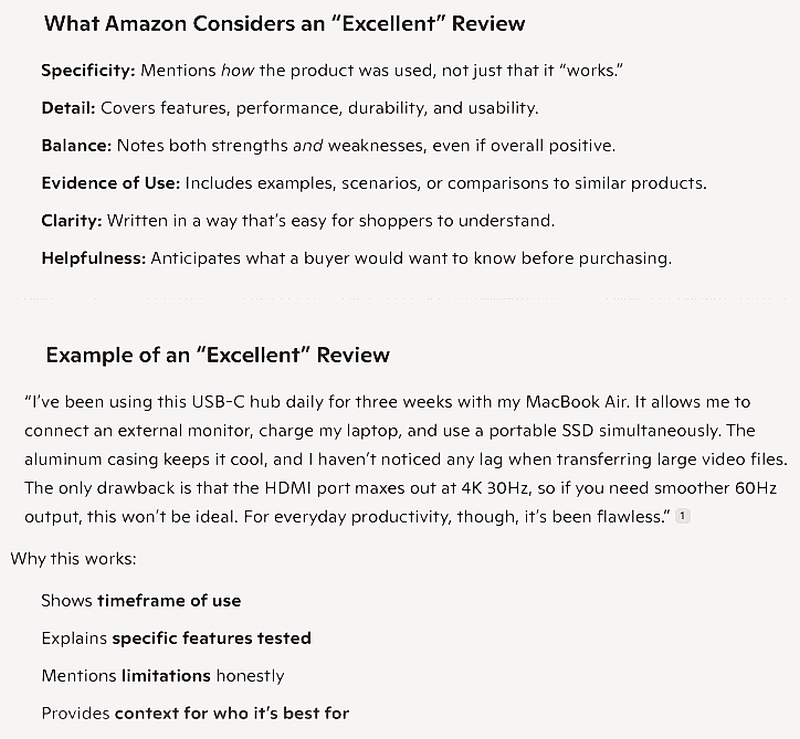
Amazon doesn't care if you like or hate it. They care it's "excellent". <https://i.postimg.cc/y6b1yKYj/excellent-review.jpg>
| Sysop: | Tetrazocine |
|---|---|
| Location: | Melbourne, VIC, Australia |
| Users: | 15 |
| Nodes: | 8 (0 / 8) |
| Uptime: | 234:21:13 |
| Calls: | 207 |
| Files: | 21,502 |
| Messages: | 83,204 |